
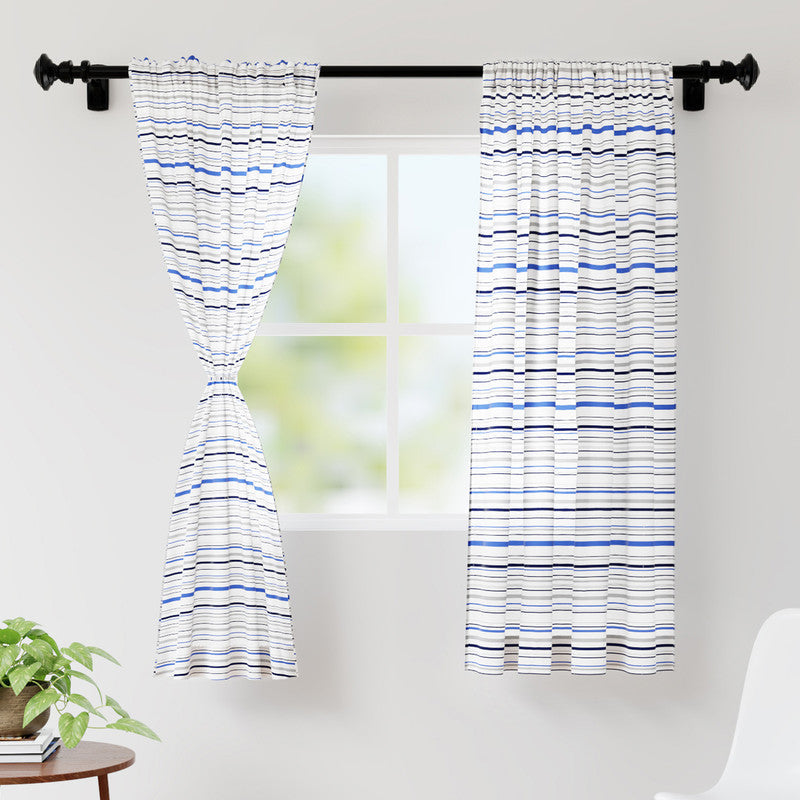
Six in the evening, the pan is hot, and the jeera goes in. The window behind the counter is open. The left panel is gathered up on its tie so it sits well clear of the working surface, and the right one is still drawn, because the flat across the shaft has its kitchen window at exactly the same height as yours. Some months on, something nobody plans for at the time of buying has quietly become normal. This is the one curtain in the house that keeps coming down and going into the machine, while the hall pair has not moved since the day it went up.
Wash frequency is the constraint that ends up driving a kitchen curtain, more than colour and more than weave. It pushes you towards a short ready length, a fabric the machine can handle without a fuss, and a price you will not resent in two years. Two things can outrank it. A window that faces a neighbour at close range needs a panel that hides you first and washes easily second, and a window boxed in by a grill may only take one kind of heading, whatever fabric you had in mind.
Why a kitchen window is a different problem
Dust in a hall is blown in. It sits on the surface of the cloth, and a good shake at the window sends most of it back out. A kitchen is not doing that. Cooking sends a fine oily mist into the air, it settles on every surface within a metre or two of the hob, and the dust that arrives afterwards lands on that film and stays there. The panel does not look dirty for a while. It goes slightly heavier, slightly duller, slightly stiffer at the leading edge, and then one day you wash it and the water tells you what it had been holding.
Because it is deposited rather than blown in, it builds up on the schedule of your cooking and not the weather. A house that fries something most evenings dirties a kitchen curtain faster than one that mostly boils and steams, at the same window, on the same street. Ordinary curtain fabric does not stop any of this. What a fabric can do is come clean easily, and cost little enough that replacing it is a shrug rather than a project.
What size are kitchen curtains in India?
The kitchen window in an Indian flat is usually a small one set high, above a counter or a sink, so the 5 ft window length hanging to just past the sill is close to automatic, and the 7 ft door length is worth buying only where the kitchen opens through a full window-door onto a utility balcony. The curtain size guide has the measuring method and the rest of the lengths.

The part the general curtain guides skip is where the rod can go. The standard instruction, repeated on most curtain sites, is to mount it a hand's width above the frame and wider than the opening, and that quietly assumes a bare window. Plenty of Indian kitchen windows carry a metal security grill, a mosquito mesh, or both, fixed at or just inside the frame. Sometimes the brackets cannot go where the rule says, and the rod ends up lower, closer in, or screwed to the frame itself.
That does two awkward things. The panel now hangs very close to the mesh, so it wants to finish clear of it rather than rest against it, or the greasy film builds up on both and you are washing two things instead of one. It also limits the heading, because the panel has to suit the rod you can actually put up. Encasa's canvas eyelet panels carry 8 metallic eyelets, each with a 4 cm inner opening, a figure taken from the eyelet graphic on those product pages. That is generous for an ordinary rod, but the rod and its brackets still need room to sit. A rod-pocket panel goes onto a slim rod and can be mounted much tighter to the frame, which on a grilled window is sometimes the only thing that fits.
Cotton canvas or polyester: the open kitchen decides it

Ask where the wall is before you ask what you like. The same beige panel that looks fussy and overpriced at a shut-away kitchen window is the sensible buy at a pass-through, because in the second case people are looking at it over dinner.
In a closed kitchen with a door, the curtain is a working item at a working window. It sits in the oil-mist zone all day, nobody outside the room sees it, and the sensible buy is the cheapest thing that washes well and dries fast. Light polyester earns its place here in a way it never quite does in a bedroom. The Polyester Dollar Beige pair is ₹672 for two panels at the 5 ft window length, in a semi-sheer twill that Encasa's own copy describes as not blocking light, with rod-pocket styling and a sewn tie-back. At that price, a pair that eventually gives up under the frying has not really let you down.
An open or pass-through kitchen changes the arithmetic, and not in the way people expect. The smoke and the smell reach the dining table anyway, so the kitchen curtain is no longer the one uniquely dirty thing in the flat. What it has become instead is furniture you look at over dinner. That is the case for spending more. A cotton pair at the pass-through window reads as part of the room rather than as a utility item, and the cotton Panama weave curtains hold a denser, more solid colour than a semi-sheer polyester can. The Canvas Natural single panel is 180 GSM solid-dyed cotton canvas at ₹1,209, currently in stock in the 5 ft window length only, which suits a narrow opening where one panel is all that fits.
| Fabric | Heading | Light | 5 ft window price |
|---|---|---|---|
| Cotton canvas, 180 GSM, single panel | 8 eyelets | Light-filtering | ₹1,209 a panel |
| Cotton Panama weave, pack of 2 | 8 eyelets | Moderately reduces outside light | ₹1,739 a pair |
| Light polyester twill, pack of 2 | Rod pocket, sewn tie-back | Does not block light | ₹672 a pair |
The cotton is the better object. It is also the one you will be more annoyed about when it comes out of the machine looking tired, which is the whole case for keeping it out of the oil-mist zone and putting it at the pass-through window instead.
Sheer or opaque, when the window faces a lane

Stand at your kitchen window and look straight out. Many of them give onto a service lane, a shared air shaft, a society corridor, or the next building's kitchen at conversational distance. At that range the daytime question has nothing to do with softening sunlight. It is whether the person at the opposite window can watch you cook. The familiar line about keeping kitchen fabric sheer so the room stays bright was written for a house with a garden outside that window.
Where that is your window, buy the less sheer panel and accept the light you lose. Encasa's cotton Panama curtains, including the Cotton Grey pair at ₹1,739 for the 5 ft length, are described on their own pages as moderately reducing outside light with no see-through from outside. The light polyester prints are the opposite by design, and are the better answer where the window gives onto open air, a duct nobody uses, or a wall.
How often kitchen curtains actually need washing
More often than anything else in the house. Elsewhere the interval follows the dust load at that particular window, which is the logic set out in the guide to washing curtains, along with the machine settings by fabric and by hardware. A kitchen curtain runs on a shorter clock than any of that, because what is landing on it comes from the hob and not the street. The useful trigger is touch rather than the calendar. Take it down when the leading edge starts to feel slightly tacky under the fingers, which happens well before it looks dirty.
That is the argument for the cheap panel in a closed kitchen, and it is a practical one rather than a thrifty one. A ₹672 polyester pair can go into the machine on that trigger without anybody weighing it up first. A heavier cotton wants a slower, gentler cycle, and asking for that every time is how a curtain quietly stops being washed at all.
Tie-backs are a kitchen habit, not a decorating one
On most windows in the house a tie-back is a styling choice. In a kitchen it is a movement you make several times a day, pulling the panel fully clear of the counter while something is on the stove, then letting it fall again when you are done. A curtain you have to slide along a rod each time gets left open instead, which defeats the point of having it.
Both light polyester prints named here are sewn with a tie-back at the centre of the panel, so it is attached rather than a separate accessory to lose. The Polyester Stripes pair at ₹672 sells in the 5 ft window length only, which is no loss at a kitchen window, and its blue and grey stripes on white give the café look that these windows suit. Anything else in the curtains collection will take a separate tie or a simple hook on the wall, which works, as long as somebody actually fits the hook.
Frequently asked questions
What size curtain is best for a kitchen window in India?
The 5 ft window length, for the usual small, high-set kitchen window. Kitchen windows tend to sit high above a counter, so a panel finishing just past the sill clears the working surface and the sink. Only a kitchen with a full-height window-door to a utility balcony needs the 7 ft door length.
Cotton or polyester for kitchen curtains?
Polyester if the kitchen is closed off and the curtain is there to work. It costs less, washes faster and dries faster, all of which matter when the panel comes down often. Cotton if the kitchen opens into the dining or living area, where the same panel is part of what people see at the table.
How often should kitchen curtains be washed?
On a shorter cycle than any other curtain in the house, set by how much frying happens rather than by the calendar. Rather than fixing an interval, use the cloth as the signal: when the edge you handle feels slightly tacky, it is due. Washing it at that stage is far easier than washing it once the film has properly set.
Can the same curtain work for an open kitchen that opens into the dining room?
Usually yes, with one condition. Once the kitchen has no door, the smells and the fine mist reach the whole area, so the curtain is no longer the only thing catching them, and matching it to the dining side of the room makes more sense than treating it as utility cloth. The condition is that it still hangs nearest the hob of anything in the room, so it will need washing before the sofa cushions do. A fabric you are unwilling to put through the machine often is the wrong pick even here.

Leave a comment
This site is protected by hCaptcha and the hCaptcha Privacy Policy and Terms of Service apply.