
Most people choose a festive runner by holding the swatch up in a bright shop or looking at it on a phone screen at noon. Then Diwali night comes, the main lights go off, the diyas and the warm-white bulbs come on, and the runner looks like a different colour. Sometimes better. Sometimes it nearly disappears into the table.
With velvet, the colour is decided by two things that are not the runner at all: the table under it and the light over it. Choose for those two and the runner will look the way you pictured it. Ignore them and even a lovely colour can fall flat.
Why velvet changes colour more than cotton
Velvet is a pile fabric. Its face is made of thousands of short, upright fibres rather than a flat weave, so light falls into the pile and bounces back from the fibre tips at different angles. That is where the glow comes from, and it is also why the same runner looks lighter from one end of the table and deeper from the other. Flat cotton reflects light more evenly, so it changes less as you walk around it.
Embossed velvet adds a second layer to this. The pattern is pressed into the pile with heat, so parts of the face are flattened and parts stand up. You see the pattern because the flat and standing areas catch light differently. That has two practical effects. A pale runner shows the pattern clearly, because the shadows in the pressed areas are easy to see. A dark runner shows it only when light hits it at a low angle, and in a dim room it can read as a plain colour.
Then there is the light itself. Diya flames, candles and warm-white bulbs give off a yellow-orange light with little blue in it. Under that light, reds, maroons and golds tend to look richer, because there is plenty of warm light for them to reflect. Blues and greys have less to work with, so they look darker and duller than they did in daylight. Whites shift towards cream.
The table under it matters as much as the light
The second half of the choice is contrast with your table top. A runner is a band of colour laid over another colour, and if the two are close in tone, the band vanishes.
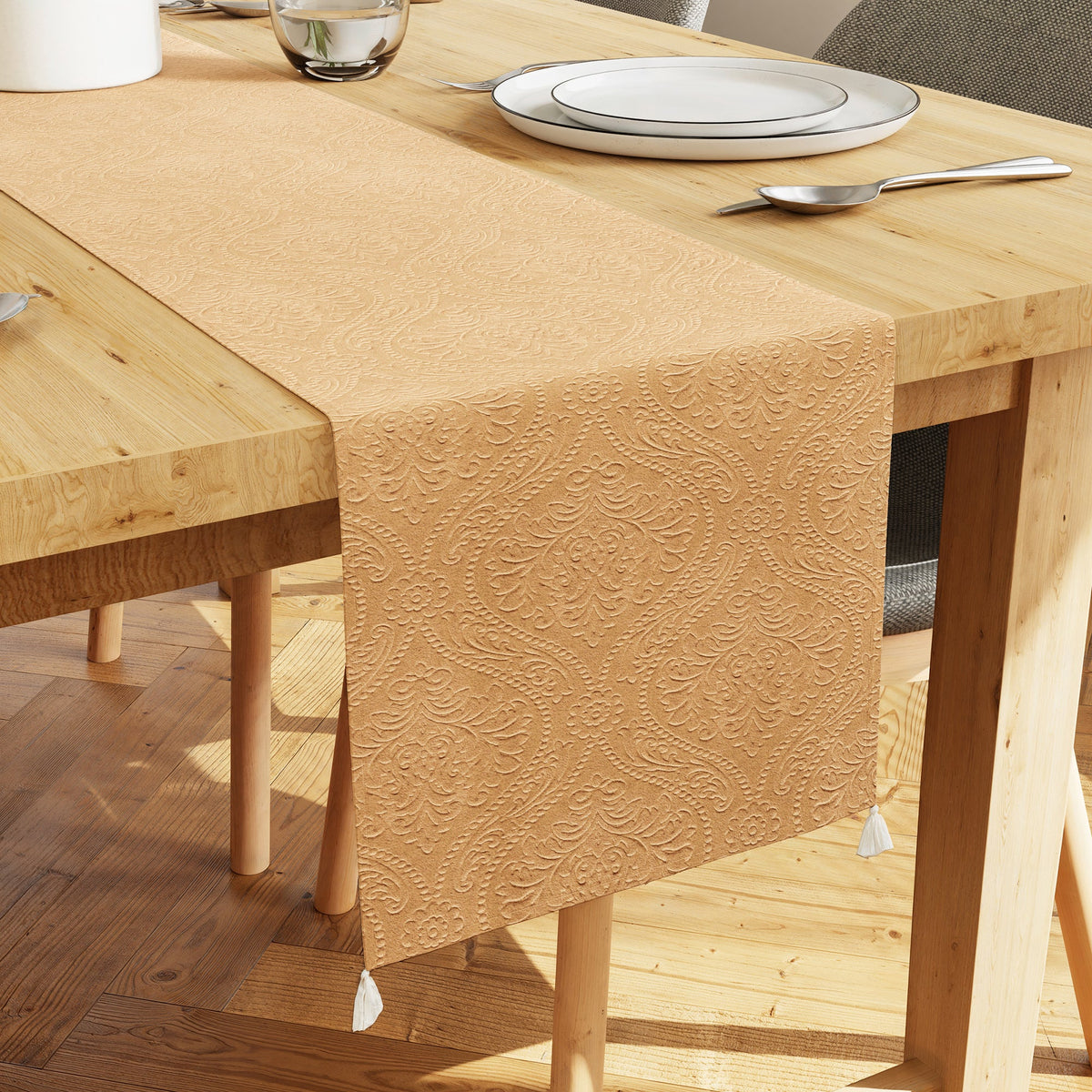
You can see this in our own product photo of the gold runner at the top of this page: on a light oak table it is nearly tone on tone. It looks soft and calm, which some people want, but it does not make a festive statement. Put the same gold on a dark sheesham or walnut table and it stands out sharply. The reverse is true for maroon and coffee: they pop on light wood and can melt into a dark wood top, especially once the lights are low.
A quick way to decide is to think in two steps:
- Is your table light (oak, pine, white laminate, light marble) or dark (sheesham, walnut, dark glass)?
- Will the runner mostly be seen in the evening, under diyas and warm bulbs, or in daylight?
Light table, evening use: maroon, red or coffee give the strongest result. Dark table, evening use: gold, beige, cream or white. Daylight events, on any table: this is where the softer colours earn their place.
Which velvet table runner colour for which occasion?
The embossed velvet line we sell comes in 13 colours: maroon, red, coffee, gold, beige, cream, white, peach, pink, pale lime, lemon yellow, navy blue and grey. Here is how they sort once you add the light and the table to the picture.

Diwali and Dhanteras evenings are where maroon and red do their best work. They hold their depth under diya light and they hide a drop of oil or a smear of haldi better than any pale shade. Wax is the exception: it dries as a pale crust and shows on dark velvet until you lift it. On a light wood table the embossed velvet maroon runner is the safe festive choice. On a dark table, switch to gold.
Cream and white are the colours that show the embossed pattern best, as the photo above makes clear, and they suit a dark table at any hour. The catch is obvious. Every turmeric splash and every drip of gravy will show, and under warm light a white runner reads as cream anyway. If you love the pattern and the meal is a sit-down dinner for adults, the cream runner is lovely. For a table full of children and finger food, it is asking for trouble.
Gold and beige sit in the middle. Gold has the most festive feel of the light shades and it glows under candles. Beige is calmer and easier to use all year.
Navy and grey are the mixed case. In daylight, on a light wood table, navy looks crisp and modern. On Diwali night it can turn close to black and the pattern fades, as the next photo shows even in studio light. But navy with silver or steel serving pieces and white plates makes a good New Year's Eve table, when you want something cooler than the Diwali reds.

If you are dressing a table for New Year, the navy blue runner works best when the room is lit properly rather than by candles alone. For Christmas, red is the natural pick from this line.
The bright pastels, peach, pink, pale lime and lemon yellow, are daytime colours. They look cheerful at a haldi lunch, a puja brunch or a child's birthday, and they tend to look washed out under low yellow light, which is why they are a weak choice for Diwali night.
What size velvet runner do you need?
All the runners in this line are 32 cm wide, which sits comfortably in the middle third of a standard dining table and leaves room for plates on either side. Length is the real decision, and the line comes in three: 150, 183 and 240 cm.
The rule from our table runner size guide is to add about 30 cm to your table's length, so the runner hangs roughly 15 cm over each end. Work backwards from each length and you get this:
| Runner length | Table length it suits (15 cm drop) | Typical table | What the product page says |
|---|---|---|---|
| 32 x 150 cm | About 120 cm | 4-seater | "4-seater and smaller tables" |
| 32 x 183 cm | About 150 cm | Large 4-seater or compact 6-seater | "4 to 6 seater tables" |
| 32 x 240 cm | About 210 cm | 8-seater, or a 6-seater with a longer drop | Not stated |

The middle size needs a closer look, because "4 to 6 seater" covers a wide range of tables. Take a five-foot (152 cm) six-seater. A 183 cm runner gives about 15 cm at each end, which is right. Now take a 180 cm six-seater, which is also common. The same 183 cm runner gives you 1.5 cm at each end. That is the in-between length that looks like a runner which was meant to reach the edge and fell short. On that table, either go flush with something cut to the table, or step up to the 240 cm runner and accept about 30 cm of drop at each end. Velvet is heavy enough to hang straight, and the tassels finish the end neatly, so the longer drop looks deliberate. Measure the table before you order. The seat count alone will not tell you.
How to keep a velvet runner looking good through the season
A velvet runner used a few times a year tends to be spoiled by heat, washing or storage long before it wears thin.
Heat first. This line is polyester velvet, 175 GSM according to the product page, and polyester softens when it gets hot. A kadhai straight off the gas or a hot casserole dish set down on the pile can flatten it or leave a shiny patch that does not brush back up. Use trivets or a placemat under anything hot. Keep diyas and candles on brass or steel plates, a hand's width from the fabric. That is for safety, and because wax is harder to get out of velvet than out of cotton.
If wax does land on it, let it harden fully, then lift off what you can with a blunt edge. The rest comes out with brown paper and a low iron, but on velvet the iron goes on the back of the runner, never on the pile. Our guide to removing candle wax and diya oil from table linen walks through it step by step for each fabric.
Washing is simpler than most people expect. The product page lists the runner as machine washable. Use a gentle cycle in cool water with a mild liquid detergent, and do not wring it. Wringing and twisting are what crush velvet, more than the wash itself. Hang it flat or lay it on a towel to dry, and brush the pile gently in one direction while it is still slightly damp. If it needs pressing, iron the back on a low setting or use steam held just above the pile. The same steps that work for velvet cushion covers work here.
After the festival, roll it rather than folding it. A fold pressed under other linen for ten months leaves a flat line across the pattern that can take a steam session to lift.
Matching napkins without matching everything
A velvet runner is already the richest texture on the table, so the napkins should be plain. Plain cotton in a colour pulled from the room does better than a second shiny fabric. With a maroon runner, cream or beige cotton napkins from the table napkin collection look finished without competing. With gold, white or grey work. With navy for New Year, white napkins and silver cutlery keep it crisp.
If you want to see the colours side by side before deciding, the table runner collection shows the full embossed velvet line next to the quilted velvet, cotton and faux leather runners, which helps if your table needs something more washable for everyday use after the festival.
Frequently asked questions
Can a velvet table runner go in the washing machine?
Polyester velvet runners usually can, and the Encasa embossed velvet runners are listed as machine washable. Use a gentle cycle, cool water and mild detergent. The damage usually comes afterwards: never wring it, dry it flat or hanging straight, and brush the pile while damp.
What colour table runner is best for Diwali?
For an evening table lit by diyas, deep warm colours such as maroon, red or gold hold their colour best under yellow light. Choose by your table as well: maroon or red on light wood, gold or cream on dark wood, so the runner stands out against the top.
What length velvet runner fits a 6-seater dining table?
Measure the table and add about 30 cm. A 150 cm six-seater suits a runner of around 180 cm. A 180 cm six-seater needs closer to 210 cm, so from the lengths sold here the 240 cm runner is the better fit, with a longer, deliberate drop.
Does embossed velvet lose its pattern?
The pattern is pressed into the pile with heat, and the product page says the runner keeps its texture through repeated washing. High heat is the bigger risk. A hot iron on the face or a hot dish set down on it can flatten the raised areas and blur the design, so iron from the back and use trivets.

Leave a comment
This site is protected by hCaptcha and the hCaptcha Privacy Policy and Terms of Service apply.