
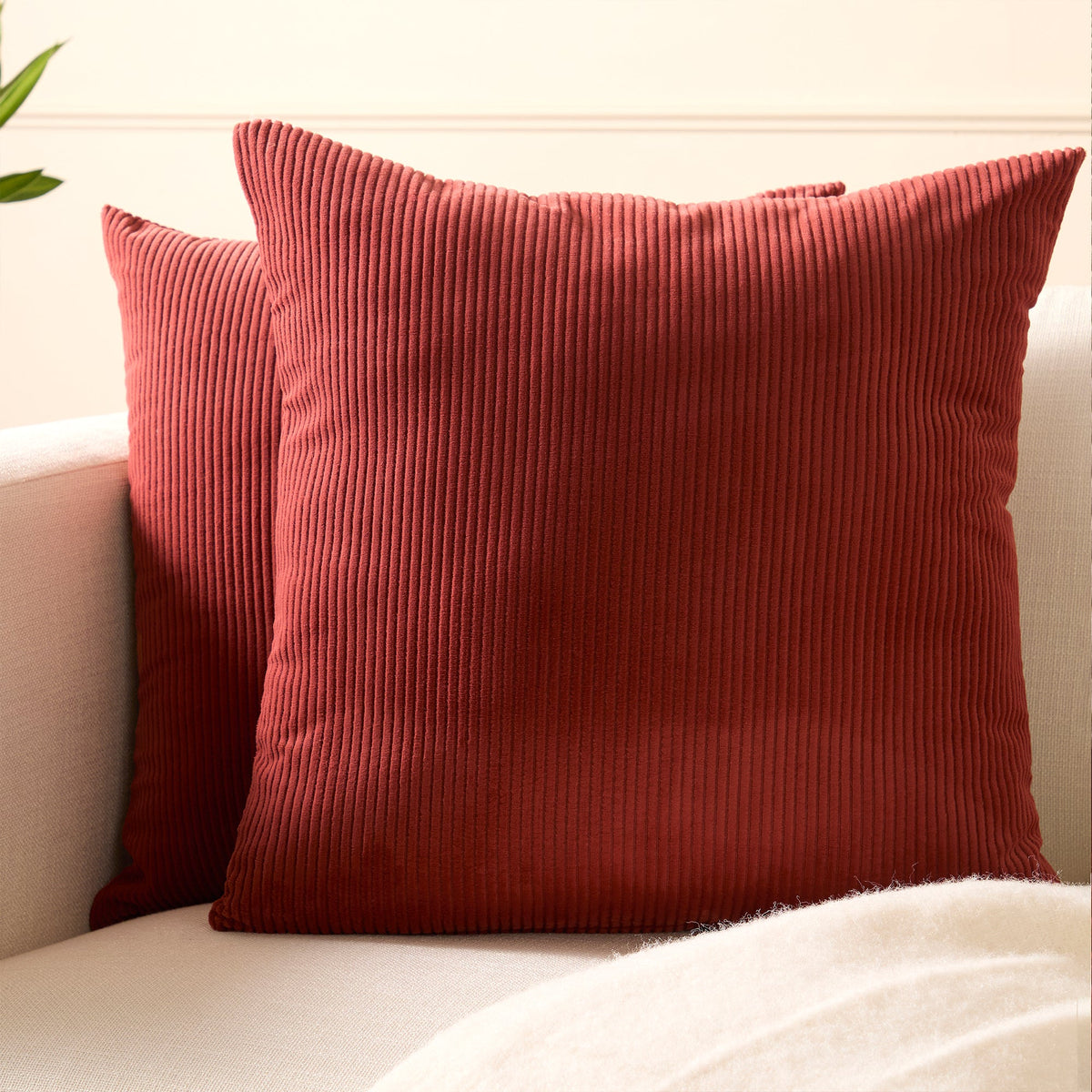
Take a grey sofa with two plain cream cushions on it. In May it looks fresh. In January, with the lamps on at six and a shawl over the armrest, the same sofa can look oddly cold, and the usual fix people reach for is colour: a maroon, a mustard, something "warm". Colour helps. But a lot of the warmth you see in a winter room is not colour at all. It is shadow.
A ribbed or quilted cushion cover makes a room look warmer because its surface is uneven. Light hits the raised parts and misses the dips, so the cover carries many small shadows, and the eye reads that as depth and softness. A flat cover in the same colour reflects light evenly and reads flat. That is why corduroy and quilted velvet are winter fabrics even in beige.
Why texture does more in winter than in summer
Two things change in an Indian winter that make surface matter more.
The light gets lower. The winter sun sits lower in the sky, so daylight comes into the room at a shallower angle and rakes across whatever it meets. After dark the main light is usually a lamp at table height rather than a tube light on the ceiling. Side light like that is what pulls texture out of a fabric. Hold a corduroy cover under an overhead light and it looks almost plain; hold it next to a table lamp and every rib shows.
The other change is touch. A cushion you lean against on a cold evening is felt before it is seen. A tight, smooth weave puts more of the fabric against your skin, and a cool smooth surface feels cold for a moment. A raised surface touches you only at its high points, so it tends to feel warmer on first contact even when the room temperature is the same. Nothing here heats the room. It changes how the sofa feels in the minute you sit down, which is the minute people judge it.
So the winter question is less "which colour" and more "how much surface". Corduroy and quilting are the two easiest ways to add it, and they behave quite differently.
What corduroy is, and the one thing that trips people up
Corduroy is a pile fabric, like velvet, but the pile is woven in raised lines called wales that run the length of the cloth. Wide ribs are bold and casual; fine ribs look closer to velvet from across the room. The covers in this guide have a fairly broad rib that you can see clearly from the sofa.

Pile has a direction, and this is what catches people out. Stroke corduroy one way and it feels smooth and looks a shade darker; stroke it the other way and it feels rougher and looks lighter. When you put a pair of corduroy covers on a sofa and one is turned upside down or on its side compared with its twin, the two can look like slightly different colours. Many people assume one cover has faded, or that the pair was mismatched in the factory. Usually it is just rotation. Turn both so the ribs run up and down and the zips sit along the same edge, and the shades match again.
Corduroy also flattens where it is pressed. The ribs on the cushion someone always leans on will crush along the lines, and a crushed rib catches light differently, so it shows as a shiny patch. A soft clothes brush drawn along the ribs lifts most of it. Steam held a little away from the fabric helps a stubborn patch. An iron pressed flat on it makes things worse, which is why the product pages for these covers say to avoid ironing.
Quilted velvet: velvet that hides its marks
Plain velvet has a smooth, even pile, and that is both its charm and its weak spot. Every place where the pile has been pushed one way, by an elbow or a sleeping cat, shows as a lighter or darker patch. On a plain velvet cushion that sees daily use, those marks are part of the deal.

Quilting changes that. The velvet is stitched in a pattern, here a small basket weave, and the stitch lines pull the fabric down while the areas between them sit a little proud. The surface is already broken into many small panels, each catching light at its own angle, so a pressure mark has nowhere obvious to show. If you like velvet but have given up on it because it always looks rumpled, quilted velvet is the version to try. The trade-off is that the stitch lines are small grooves, and grooves collect dust and the odd crumb. A vacuum brush or a damp cloth along the lines once a week or so keeps them clean.
The quilted velvet dark grey covers are a good test of this. Dark colours tend to show velvet marks clearly, and the quilting keeps them from reading as patches. They are quilted on both sides, so you can turn a cushion over and rest one face, and they come in four sizes from 40 to 60 cm, ₹689 to ₹999 for a pair. If you are not sure you will like the look, the line is also sold singly in some colours from ₹329, which is a cheap way to try one on the sofa before buying the set.
Corduroy vs quilted velvet vs plain velvet vs chenille
| Fabric | What the surface does | What shows wear | Good spot on the sofa |
|---|---|---|---|
| Corduroy | Ribs in one direction; bold lines of shadow | Crushed ribs; shade change if the cover is rotated | Corners and the ends people lean on, in neutral or earthy colours |
| Quilted velvet | Stitched pattern; pile broken into small panels | Dust in the stitch lines; marks hide well | Daily-use cushions where plain velvet looks rumpled |
| Plain velvet | Smooth pile; strong sheen that shifts with light | Pressure marks and crush patches | One or two accent cushions that are looked at more than leaned on |
| Chenille | Soft, nubby yarn; matte | Little; marks rarely show | A family sofa that gets used hard |
If you want the sheen of plain velvet in a solid colour, the velvet cushion cover range has it, and our guide to whether velvet cushion covers are worth it works through the upkeep. If you want texture with less care than either, the chenille covers are the calm option.
How to pair textures on one sofa
The mistake with textured cushions is using too many at once. Four kinds of surface on one sofa look busy, and the eye stops reading any of them. Two textures and one smooth fabric is usually enough.
Vary the scale. A bold rib next to a small quilted pattern works because one is big and one is fine. Two bold textures side by side fight each other. And put texture against smooth: if your sofa is a flat, tight weave or leatherette, ribbed and quilted covers will stand out from it straight away. If the sofa itself is nubby or boucle, use one textured cover and let the rest be plain.
Colour still matters, but it can be quiet. Texture does its best work in a narrow, warm palette: cream, beige, taupe, coffee, rust. The ribs and stitches give the eye something to look at, so the colours do not have to.

Take a light grey three-seater in a flat weave, in a north-facing living room that never gets direct sun in winter. It has four cushion slots: two corners and two inner seats. The corners take the lean, so they get the bolder texture in a larger size: a pair of 50 cm light taupe corduroy covers, ₹999 for the two. Against the grey, the taupe is warm enough to carry the room on its own. The inner seats get a pair of 40 cm cream quilted velvet covers at ₹689, a fine pattern that sits between the bold ribs and the plain sofa. That is ₹1,688 for the full change, the existing inserts stay, and nothing in it says "festival", so it can stay up from late October to February.
If the room is already warm in colour, with wooden furniture or a terracotta wall, swap the taupe for light grey corduroy and keep everything pale. The ribs still do the work.
The insert matters as much as the cover. Texture only shows on a cushion that is full; a slack cover lets the ribs and stitch lines fold in on themselves. Our cushion cover size guide explains why the insert should be a little bigger than the cover. More colours of both lines are in the full cushion cover collection; corduroy currently comes in light grey, light taupe and dark grey.
Washing quilted and corduroy cushion covers
Both lines can be washed at home, and both go wrong in the same way: too much heat or pressure flattens the texture you bought them for.
For corduroy, the product pages say hand wash or a gentle machine cycle, tumble dry on low, and no ironing. Turn the cover inside out and close the zip first, so the ribs rub against each other less in the drum. Shake it out while it is damp and smooth the ribs with your hand in one direction before it dries.
For quilted velvet, the pages say it can be washed at home and should go in with similar colours. A cold, gentle cycle with the cover inside out is the safe way. Dry it flat or hung in shade rather than in hot sun, which is hard on any coloured pile. Our guide on washing velvet cushion covers has the full method, and it applies to the quilted kind too.
Where this sits next to Christmas
Texture and colour are two separate levers. Everything above works in neutrals and can stay up for the whole cold season. If you want the sofa to say Christmas for two weeks in December, that is a colour job, and our guide to Christmas cushion covers covers the reds and greens. The two combine well: a red or forest green cover dropped in among taupe corduroy and cream quilting looks festive, and when you take it out in January the textured base is still there.
Frequently asked questions
Are quilted cushion covers good for winter?
Yes. The stitched pattern breaks up the surface so it catches side light and looks soft, and the raised areas feel less cold to lean on than a flat, smooth weave. Quilted velvet also hides the pressure marks plain velvet shows, which helps in a season when the sofa gets more use.
Why does one of my corduroy cushions look a different colour from the other?
Corduroy pile has a direction, and it looks darker one way and lighter the other. If one cover is upside down or turned on its side, the pair will not match. Rotate it so both have ribs running the same way.
Can you iron corduroy cushion covers?
It is better not to. Pressing an iron on corduroy crushes the ribs and can leave a shiny mark. Smooth it by hand while damp, use a soft brush along the ribs, or hold a steamer a little away from the fabric.
Can corduroy and velvet cushions go on the same sofa?
They can, and they pair well because one is ribbed and the other smooth or quilted. Keep the colours close, use the bolder corduroy at the corners and the finer velvet in the middle, and stop at two textures plus one plain fabric.


Leave a comment
This site is protected by hCaptcha and the hCaptcha Privacy Policy and Terms of Service apply.