
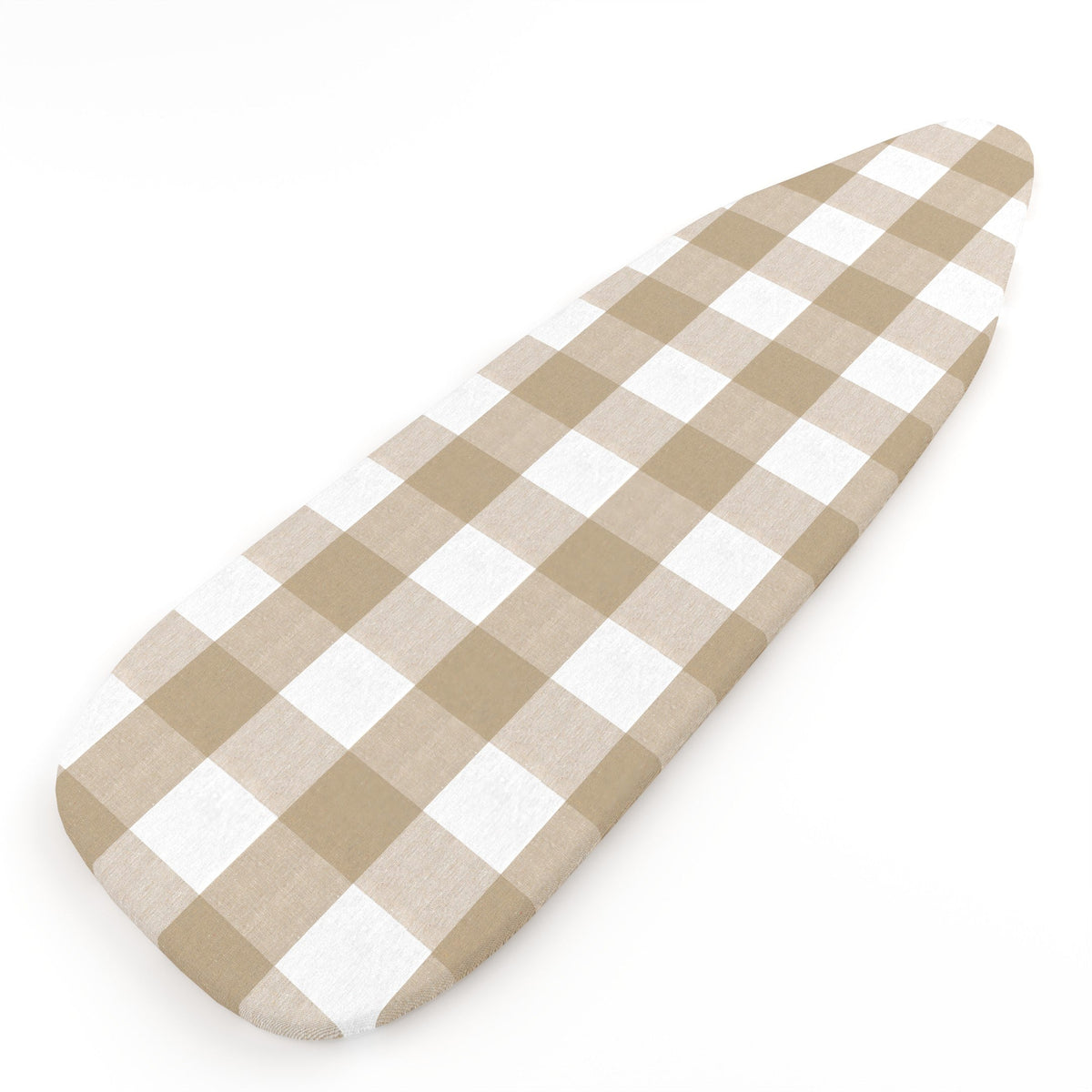
Can I just buy a new ironing board pad and slip it under my old cover? You can, if you find a loose pad and the cover still has some life left. You will not find one from us. Encasa sells no loose pad or underlay: the padding is built into the cover, so the two get replaced together.
An ironing board pad is the soft layer between the cloth you iron on and the metal mesh of the board. It stops the mesh pressing into your clothes and gives the iron an even surface to push against. When it goes flat, the cloth on top can look fine while the ironing gets steadily worse.
What does an ironing board pad actually do?
An ironing board top is a hard grid with gaps in it. The gaps let steam escape, but the wires between them do not give. Press damp cloth straight onto that and the cloth takes the shape of the wires, which is how you get faint lines or a shiny patch on dark trousers.
The pad sits in that gap between hard metal and soft cloth. The weight of the iron spreads out across the pad, so it does not collect on the wires. Think of it as the difference between kneeling on a mat and kneeling on a drain cover.
Its other job is easier to miss. Steam goes down through the cloth, through the pad and out through the holes in the board. That way out is what a solid table lacks, and it is a big part of the trouble with ironing on a table or a bed with no board.
How to check your ironing board padding
Do this on a cold board. Your own pad gives you something to compare against, because the iron wears it unevenly.
The fingertip test tells you the most. Press down hard near the edge at the wide end, where the iron rarely goes, then do the same on the stretch where the iron does most of its work. If the two feel alike and you cannot make out the wires, the pad is still doing its job. If you can feel the wires on the working stretch and not at the edge, it has packed down where you use it.
Thickness is only half of it, so run a flat hand along the whole length as well. A pad that has gone lumpy can show through as ridges on thin cloth, even where there is plenty of it left.
A dark shirt can confirm it. Iron one with your normal firm press and look at it under good light. A faint grid means the mesh is reaching the cloth. Shine on its own is less clear, because too much heat or pressure can cause it on a sound pad.
Last, undo the drawstring and turn the hem back. You should find one of three things. Some covers have the pad fixed to the back of the cloth, so the two lift off as one piece. Some boards have a separate layer of foam or felt lying on the mesh with a thin cover over it. And some covers are plain cloth with nothing behind them, which only works if a good pad is already on the board.
When should you replace an ironing board pad?
Go by what the checks show, not by the date on the box. A pad used every day gives out long before one used on Sundays, so the same age can mean very different things. Our guide to replacing an ironing board cover goes through the other signs and gives a rough age to expect.
A built-in pad changes the sum a little. The pad and cloth now have one life between them, so whichever fails first decides. If the cloth has scorched over a pad that still feels fine, the whole cover goes. If the print looks new over a pad you can feel the wires through, it goes too, and that second case is the one people live with for years because nothing looks wrong.
Can you replace only the pad?
With a separate pad, yes. Loose felt and wool pads do exist. The ones we came across while writing this were from sellers abroad, and at least one is sold to be trimmed to your board. That route makes sense if your cover's cloth and hem are still sound and you can get a pad delivered without much trouble.
The other route is a new cover with the pad already in it, which is how the Indian listings we saw sell them and how we sell ours. By the time a pad has packed down the hem may have gone slack too, and this replaces both for one price.
If an old loose pad is already on your board, feel it before you cover it again. Take it off if it is lumpy, because a new pad laid over lumps will tend to follow them. If it is still flat you can leave it, but it makes the board's edge deeper, and that uses up the slack a cover needs to close underneath. Our ironing board cover size guide explains how to allow for that when you measure.
What thickness of pad do our covers have?

On our listings, look for the pad thickness on the gallery images, because the written text does not always give it. These four covers show a clear figure, and they are examples rather than the whole range.
| Cover | Pad shown on the listing's image | Medium to X-Large |
|---|---|---|
| Silver Premium | 2 mm foam | ₹689 to ₹999 |
| Big Leaves Blue | 3 mm felt | ₹669 to ₹989 |
| Cotton Buffalo Beige | 4 mm felt | ₹759 to ₹999 |
| Silver Luxury | 4 mm felt and 2 mm foam | ₹869 to ₹999 |
Some other covers of ours show only a "thick felt padding" icon, with no figure beside it.
Thicker is not simply better. Too thin leaves little between the cloth and the mesh, and the Silver Premium and Big Leaves both sit below the rule of thumb in our ironing board cover buying guide. Too thick and the surface goes spongy and the board's edge gets deeper. As for ironing board foam against felt, foam starts softer and can flatten under frequent heat, while felt starts firmer and holds its shape for longer. How often you iron decides it, and the guide has the full argument.
Picking a replacement: one board, three budgets

Take a board that measures 122 x 38 cm, which is a Large on our chart. The owner irons with steam most days, and dark work shirts have started to show grid lines.
Daily ironing is where felt's firmness pays off, so the Cotton Buffalo Beige in Large at ₹869 is the one we would start with. Of the two covers in the table without a silver face, it has the thicker felt.
The Big Leaves Blue in Large costs ₹689, which is ₹180 less, and has a 3 mm felt pad (its page text says "fibre pad", and felt is a fibre pad). For this owner that is the compromise choice. For someone who presses a few shirts a week with a light hand, it is a fair saving, though a pad this thin may let you feel the wires when you press hard.
The Silver Luxury in Large costs ₹989 and has the most padding on paper. We would not move this owner to it, though. As the buying guide explains, a slick silver face suits a big pile ironed dry, and thin cloth can shift on it under steam.
If those prints do not suit you and you are choosing from the full ironing board cover range, check a cover's images before you buy. A cover with a pad names it on a spec image, as felt, foam or thick padding. A cover without one lists only its cloth, and may mark its underside "Not Laminated", which means no pad is stuck to the back. Our Daisy and Grey Tiles covers, sold in Medium and Large at ₹429 to ₹459, are like that, so leave them out if a flat pad is your problem. The other lines we sell have the pad built in.
Watch the wording in one more place. We also sell a silicone ironing pad. It is a sheet for the hot iron to stand on, not padding, and it will do nothing for mesh marks.
When a padded mat makes more sense

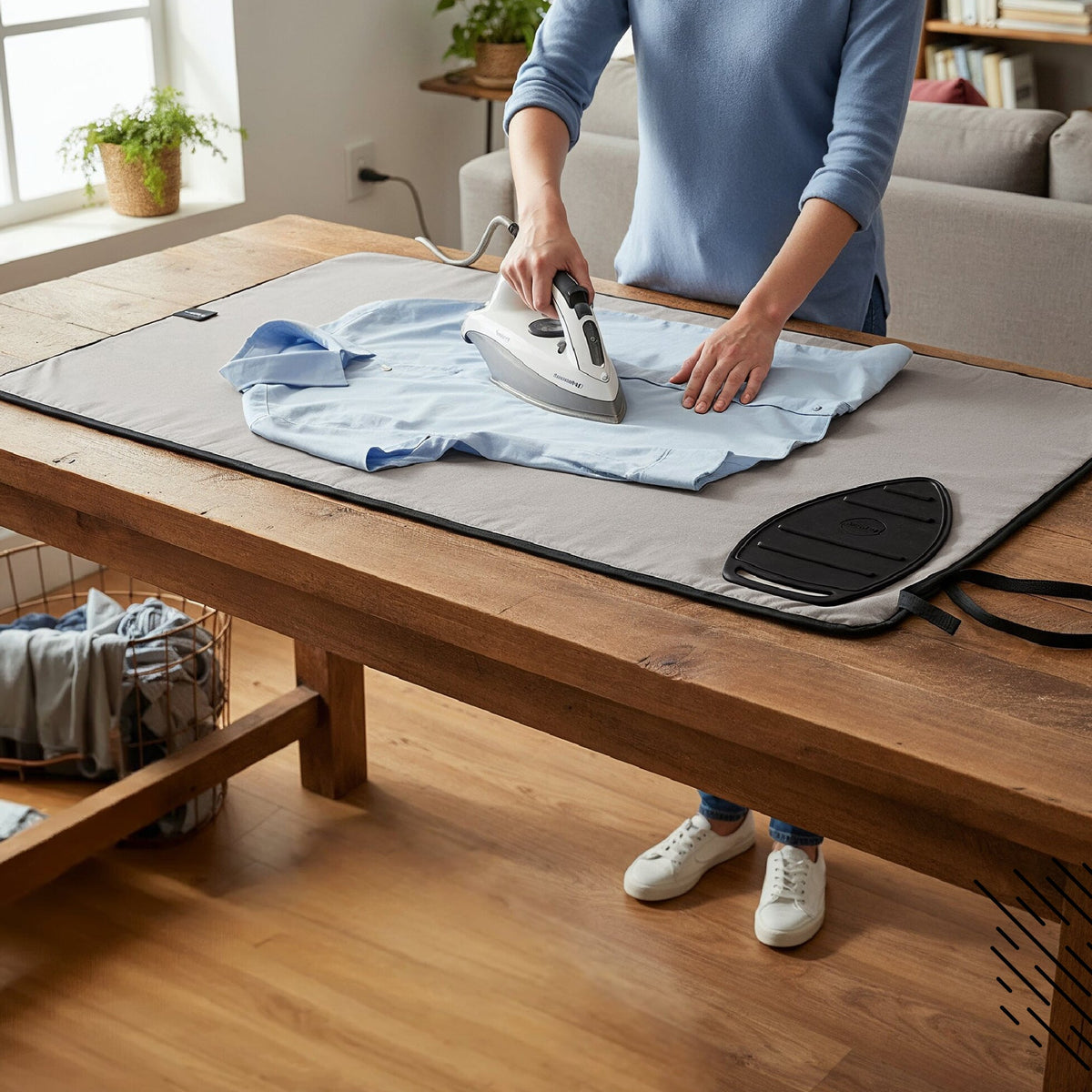
Sometimes the board is the real problem. If the frame wobbles or you have no room for it, a new pad on top changes little. A mat skips the mesh altogether, so its padding has a different job: it lies on a table that is already flat and hard, and it has to protect that surface while giving you something to press on.
The Green Leaflet mat comes in 120 x 70 cm at ₹999 and 70 x 50 cm at ₹759. Its images show the padded back. On a polished table where grip matters more, look in the ironing mat range for the anti-slip versions, whose images show rubber dots on the base. The guide to ironing without a board compares a mat with the towel you might otherwise use.
Common questions
Can I buy just the pad from Encasa?
No. There is no separate pad, foam sheet or felt sheet in our range. If your cover is fine and you only want more cushion under it, you will need a loose underlay from another seller.
Can I use a towel or blanket as ironing board padding?
As a stopgap, yes. Use something pale and thin, and lay it completely flat, because folds and thick pile can press through into your clothes. Take it off and dry it after a steam session. Dark cloth is the real risk: under heavy steam, its colour can bleed into whatever you are pressing.
What is an ironing table cover, and does it have a pad?
It is usually the same thing as an ironing board cover, since some people call a folding board an ironing table. Whether it has a pad depends on the cover, so check the listing's images, or turn the hem back if you already own one. A small tabletop board needs a smaller cut, so measure it the same way.
Can I wash a cover with a built-in pad?
The Big Leaves Blue, Cotton Buffalo Beige and Silver Luxury listings all say cold water. The pad gets wet along with the cloth and cannot be taken out, so let the whole cover dry fully before it goes back on the board, especially in the monsoon.
Encasa XO is our own brand, and the covers, mats and silicone pad named here are ours.


Leave a comment
This site is protected by hCaptcha and the hCaptcha Privacy Policy and Terms of Service apply.