
Take a pair of navy office trousers, a polyester and viscose blend, ironed in a hurry on the dining table before work. The iron is set to what the label allows. Ten minutes later the left leg has two lines down the front, a few millimetres apart, and the main crease has a faint shine to it when the light catches it.
The two lines appeared because the leg was lying slightly off its seams, so the new fold landed beside the old one. The shine most likely came from the hot metal plate pressing straight onto dark, partly synthetic cloth, though too much heat or pressing too long on one spot can add to it. Line up the seams and put a cloth between the plate and the trousers, and the same iron has a much better chance of giving one clean crease.
To iron trousers, fold each leg so the inside seam lies exactly on top of the outside seam, lay a damp plain white cotton cloth over the part you are pressing, and press down and lift instead of sliding the iron. Work from the hem up to just below the front pocket, then let the trousers cool before anyone wears them.
Why trousers end up with two creases
A crease is a fold that heat and moisture have set. Damp fibres loosen, the iron pushes them into whatever shape they are lying in, and as the cloth cools and dries it keeps that shape. The iron cannot tell a crease you want from one you do not. It sets whatever fold is under it.
A trouser leg is a tube with two seams: one on the inside of the leg and one on the outside. When the leg is flattened with those two seams sitting on top of each other, the folds at the edges fall at the centre front and centre back. That is where a factory crease sits, and where an old crease will already be.
Flatten the leg a little off those seams and the fold moves. It may be only a few millimetres, but the old crease is still there, so the iron now sets a second one next to it. That is the double crease, the "railway lines" you see on school trousers by the middle of term. Pressing harder only sets the wrong fold more firmly.
Do you need a press cloth for ironing trousers?
For some trousers, yes, and it costs nothing if you already own a plain white cotton cloth.
A press cloth is a thin layer you lay between the iron and the garment. It spreads the heat, holds a little water for steam, and keeps the metal plate off the face of the cloth. The New Mexico State University extension guide to pressing says that whenever you press on the right side, you should use a press cloth to prevent shine. It says wool should never have the iron placed directly on it, and that dark cottons should be pressed on the wrong side for the same reason.
Here is how that works out for the trousers in a typical Indian wardrobe. The heat always comes from the care label, never from this table. Our care label guide explains the dots.
| Trousers | Which side to press | Press cloth? |
|---|---|---|
| Light cotton (chinos, summer trousers) | Either side | Only if it starts to shine |
| Linen | Wrong side, or right side through a cloth | Damp cloth or steam |
| Dark cotton, including jeans | Inside out | Use one if you press the right side |
| Polyester or a blend (check the label: many office and school trousers are) | Inside out, or right side through a cloth | Yes, damp, for setting the crease |
| Wool or a wool blend (suit trousers) | Right side through a cloth | Always, with steam |
| Cotton pyjama, salwar or track pants | Either | Not needed |
We do not sell a press cloth, and you do not need to buy one. Any thin, plain white cotton will do: an old handkerchief, a worn pillowcase, a smooth (not looped terry) kitchen towel. Plain white matters because a printed or dyed cloth can give up colour under steam; use one that has been washed many times. Thin matters because a thick towel blocks the heat and you end up pressing longer.

A white cotton table napkin, if you have them, is about the right size to hold in one hand and move along a leg. Pick a plain one. The napkin range also has white napkins with embroidery, and raised stitching under a hot iron can leave its outline on the cloth below. Plain ones such as these white cotton napkins are 43 x 43 cm. Wet it, wring it out until it is just damp, and lay it flat over the stretch of leg you are about to press.
How to iron trousers with a crease, step by step
Art of Manliness and Gentleman's Gazette, two menswear sites, both fix the crease at both ends first and only then join the two points. That beats chasing the line down the whole leg in one go.
- Test first. Press a hidden spot, such as the inside of the hem or a pocket bag, and compare it with the cloth next to it. If it has gone shiny or flat, the iron is too hot or the cloth is needed.
- Set the hem. Lay one leg flat on its side with the other leg folded back out of the way. At the hem, put the inside seam exactly on top of the outside seam, using the old crease as your guide. Lay the damp cloth over the bottom of the leg and press the two folded edges for a hand's width.
- Set the top. Move to the top of the same leg and line the seams up again. Guides disagree on how high the front crease should go. Art of Manliness stops it at the bottom of the front pocket, and Gentleman's Gazette sets it at about 18 inches (about 46 cm) below the waist. Both keep it out of the pocket. On pleated trousers, follow the pleat into the crease. Press a short stretch here too.
- Join the marks. With both ends fixed, press along the front edge from one mark to the other: set the iron down, hold for a moment, lift, move along, set it down again. The NMSU guide calls this pressing, as against ironing, and it keeps the cloth from stretching. Then do the back edge the same way.
- Fill in the middle. Press the flat part of the leg between the two creases. Do not let the iron go over the edges again.
- Turn and repeat. Flip the trousers, fold the finished leg back, and do the second leg. Check the seams line up before the iron touches anything.
- Finish the top. Pockets, waistband and the seat go last, pressed over a rolled towel or the end of the board so the finished creases are not pulled out of shape.
Then hang them by the hem from a clip hanger, or fold them over a bar along the creases, and leave them until they feel cool and dry. Warm, damp trousers take a new fold if they are sat in or folded, the same reason a shirt picks up new creases while you iron it.
Filling and setting a steam iron is covered in how to use a steam iron.
How to iron jeans, pyjamas and trousers that should not have a crease
Plenty of trousers look wrong with a sharp centre line.
Jeans are dark cotton, so the NMSU advice on dark cottons applies: turn them inside out and press the wrong side. Line the side seams up as usual, but press the leg flat and stop short of the folded edges if you do not want a crease. A crease on jeans is a matter of taste, not a rule. Stretch jeans may carry a lower heat on their label than plain cotton, so check it each time.
Cotton pyjamas, a salwar, palazzos and track pants are pressed flat. Lay them with the seams together for neatness, run the iron over each layer, and leave the edges soft. With a drawstring waist, press the gathered part with the tip of the iron in short strokes rather than trying to flatten it.
Ironing trousers on a table or a mat: a worked example
A board gives you padding, a narrow end for the waist and a top that is long enough for a leg. A dining table is often long enough but has no padding and no narrow end, and a folded bedsheet on top slides and puts its own wrinkles into the cloth. Our guide to ironing without a board covers the options. For trousers, length matters most.

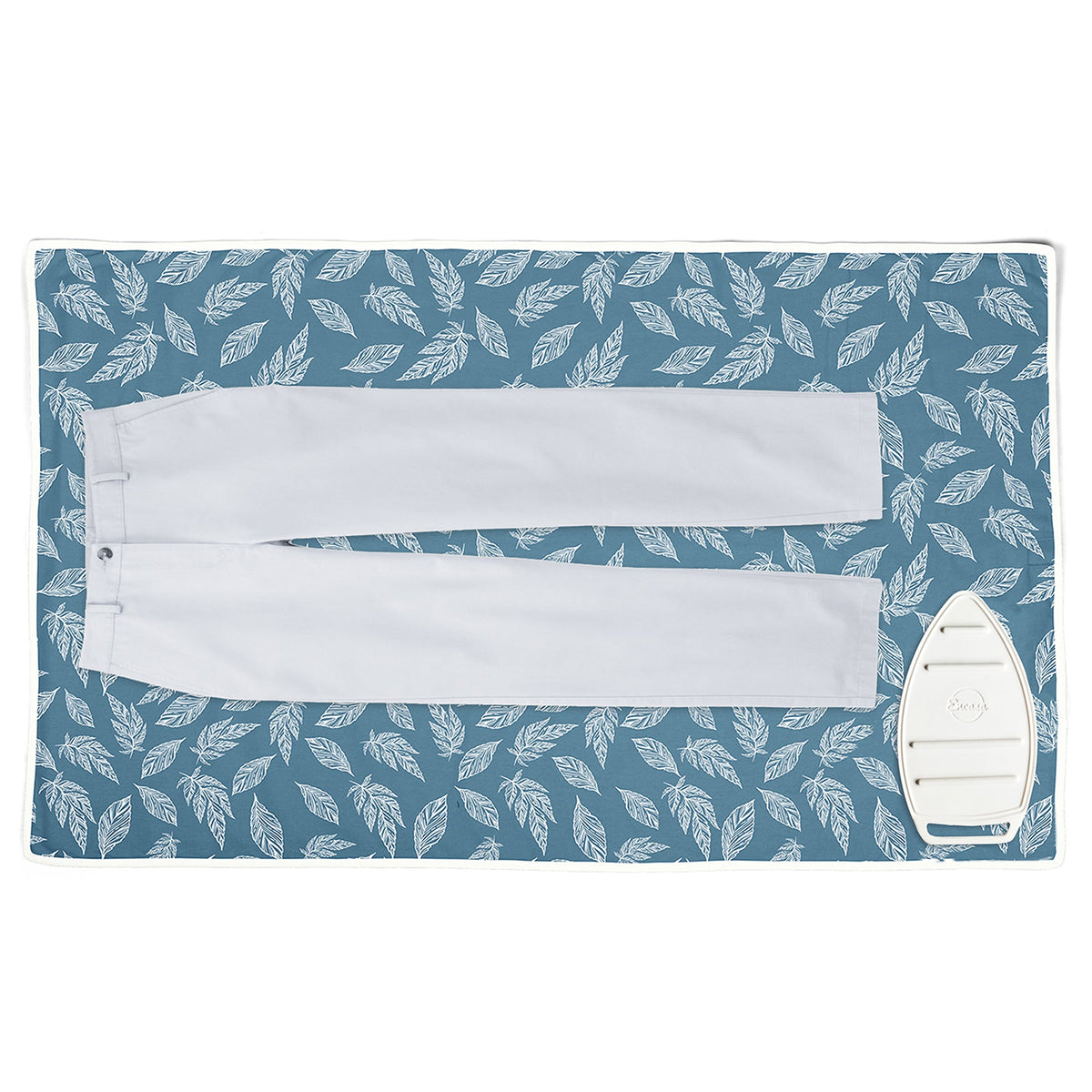
Measure your own trousers from the top of the waistband to the hem. Say a pair of school trousers measures 95 cm. On a 120 x 70 cm mat laid lengthways, that leg lies flat from hem to waist with a little room left over, so you can set and join the crease without moving it. On a 70 x 50 cm mat, the same leg has to go on in two halves. You set the lower half, slide the leg up while it is still warm, and the hem end hangs off the table edge. That is exactly the moment a kink appears where the crease crosses the edge of the mat.
So if trousers or school uniforms are a weekly job and you iron on a table, the large size is the one to buy. The Big Leaves Blue ironing mat in this photo comes in 120 x 70 cm at ₹999 or 70 x 50 cm at ₹759. Its page lists cotton over a 3 mm felt layer and a silicone rest for the iron. Other prints in the ironing mat range come in the large size too, but not all of them have it in stock, so check the size on the listing you pick. For a desk-sized space and the odd pair of trousers, the small mat still works if you finish one half of the leg and let it cool before you move it. Mat, board or silicone pad compares the three for small homes.
If the shine has already happened, the iron-stains guide has a section on removing the shine an iron leaves.
Common questions
Should you iron trousers inside out?
Dark trousers, yes, unless you are using a press cloth on the right side. Any shine then lands on the inside, where it does not show, though seams and pocket edges can still press an outline through. A crease pressed from the inside also tends to come out a little softer. One way round it: do the main pressing inside out, then turn the trousers and set the crease through a damp cloth.
How do I get rid of a double crease?
Lay the leg flat with the wrong crease on top, cover it with a damp cloth and press it flat with plenty of steam if the label allows it. Then line the seams up properly and set the crease you want. On polyester, a crease that was set hot can be stubborn, so it may take a few goes, and a faint mark can stay.
Can you iron wool trousers at home?
Yes, with steam and a press cloth every time, and the iron set no higher than the label says. Never put the iron straight on wool. Press and lift without sliding, and let the trousers hang until they are fully dry before anyone wears them.
What about pleated trousers?
Lay the leg as usual and let the front crease run up into the pleat, so the two form one line. Press the pleat itself through the cloth with the tip of the iron, along its existing fold.


Leave a comment
This site is protected by hCaptcha and the hCaptcha Privacy Policy and Terms of Service apply.