
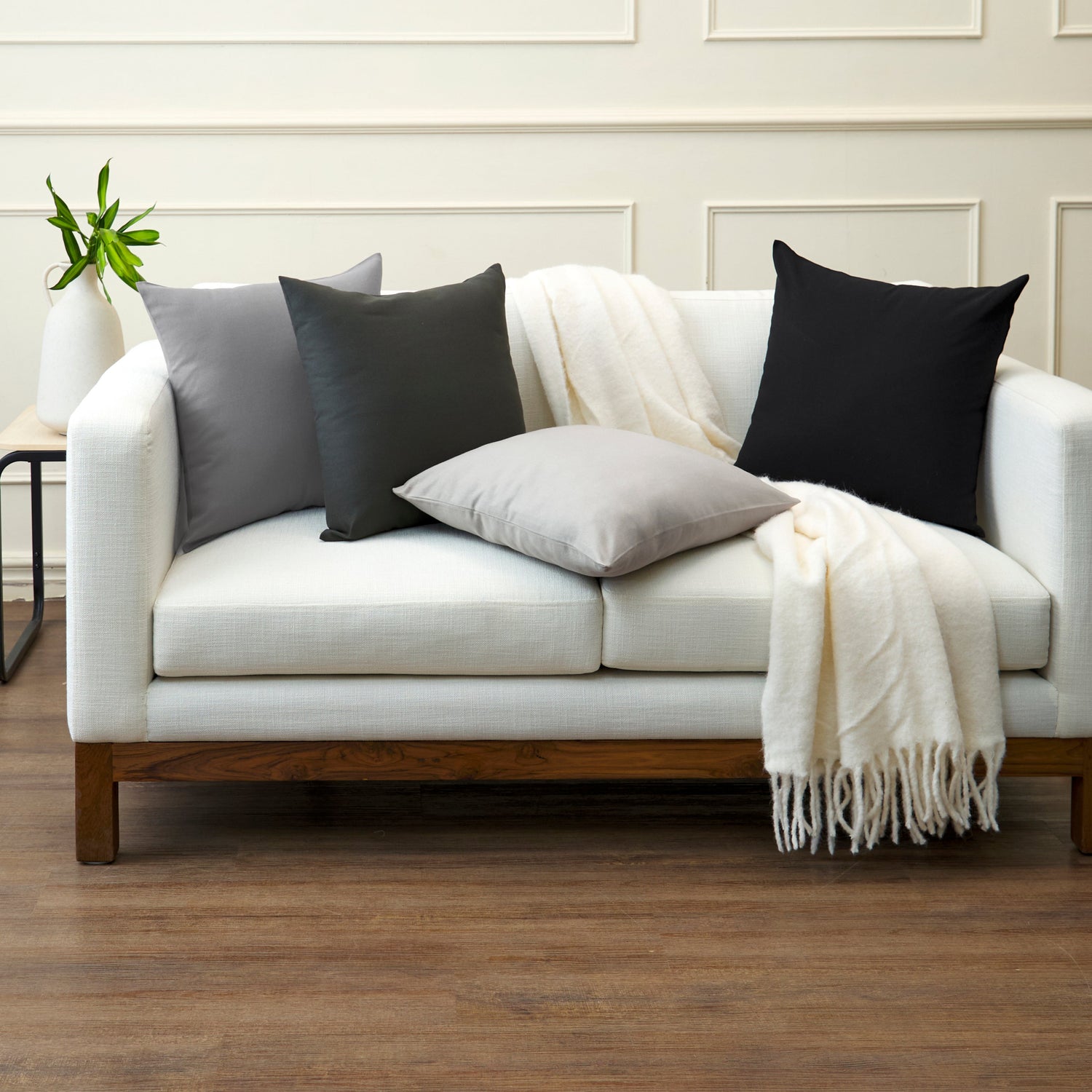
Buy two cushions for a three-seater and the sofa looks unfinished no matter how good the fabric is. Buy seven for an L-shaped sectional with no plan and the corner turns into a pile someone has to move before they can sit down. Both sofas can carry the right number of cushions. The number just isn't the same, and it isn't really a matter of taste either.
Most advice on this treats cushion count as a style choice, somewhere between "a few" and "however many you like." It works better as a measuring problem. A straight three-seater is one run of backrest to fill. An L-shaped sofa is two runs meeting at a corner that behaves differently from either of them, and the two runs are rarely the same length.
For a standard three-seater, three to five cushions covers most rooms: three for a clean, tailored look, five for a fuller, layered one. For an L-shaped or corner sofa, count the long run and the short run separately rather than as one total, and treat the inside corner as its own decision rather than just another slot in the row.
How many cushions on a sofa is enough, and how many is too many?
Start with the width you actually have to fill, not a number you saw somewhere. A typical three-seater in an Indian living room runs somewhere between 72 and 84 inches (183 to 213 cm) across, and the section of backrest that actually holds cushions is a little narrower than that once the arms are accounted for.

Take a fairly standard three-seater with a 200 cm (about 79 inch) backrest. Three 16-inch (40 cm) cushions, spaced with a hand's width of gap between each, use up around 145 cm and leave clean margins at both arms. That's a tailored, uncrowded look, and it's most of what a chenille pair does well against a plain sofa: two matching cushions, evenly spaced, nothing competing for attention.
Swap in two 20-inch (50 cm) cushions at the corners instead, drop a 16-inch pair to the middle, and the same 200 cm run is close to full before you've even added a centre accent. That's the fuller, layered version, and it's the one that starts to look cluttered past five pieces on a standard three-seater, because there's no backrest left for the cushions to lean against once you've covered it.
The three-seater breakdown, with real numbers
Three cushions is the floor for a finished-looking three-seater; fewer than that and the sofa reads bare even when everything else in the room is done. Five is close to the ceiling before you're fighting for space with anyone who sits down. In between, the honest answer depends on how deep and how wide the sofa actually is, more than on any decorating rule.
A compact three-seater, the kind common in smaller apartments with a backrest closer to 165–185 cm, sits comfortably with three or four cushions: three matching 16-inch covers, or two 16-inch with one 20-inch anchor at an end. Push a fifth cushion onto a sofa that size and there's rarely enough flat backrest left for it to sit upright rather than slide forward onto the seat.
A larger three-seater, 185–215 cm, has the room for the classic five-piece layered set: two 20-inch cushions in the corners, two 16-inch just inside them, and one 12-inch or lumbar accent in the centre. It's a standard arrangement precisely because it matches how much backrest a generous three-seater actually offers.
L-shaped sofas need two counts, not one
An L-shaped sofa is two straight runs joined at a corner, and the mistake is adding up a single cushion count for the whole thing as if it were one long sofa bent in the middle. The main run, the longer straight side, is sized and cushioned much like a three-seater. The return, the shorter side that turns the corner, is usually narrower and often serves a different purpose, which changes how many cushions it should carry.

A compact L-shaped sofa might run 6 ft (about 183 cm) along the main side and 4.5 ft (about 137 cm) along the return. The main run holds three or four cushions on the same logic as a three-seater of that width, so a corduroy pair anchoring each end reads well against the longer side, where the texture has room to register instead of getting lost. The return is the part people get wrong.
If that shorter side is built as a chaise, the kind you can stretch out on, it usually wants one or two cushions at the far end for head support, not a matching row down its length. A full line of upright cushions along a chaise blocks the one thing the piece is for. If the return is a normal seating run instead, closer in depth to the main sofa, it can carry two cushions on the same size logic as the main run, just fewer of them because the run is shorter.
Where people get the corner wrong
The inside corner is where most L-shaped arrangements fall apart, and the fix is almost always to do less there, not more. It's tempting to treat the corner as just another slot and drop a square cushion into it to match the rest, but that spot is where the seat cushions themselves already curve or step down to make the turn, and a full-size square cover sits awkwardly on top of that change in level. It also gets shoved onto the floor first, every time, because it's directly in the way of anyone crossing from one run to the other.
A single lumbar-shaped cushion, angled into the corner rather than squared up to either run, fills the gap without competing with the geometry. Leaving the corner bare works just as well, and on a sofa that already carries five or six cushions across its two runs, it's often the better call: one less piece to move before the seat is usable.
Cushion count and size mix by sofa type
| Sofa type | Approx. backrest width | Cushion count | Typical size mix |
|---|---|---|---|
| Two-seater | 130-150 cm (51-59 in) | 2-3 | Two 16 inch, or a 16 inch pair plus a 12 inch accent |
| Compact three-seater | 165-185 cm (65-73 in) | 3-4 | Three 16 inch, or two 16 inch plus one 20 inch |
| Standard three-seater | 185-215 cm (73-85 in) | 4-5 | Two 20 inch corners, two 16 inch, one 12 inch centre |
| L-shaped, main run | 180-215 cm (71-85 in) | 3-4 | Same mix as a three-seater of that width |
| L-shaped, return or chaise | 120-150 cm (47-59 in) | 1-2 | One 20 inch at the far end, or none if used for reclining |
Odd numbers, even numbers, and the sizes underneath
There's no rule that a sofa needs an odd or an even number of cushions, and chasing one over the other misses what actually makes a row look considered. An even count either side of a centre accent reads a little more formal and symmetric. An odd count, three across a three-seater or five once a centre piece is added, reads a touch more relaxed because nothing is perfectly mirrored.
What decides whether the arrangement looks put-together is the size mix, not the parity: larger cushions anchoring the ends, sizes stepping down toward the middle or toward the shorter run of an L-shape. The full breakdown of which size suits which seat, and the fit between the cover and the insert that keeps a cushion looking plump rather than saggy, is covered in the cushion cover size guide; worth reading alongside this if you're starting from scratch. For the centre or corner accent specifically, something with a bit more visual weight than plain cotton, a velvet cover or a piece from the cushion cover collection in a contrasting texture, does the job of drawing the eye without needing another cushion added to do it.
Fabric plays a small part in how full a row looks, too. Two cotton canvas covers sit flatter and read as fewer pieces than the same count in a textured weave, so a mixed-fabric row, canvas at the centre and something with more pile at the ends, can look fuller with the same number of cushions rather than needing an extra one.
Frequently asked questions
How many cushions for a 2-seater sofa?
Two is the safe minimum on a two-seater, and three starts to crowd a run that's rarely wider than 150 cm. For a fuller look without adding a third cushion, go up a size instead, two 20-inch covers rather than two 16-inch, since there's usually more backrest depth to support a bigger cushion than there is length for another one in the row.
Should I use an odd or even number of cushions?
Neither is a rule. Three on a three-seater is the shape most people picture when they think "finished." Five needs a centre accent to keep the middle from looking bare, which is why five-piece sets are almost always built around a lumbar or 12-inch square rather than four same-size cushions with a gap. The count follows from the size mix, not the other way round.
Do I need a cushion in the corner of an L-shaped sofa?
Rarely, and if you do, keep it to one. The corner seat cushion itself is usually cut at an angle or stepped down to make the turn, so a standard square cover perches on an uneven base instead of sitting flat. A bolster or soft lumbar shape follows that angle better than a square ever will, which is the real reason corners tend to go bare rather than square-cushioned.
How many cushions is too many for a sofa?
Five is already the fuller end of a standard three-seater. Go past that and there's no backrest left for the next cushion to lean against, so it slides onto the seat or ends up on the floor. On an L-shaped sofa, apply that same five-cushion ceiling to the main run alone, not to the whole sofa including the return.

Leave a comment
This site is protected by hCaptcha and the hCaptcha Privacy Policy and Terms of Service apply.