
Take a centre table 100 cm long, 60 cm wide and 45 cm high. These are example numbers, not a standard, so swap in your own later. Now lay our smallest tablecloth on it, a 56 x 56 inch square, which is 142 cm each way. It hangs 21 cm past each short end and 41 cm past each long edge. Along the side facing your sofa, that leaves 4 cm between the cloth and the floor. Each corner has about 46 cm of loose cloth, so the corners reach the floor.
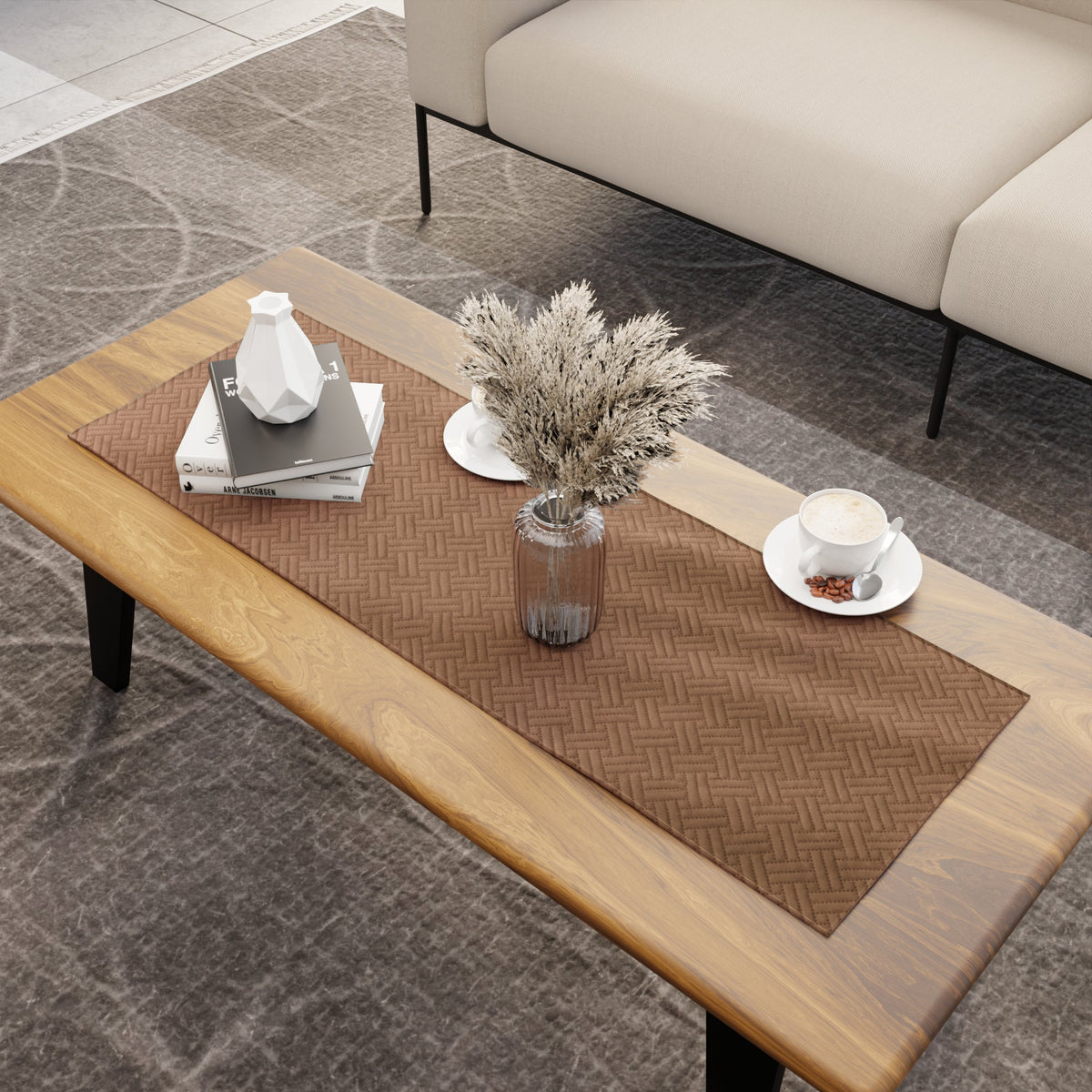
Here is the same table with that cloth and three short runners.
| On a 100 x 60 cm top | Size | At each short end | Along each long edge |
|---|---|---|---|
| Square cloth | 142 x 142 cm | hangs 21 cm | hangs 41 cm |
| Runner | 32 x 91 cm | stops 4.5 cm short of the edge | 14 cm of bare table |
| Runner | 32 x 122 cm | hangs 11 cm | 14 cm of bare table |
| Runner | 30 x 137 cm | hangs 18.5 cm | 15 cm of bare table |
So a centre table cover has to be sized from your own table, and on a rectangular centre table a runner is usually the better fit. A cloth can work on a small square or round table if you are happy with a long drop.
The smallest cloth we sell is 56 x 56 inches (142 cm). We make nothing smaller for a coffee table, and we sell no transparent PVC cover, which is what many covers sold under this name are.
How do you measure for a center table cover?
You need three numbers: the length of the top, the width of the top, and the height from floor to top. The sum is the same one used for a dining table. Cover size = top size + twice the drop, and drop is how far the cloth hangs past the edge.
The height is what makes a low table different. A dining table is typically about 75 cm tall, so a 41 cm drop still leaves 34 cm of clear space under it. Our example table has only 4 cm. There is no single correct drop for a low table, so compare your drop with your table's height and decide what you can live with. A cloth close to the floor catches on feet, gets pushed by the broom and hides the shelf under the table if there is one.
Every 10 cm your table is smaller adds 5 cm of drop on that side. A 142 cm cloth gives 21 cm on a 100 cm side, 31 cm on an 80 cm side and 41 cm on a 60 cm side.
The two directions do not help each other. Make that example table 120 cm long and the ends tidy up to 11 cm, but the long edges still hang 41 cm, because the width has not changed. A longer narrow table gets more uneven, not less.
Ignore "4 seater" on a centre table cover. That is a dining label, nobody sits around a centre table, and it tells you nothing about the top. The sizes on the listings we read also disagree, one of them within its own page, so your tape measure is the only number to trust.
Cloth or runner? Let the shape of the table decide
On a rectangle, use a runner. The drawing shows why, to scale: the cloth buries the table and hangs unevenly, while the runner leaves the top in view and hangs only where you want it to.
The table runner size guide has the length rules. Its advice for a coffee table is to leave about a hand's width of bare table at each end, which a 91 cm runner does on a 110 cm top, at 9.5 cm each end. A runner that hangs past the ends, like the 137 cm one above, is the other look.
A rectangle under about a metre has one more option if you want full cover. A tailor can cut a 142 cm cloth down and hem it. The example table with a 15 cm drop needs 130 x 90 cm before hems, and that fits inside the 142 cm square. A plain cloth is the one to do this with, because a border print would be lost in the cut.
Square and round tables are where a cloth earns its place, because the drop comes out even on all sides. An 80 cm square gets 31 cm all round from a 142 cm cloth. On a 45 cm high table that leaves 14 cm above the floor, enough room for a broom. For bigger tables, the tablecloth size chart works through the longer cuts. Our 57 and 60 inch squares only add drop on a small table, so start with 56.

A small round teapoy is the hardest case. A 60 cm top under a 142 cm round cloth gets 41 cm all round. That can look deliberate on a teapoy standing in a corner, with the cloth nearly at the floor, and it looks wrong on one in front of the sofa, where feet go. A square cloth is worse here: the sides hang 41 cm, and the corners have about 70 cm of cloth to drop, far more than a 45 cm table is tall. On a round top, buy a round cloth, like the 56 inch Cotton Natural round in the picture. The round table cover size guide has the arithmetic for other diameters.
What a glass top changes
A cloth hides the glass completely, so a full cover only makes sense if you no longer want the clear top.
Cloth also slides on glass. Polished glass gives fabric very little to hold, so a cloth with a short overhang moves when someone drags a cup or leans on the edge. A longer drop adds hanging weight, and something solid in the middle of the table helps too.
Then there is grit. A speck of sand caught under fabric can mark glass when the fabric gets dragged over it, so wipe the top before you lay a cover.
To keep the glass in view, use a runner. Take a 91 x 45 cm top, one size a seller lists for a glass centre table. A 30 x 91 cm runner matches the length and leaves 7.5 cm of clear glass along each long edge. A 142 cm cloth on that same top hangs 48.5 cm along the long edges, more than a 45 cm high table is tall.
Or use no textile at all. The tea coasters guide explains why an ordinary cup leaves no permanent ring on glass, so a tray and coasters may be all this table needs.
We sell no PVC cover, no grip liner and no glass film, so look for those in hardware and home stores. Treat any promise of scratch protection on a cover as the seller's wording, not a guarantee.
Which fabric suits a table that gets tea, not dinner?
A centre table takes more cups and fewer meals, so washing matters more than looks over time. On wood, keep in mind that a runner does not stop a ring: a wet cup can leave one under the fabric where you do not see it until later.
Among the cloths, polyester is the cheap way in. Polyester squares start at about ₹450, and the Polyester Beige cloth, which reads as sand rather than pale beige, is about ₹500 in both the 56 inch square and the 56 inch round. The Cotton Natural cloth, which reads cream, costs about twice that, at about ₹1,000 square or round. Its page states 180 GSM and machine washing, no bleach. Cotton soaks up tea quickly, so plan on washing it rather than wiping it. If you want a print, the tablecloth collection shows size as an option on each product, so check for a 56, 57 or 60 inch square first and look at the pattern second.
With runners, start from what the table has to put up with.
If tea gets spilled here every week, you want something flat that goes in the machine. The Cotton Natural runner fits that, at 32 x 91 cm for about ₹330, marked machine washable. For a table closer to a metre long, the 32 x 122 cm cut hangs 11 cm at each end. It is sold on only a few lines, among them Franca stripes and Cotton Mango, so check the sizes in the runner collection.

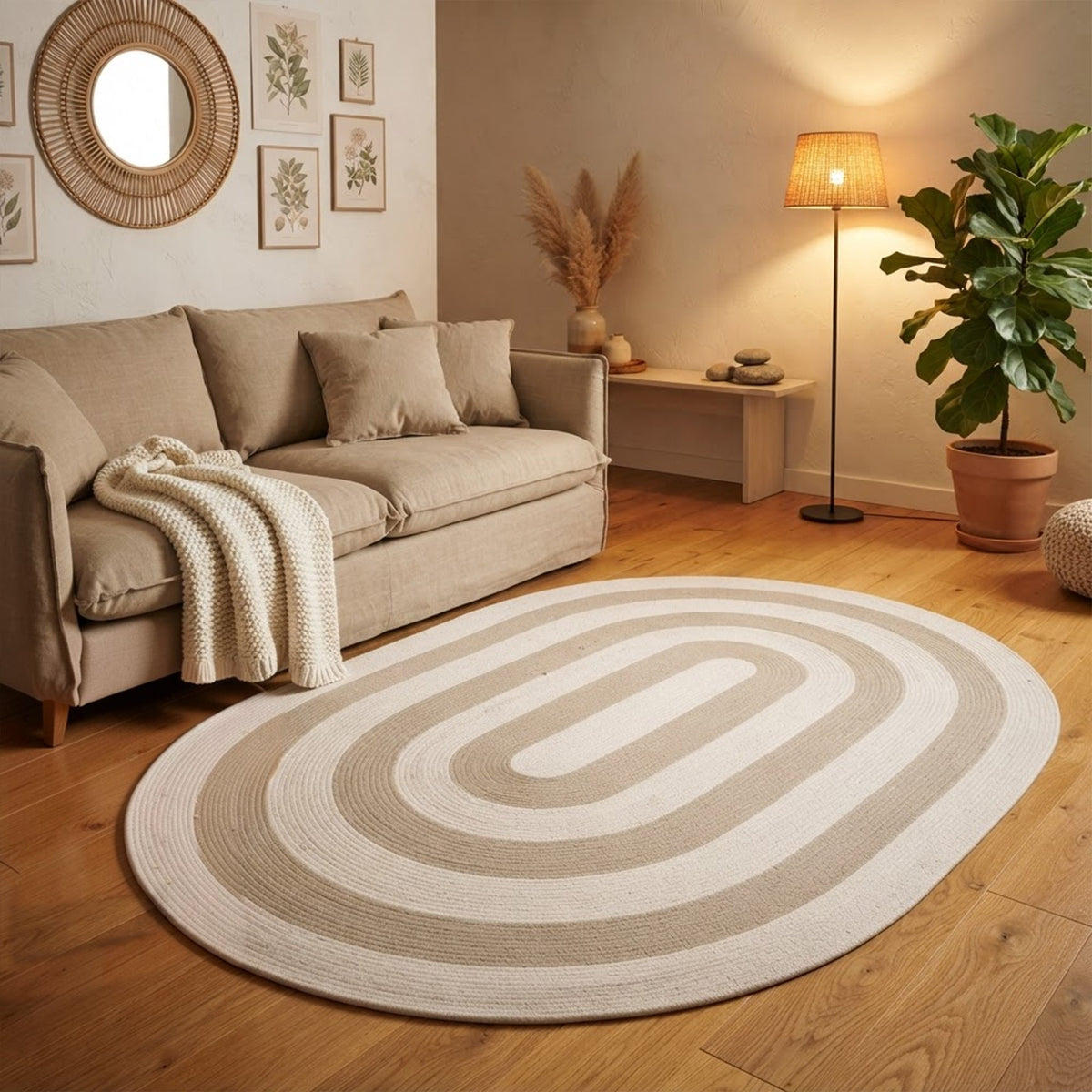
A glass top changes the choice, because weight now matters more than quick washing. The Cotton Off White runner is what the photo above shows, in 30 x 91 cm at about ₹500 or 30 x 137 cm at about ₹770. Its page calls it thick and heavy, and it is a braid with rounded oval ends, not a flat strip with square ones. It is also marked hand wash, and a braid that thick holds water longer than flat cloth, so put a tray on it and keep the spills off.
Velvet is for a table that holds books and a vase more than daily chai, since pile tends to be harder to blot than flat cotton. The Quilted Velvet Tan runner comes in 32 x 91 cm at about ₹430 and looks copper-brown rather than tan in its pictures.
Questions about centre table covers
What is a teapoy cover?
A cover for a teapoy or tea table, which in many Indian homes is another name for a small low table, often round or square. Many of these tops are small enough that a full cloth reaches close to the floor.
How much should a centre table cover hang over?
There is no fixed figure. Subtract the drop from the table's height to see how much floor clearance is left. A table in front of a sofa needs more clearance than one standing in a corner.
How do I stop the cover sliding?
Give it weight in two places: enough overhang to pull down on the edges, and something heavy on top, such as a tray. A heavier cloth holds better than a light one. If it still moves, a grip liner from a hardware store goes underneath, trimmed smaller than the top so it does not show.
Does Encasa sell a cover made for a centre table?
No. Our smallest cloth is 56 x 56 inches (142 cm), a size cut for small dining tables, and we sell no transparent PVC cover. What suits a typical centre table from our range is a short runner.

Leave a comment
This site is protected by hCaptcha and the hCaptcha Privacy Policy and Terms of Service apply.