
Watch people buy a bathroom mat online and the order is often the same. Colour comes first, then a long look at the photo to guess how soft it would feel under a bare foot. Neither of those turns into the complaint later on. The complaint is that the mat is still damp when the second person walks in, or that it has crept away from the shower and now lies half under the basin. A screen at least gives you a guess at colour and softness. Drying and grip only show up at home, after the money has gone.
To choose a bathroom mat, settle three things in this order: the spot it has to cover, how fast it has to dry before the next person needs it, and what will be underneath it. Fibre follows from the second question and backing from the third. Colour can wait until those are done.
How to choose a bathroom mat: start with the spot
A mat does its work at one place, where wet feet meet a floor you want dry. In most homes that means one or more of four spots: the step out of the shower, the basin, the door and the base of the toilet. So measure the clear floor at that spot, not the room. A large bathroom can have a tight gap, and a small one can have a long run of open floor.
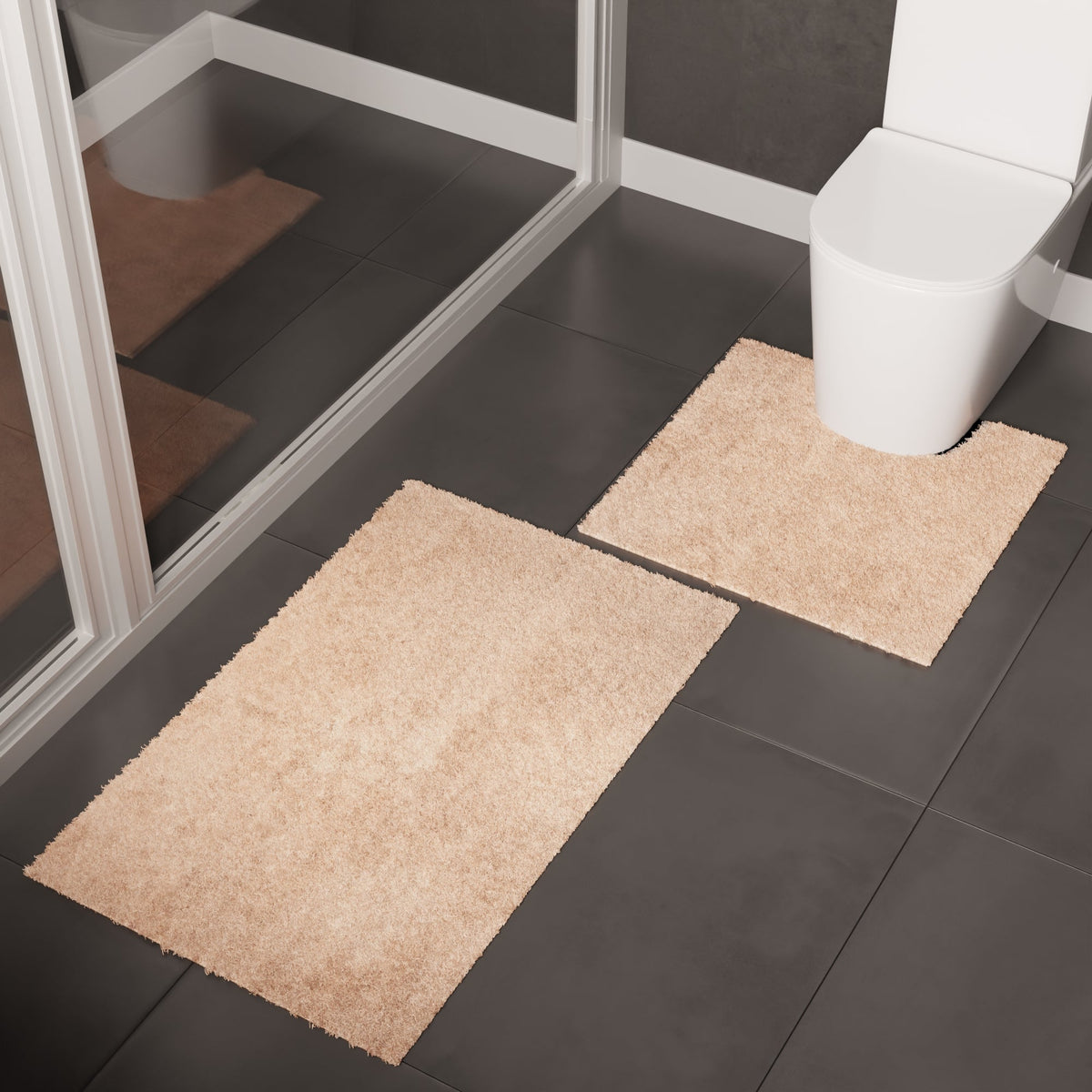
Listings here often quote rectangles of about 60 x 40 cm or 80 x 50 cm, and a U-shaped piece is cut to wrap the toilet base. The bath mat size guide covers which one goes where and how many a bathroom needs.
The spot changes the next question too. The mat at the shower takes the full load from every wet foot, every morning. The mat at the basin mostly takes splashes. A household that wants one soft, plush mat can often have it at the basin and put the quicker-drying mat at the shower. It does not have to be one fibre for the whole room.
Which is the best material for a bathroom mat?
That depends on how soon the next person arrives. Every mat has to lose the water it took on, and it cannot do that faster than the room allows. The more water a mat holds, the more it has to lose.
So count. If two or three people bathe within an hour of each other, in a small bathroom that stays humid through the monsoon, choose dry time over softness. That points to microfibre or another thin mat. If one or two people use a bathroom with a window or an exhaust fan, or you can hang the mat out after the last bath, cotton's softer landing costs you much less. The cotton vs microfibre comparison sets that trade out in full, and the quick-dry guide goes through how each material dries.
Two things on a listing will not answer this for you. "Quick dry" is a description, not a test result, and the same mat dries very differently in a room with a fan and a room without one. For that reason we would ignore any promise of a dry time in hours. GSM tells you how heavy the mat is for its area. Pile, density and backing all change how that weight behaves when wet, so a big GSM number promises nothing about drying.
The room can also beat the fibre. In a sealed bathroom, even a quick-drying mat stays damp if it is left flat on the floor. If yours has no window and no fan, the habit of hanging the mat up will do more than the choice of fibre.
What goes under the mat, and does your floor matter?

A textile mat does not stick to the floor. It stays put because its backing is in contact with clean, dry floor, and it lets go when something gets between the two: a film of water, soap residue or hard-water scale. That is why a mat can hold well on a dry morning and move later the same day. The backing shown above, from Encasa's cotton set of four, is a sprayed latex layer, so it is thin and works by that same contact.
A chart matching mats to marble, vitrified tile or kota stone would be handy, but we have no test data on any of those floors, so there is none here. A backed mat needs a clean, dry floor beneath it, whatever that floor is. To check yours, lift the mat a few days after you start using it. If the tile under it is wet or feels filmy, deal with that first, because a different backing will not fix it.
Backing and drying can pull against each other. A thick rubber backing tends to grip firmest, and it also tends to make a mat heavier and slower to dry. The anti-slip bath mat guide goes through each backing type, why grip fades, and what to check if older parents or small children use the bathroom. No backing makes a wet floor safe on its own, so coverage still matters.
Suction mats are a separate product. They go inside a bathtub or on a smooth shower tray. Encasa sells only the textile kind, for the floor you step out onto.
Read the listing, not the title

A title is the shortest description on a product page, so it is the last place to settle anything. Three other places tell you more.
The size option is what you are actually buying, and it can differ from what a line of the description says. The pack line tells you how many pieces come in the box, though not always what shape they are. The photos with printed details, often called spec cards, can show dimensions, the fibre and the underside. Open every photo, not only the first.
Then check that those places agree about the fibre. If the title says one thing and a spec card or the description says another, you do not know what the mat is made of. Ask the seller or pick a different listing. That goes for any shop, ours included.
"Pack of 2" deserves its own warning, because it may not mean two matching mats. On Encasa's cotton pack of 2, the options read 80x50 cm and pack 2, and the pictures show one 80 x 50 cm rectangle and one 45 x 45 cm U-shape. If you want a mat at the shower and one around the toilet, that is the right set. If you wanted two rectangles for two doors, it is not. The cotton pack of 4 is two of each.
Which Encasa bathroom mat suits which home
Take a family of four who all bathe before nine, in a bathroom where the shower drains across open floor and nothing really dries in August. The mat at the step-out is doing the hard work, so that is the place for the 76 x 51 cm microfibre mat, a grey and white chevron at about ₹800. A second, 60 x 40 cm microfibre mat at the basin adds under ₹500, which brings the pair to about ₹1,300.

Now take two people and an attached bathroom with a window, the toilet right beside the shower, and bare tile around its base. Here cotton makes sense, and the shape matters more than the fibre. The cotton pack of 2 costs about the same as that one microfibre mat and covers both spots with a soft, shaggy pile.
The family of four may still dislike the denser, slightly synthetic feel of microfibre, which some people do notice. Then they can buy cotton and pay for it in effort. The cotton pack of 4, at about ₹1,500, gives one set on the floor and one drying, swapped each day. It works only if the house has somewhere for a heavy wet set to hang, and in August that is a real question.
For cotton at a narrow spot, the 60 x 40 cm woven cotton mat is a chunky grey and white weave, nothing like the shaggy sets, and it is under ₹700. Thick cords like those tend to hold water, so it suits a bathroom with some air moving through it.

One mat in the range carries the bath mat name and belongs elsewhere. The 60 x 40 cm polyester mat is plush and printed, and its pictures show it on a kitchen floor, a balcony, at a puja corner and by a dressing table, with no bathroom among them. Take it for those places, at under ₹300 for one or under ₹500 for two. For the wet floor outside a shower, choose from the mats above.
| Mat | Fibre | What is in the box | Backing named on its page | Price |
|---|---|---|---|---|
| Microfibre, 76 x 51 cm | Microfibre | One rectangle | Hot melt adhesive | About ₹800 |
| Microfibre, 60 x 40 cm | Microfibre | One rectangle | Hot melt adhesive | Under ₹500 |
| Woven cotton, 60 x 40 cm | Cotton | One rectangle | Hot melt adhesive | Under ₹700 |
| Cotton pack of 2 | Cotton | One 80 x 50 cm rectangle, one 45 x 45 cm U-shape | Latex spray | About ₹800 |
| Cotton pack of 4 | Cotton | Two rectangles, two U-shapes, same sizes | Latex spray | About ₹1,500 |
| Polyester, 60 x 40 cm | Polyester | One or two rectangles | Slip-resistant, material not named | Under ₹300 for one, under ₹500 for two |
If you want another colour from the full bath mat range, each colour has its own page, so run the same check on the one you pick.
After you buy
Two guides pick up from here: how to wash a bath mat without damaging the backing, and why the floor stays wet and the mat smells if it starts to.
Frequently asked questions
What size bathroom mat do I need?
The one that fits the clear floor at that spot, with no edge bunching against a cabinet or caught under the door. A shower step-out usually has room for the larger rectangle, while a doorway or tight basin gap often suits the smaller one. The size guide has a worked example.
Do bathroom mats need a non-slip backing?
On smooth tile it is worth having, since a light textile mat with nothing under it can slide. Remember what the backing can and cannot do, though: it holds on clean, dry tile and loses its hold on wet or soapy tile. The anti-slip guide explains how to get the grip back when it fades.
How often should a bathroom mat be washed or replaced?
There is no reliable fixed interval, because it depends on how damp the room stays and how many people use the mat. Go by the mat's condition: a smell says it is due a wash, and corners that stay curled after it has dried flat say it is near its end. The washing guide has a routine for the monsoon months.
What is the difference between a bath mat and a shower mat?
Where it goes. A shower mat is usually rubber or PVC with suction cups, and it sits inside the tub or tray. A bath mat is textile and lies outside, on the floor you step onto, where it takes the water off your feet.

Leave a comment
This site is protected by hCaptcha and the hCaptcha Privacy Policy and Terms of Service apply.