
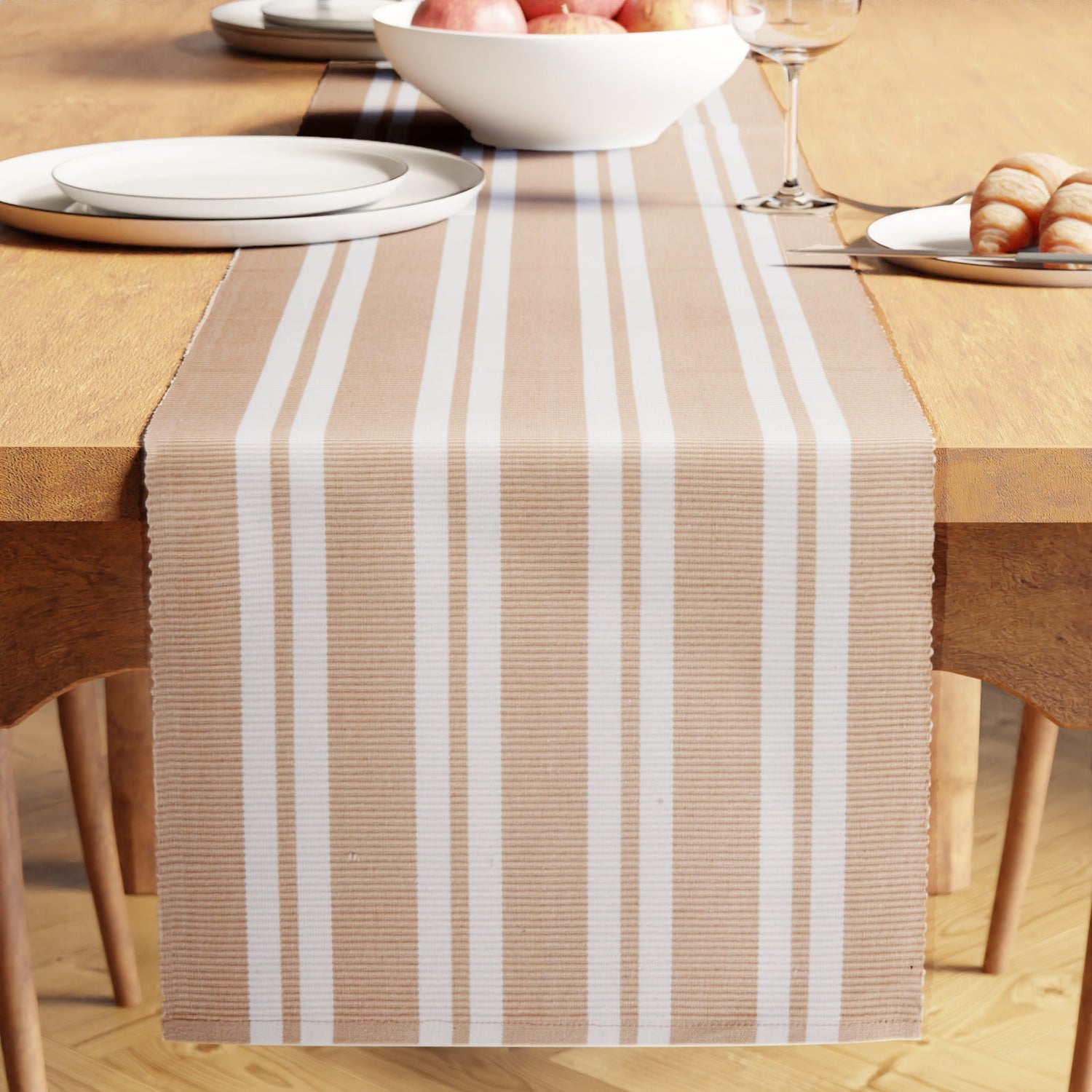
A table runner should be about 30 cm longer than your table, so it hangs roughly 15 cm over each end. On a 180 cm dining table that means a runner of around 210 cm. That one measurement settles most of the buying decision; the rest of this guide is the chart for your own table and the width question people forget until the runner is already home.
Length is the part people get wrong. Cut it too short and it stops awkwardly before the edge; too long and it pools onto the chairs. Get the drop right and the runner looks like it belongs, a clean line down the centre with a tail at each end.
The overhang rule, and its one exception
Measure the length of your table top, not the seating, and add about 30 cm. That gives you a runner that hangs a hand's width over each end, which is the proportion most people find looks intentional. Fifteen centimetres each side is roomy enough to show a defined tail, but not so long that the fabric brushes a seated guest's lap or catches when a chair is pulled in.
There is one deliberate alternative: the flush look. Some modern tables, especially plain wood or a table you want to keep visually flat, suit a runner cut to the exact table length with no overhang at all, the tails stopping right at the edge. It is a cleaner, more contemporary line, and it is a valid choice rather than a mistake. What almost never works is the in-between: a runner that overhangs by two or three centimetres looks like it was meant to reach the edge and failed. Commit to a proper 15 cm drop or commit to flush.
Table runner length chart
Most dining tables land near a few common lengths by seat count, so you can usually pick from the chart to get close, then confirm with a tape measure, since sizes vary between makers.
| Table | Typical top length | Runner length (15 cm drop) | Flush option |
|---|---|---|---|
| 4-seater | 90 to 120 cm | 120 to 150 cm | 90 to 120 cm |
| 6-seater | 150 to 180 cm | 180 to 210 cm | 150 to 180 cm |
| 8-seater | 210 to 240 cm | 240 to 270 cm | 210 to 240 cm |
If your table falls between two rows, measure it and add 30 cm rather than guessing from the seat count, since a "6-seater" from one maker can be a good 20 cm longer than another's. And if you use a table extension leaf for guests, buy for the extended length and let the runner sit a little shorter on ordinary days, which looks fine, rather than the other way around.

Width: the decision people skip
Length gets the attention, but width is what keeps a runner looking like a runner rather than a narrow tablecloth. The guide is that the runner should take up roughly the middle third of the table's width, which in practice means something in the 30 to 40 cm range for most dining tables. That leaves room on either side for place settings without the plates sitting on the fabric.
What it holds decides where in that range you land. If the runner's only job is to carry a centre arrangement, flowers, a bowl, festive diyas, go narrower, since it is a stage for the centrepiece rather than a surface for plates. If you set the crockery over it for a more layered look, keep to the wider end so the fabric reads deliberately under the plates. A runner much wider than 40 cm on a standard table starts competing with a tablecloth and loses the crisp central-line effect that is the whole point. The table runner collection lists the exact width on each design, so check it against your table before buying, and a classic like the cotton striped runner sits right in the versatile 30 to 40 cm band. Fabric is the other half of the choice, for everyday meals versus a festival table, and our guide to choosing a table runner for a dining table covers it.
Runner alone, or over a cloth?
A runner works two ways, and the size logic is the same for both. Straight onto a bare wood table, it protects the centre and draws a line down an otherwise plain surface, which suits everyday and modern rooms. Layered over a tablecloth, say a hand-block-print cotton cloth, it adds a second texture and a focal band down the middle, which is the dressier, festive setup. Either way, size the runner to the table by the overhang rule above, not to the cloth. If you are building a full setting with placemats and napkins as well, set the runner down first and arrange everything else around it, so get its length right before you worry about the placemats and napkins. For the napkins, the everyday dinner size is 43x43 cm, as our table napkin size guide explains.
Frequently asked questions
How long should a table runner be?
About 30 cm longer than your table, so it hangs roughly 15 cm over each end. For a 180 cm six-seater table, that is a runner around 210 cm. Alternatively, cut it flush to the table length with no overhang for a modern look, but avoid a small two to three centimetre drop, which looks unintentional.
How wide should a table runner be?
Roughly the middle third of the table's width, which is about 30 to 40 cm for most dining tables. That leaves space on either side for place settings. Go narrower if the runner only holds a centrepiece, wider if you set plates over it. If those place settings sit on table mats, measure against the gap the mats leave rather than the bare table width.
Do table runners work on round or coffee tables?
On a round table a runner laid across the middle looks odd, since it has no long axis to follow; a round cloth or a small centre mat suits it better. On a coffee table a short runner works well as a low centre strip, sized to leave a hand's width of bare table at each end rather than the full 15 cm drop.
Should a table runner hang over the edge?
Traditionally yes, about 15 cm over each end, which looks balanced and intentional. A flush runner with no overhang is a valid modern alternative. The look to avoid is a very small overhang of a few centimetres, which reads as the wrong size rather than a deliberate style.

Leave a comment
This site is protected by hCaptcha and the hCaptcha Privacy Policy and Terms of Service apply.