
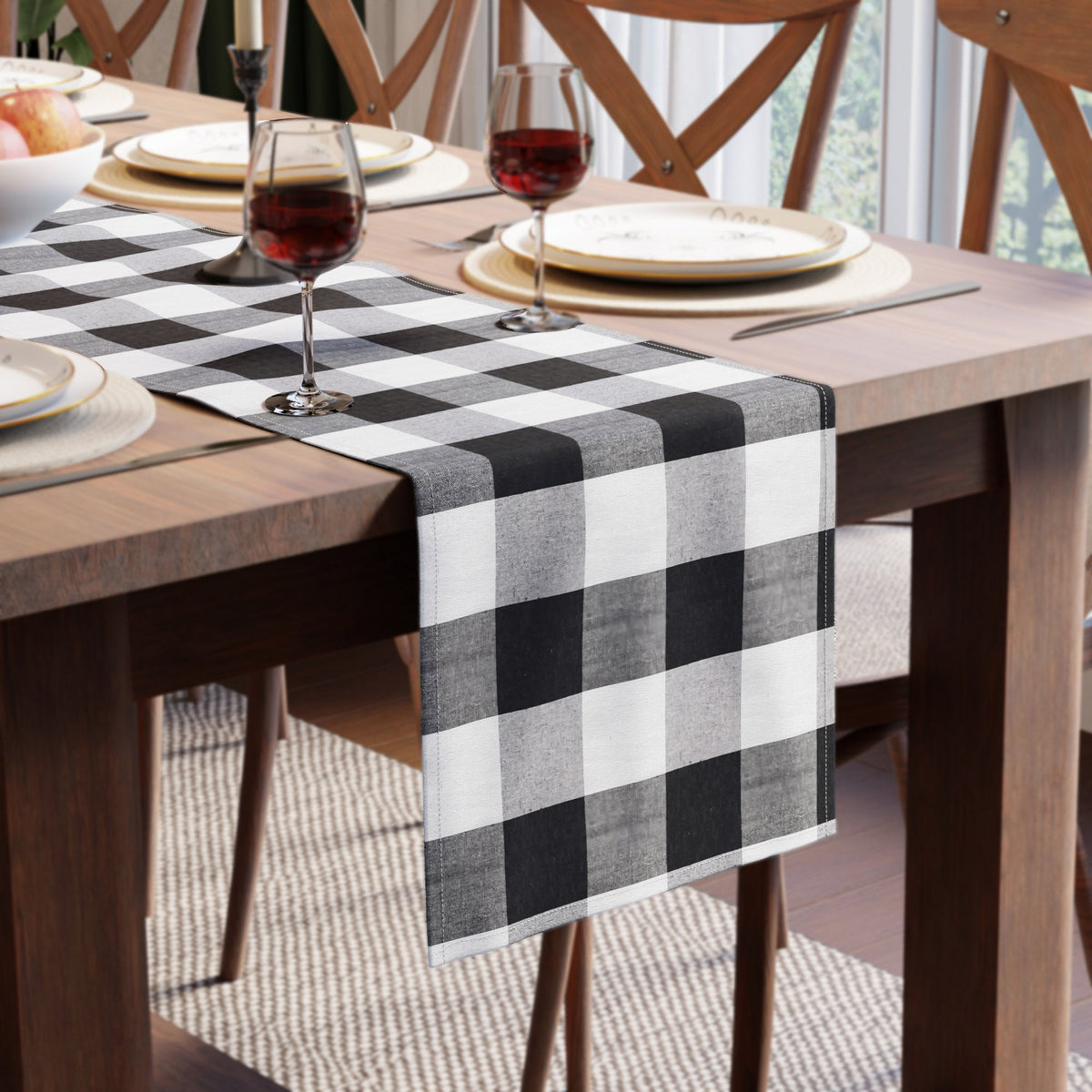
Runners get chosen from pictures of tables with nothing on them. One strip of fabric, a vase, two plates set for the camera, and a lot of clean wood on either side. The table it comes home to has a fruit bowl parked on it by Tuesday and four serving dishes on it by Sunday lunch, and the runner spends most of its life being the thing everything else is put on top of.
Length is the question that gets asked first, and it is the easiest one. It is a tape-measure job, and the table runner size guide has the chart and the overhang rule for it. The harder question, and the one that decides which runner is worth buying, is whether it is going down on bare wood or over a table cover.
Both placements are ordinary. On bare wood the runner is the only thing on the table, so it does the decorating and whatever protecting gets done. Over a cover it is the top layer of a set, free to be plush or patterned because the cloth underneath is taking the damage. Which one you are doing decides whether you want something washable, something wipeable, or something you only get out twice a year.
Bare table, or over a table cover?

Count what the runner is actually under in the image above. A bowl of fruit, and the salt and pepper. The four plates, the glasses and every piece of cutlery are on bare wood, because a runner is a strip down the middle and place settings go either side of it.
An everyday Indian meal widens the gap. Rice, dal, two sabzis, a bowl of curd and a serving spoon standing in each of them do not fit in the middle of the table. They go where there is room, which is everywhere, and the drips travel with them. I would only put a runner down alone on a table I am not precious about.
So the sensible order depends on the table. Laminate, glass, or wood that has already earned its marks: the runner is a styling decision, pick on looks. Wood you are still protective of: the protection has to come from something with more coverage, and the runner goes on top as the good-looking layer. A table cover sizes that job for the whole surface, table mats do it place by place, and the case for covering the table at all is made in more detail here.
Then there is the case in between. You want the middle of the table protected, you do not want a full cloth, and you are not going to wash a runner after every meal. That is what a wipe-clean runner is for. The faux leather chocolate runner is described by its own page as made "for everyday Indian households", with a waterproof leatherette surface against spills from tea, coffee, oil, dal and sauces, cleaned with a damp cloth rather than a machine. The same page puts its thickness at 0.7 mm and says the backing is there to stop it sliding on a glass or wooden top. Four lengths, ₹369 to ₹629. Treat it as spill and scuff cover rather than permission to drag a heavy dish across it.
What runner fabric suits everyday meals, and what suits a festival
Runners are usually sorted by style, which is the wrong axis, because farmhouse and minimal do not tell you anything about the Sunday after. The fabric tells you how it gets cleaned, and cleaning is what you will spend years doing with it.
| Fabric | What it is | Care | Where it earns its place |
|---|---|---|---|
| Cotton, plain, striped or check | Yarn-dyed woven cotton; the buffalo check page states 200 gsm and a chambray weave | Machine wash, and that page rates its colours fast to a 40 degree wash | Daily meals on a table that gets wiped and reset |
| Chenille | Ribbed chenille woven from polyester yarn, heavier in the hand than it looks | Washable per its page | A table that has to look finished on a weekday without being fussed over |
| Velvet | Polyester velvet; the embossed maroon states 175 GSM | Machine washable per its page | Festivals, guests, and rooms lit by lamps rather than daylight |
| Madur Kathi grass | Handwoven river grass, stiff and textured, not a cloth at all | Damp cloth only, never a machine | Festive and natural settings, and warm serving dishes |
| Faux leather | 0.7 mm leatherette with a non-slip backing | Wipe clean | Homes that are not going to wash a runner after dinner |
Cotton is the default because of the wash. A woven check or stripe hides a few days of ordinary use, and when it stops hiding it, the machine takes it. The beige striped cotton runner is the safe version, five lengths, ₹369 to ₹698, and it will not argue with anything already on the table. The black and white buffalo check is the same money and a much louder piece of cloth, so it wants plain crockery around it. Its page is also unusual in explaining a construction detail: a 1.5 cm hem on all four sides, which it says puts weight at the edges so the fabric sits flat. That is a reasonable thing to check on any cotton runner before buying, because a light unweighted hem is what curls up at the corners.
Chenille is the odd one, in that its own page claims both everyday and special use and the fabric roughly earns it. The ribbed surface reads as texture rather than pattern, so it looks considered on a plain table without competing with anything. Then you live with it and the solid dark colour shows dust and stray atta, with no pattern for a tea ring to hide in until wash day. One length, ₹599, and it is the runner I would pick for a centre table rather than a dining one.

Velvet is bought for light rather than for use. The pile catches lamplight and holds a deep colour instead of flattening under it, which is the argument for it on a festive table and no argument at all on a weekday one. The embossed velvet maroon runner presses a raised damask pattern into 175 GSM polyester velvet, and at ₹499 it changes the character of a table for less than most new cloths cost. What velvet is bad at is being ignored. Lint shows on it, crumbs sit on top of the pile instead of falling into a weave, and a heavy dish left in one place flattens the nap into a visible patch that needs brushing back. Keep it well away from anything lit, too. Our Diwali table setting guide covers the flame distances and the order the layers go down in.
One thing about runners that mats and napkins will not prepare you for: they are sold one at a time. The runner collection runs past 250 designs and, apart from one line of seven-piece grass sets, which pairs six placemats with a runner cut to sit alongside them for ₹999 in five colours, they are single pieces. So "how many do I need" barely exists as a question here. One per table, and a second only if you want one in the wash while the other is out.
Can you put a hot dish on a table runner?

General advice about runners repeats that they protect the table from hot dishes, as though this were a property of runners. It is not. It is a claim some product pages make and others do not, and even the ones that make it are describing something narrower than the advice implies.
The Madur Kathi grass runner is the clearest case: handwoven river grass, and its page says the natural fibre helps protect the table from hot dishes and minor spills. That is a claim about the material doing what stiff woven grass has always done. The faux leather page describes a shield against scratches, scuffs and heat marks from serving bowls and hot plates, and the embossed velvet page makes almost the same claim. The cotton check and the chenille make no heat claim of any kind, and there is no reason to read one into them.
Which leaves a rule that ignores the material. A serving bowl that has been sitting on the table already is not the problem. A pan lifted straight off the gas gets a trivet or a metal stand, and it gets one on grass and leather too, because a heat mark on a runner is cheap and a heat mark on the table underneath is not. The grass runner comes in two lengths, ₹439 and ₹659. Pick it if you want the look, and take the heat claim as a small bonus rather than the reason.
Pattern, colour, and how much is already on the table
Start with the crockery rather than the runner, because the crockery is the thing you cannot swap between meals. Patterned plates and a checked runner will fight and the plates will win, so a solid or a woven texture is the safer buy in that house. Plain white plates leave the runner free to be the interesting thing on the table.
Colour is worth a second thought for a duller reason. The runner is the one piece of table linen that stays out between meals, so it is what the room looks like for most of the day, with nothing on it and nobody eating. A mid-tone or a textured weave carries a week better than a pale solid. A pale solid looks best for exactly as long as it stays clean.
Frequently asked questions
Should a table runner be used with or without a tablecloth?
Both work and they do different jobs. Straight onto the table, the runner is the only decoration and the only cover, which suits a surface you are relaxed about. Over a cloth, it is the top layer of a set and can be plusher or bolder, because the cloth underneath is handling the spills. Decide which one you are doing before choosing the fabric.
How do I choose a table runner for a dining table?
Settle the placement first, bare table or over a cover. Then pick the fabric by how you will clean it: cotton or chenille if you are happy to machine wash, faux leather if you would rather wipe, velvet or grass if it is coming out for guests and festivals. Length comes last and is a measurement, not a preference.
What table runner material is best for everyday use?
Woven cotton, in a check or a stripe rather than a pale solid. It goes in the machine, the pattern carries a few days of ordinary use between washes, and it costs little enough to replace when it stops looking fresh. Chenille is the alternative if you want more texture and less pattern.
Is a table runner necessary on a dining table?
No. A runner is a choice, not a requirement, and on a table you want to protect it is the weakest of the options because it only covers the middle. Buy one because you want the table to look finished, or because you want the centre of it kept clean. If the aim is protecting the whole surface, a cover or a set of mats does that job.

Leave a comment
This site is protected by hCaptcha and the hCaptcha Privacy Policy and Terms of Service apply.