
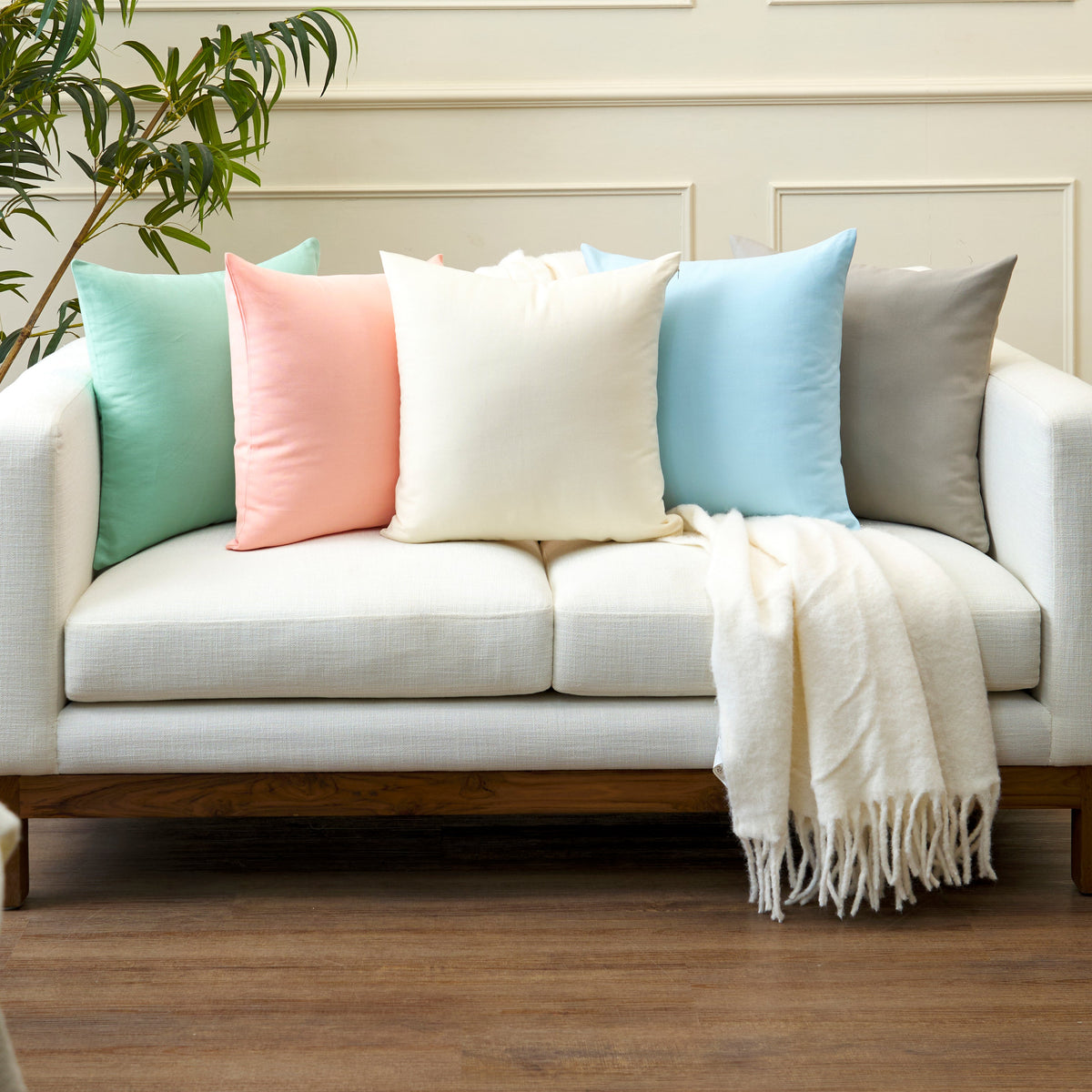
A whole sofa of round cushions rarely works. One round cushion, in the right spot, often does.
That is the short answer. Square cushions build the arrangement: they line up, lean flat against a backrest and stack in sizes. A round cushion finishes it. It works as a single accent in front of the squares, on its own on a chair, or as one seat on the floor. Buy squares for the job and a round for the look, and don't expect a round cover to do a square's work.
Why the two shapes behave so differently
A square has corners and a bottom edge. Stand it on a sofa seat and it rests along that edge, leaning back against the cushion behind it or the backrest. Put three side by side and their edges line up, so the row looks planned even when it has been thrown together.
A circle has neither. It touches the seat at one point, so in a row it tends to tip sideways or slide down into the gap between seat cushions. It also has no top or bottom. You cannot put it on crooked, which is why a round cushion left anywhere still looks placed. That suits it to places where it sits alone, and makes it awkward in a row.
There is a build difference too. Round cushions come in two common forms. One is flat: two circles sewn together at the edge, like a disc. The other is boxed: two circles joined by a side strip, which gives a drum shape with straight sides. A flat round reads as decoration. A boxed round looks more like something to sit on, which is why floor cushions and seat pads are so often made that way.
Does a round cushion look smaller than a square?
Yes, and by more than you might expect. A round cushion is sized by its diameter, a square by its side, so a 40 cm round fits exactly inside a 40 cm square and loses the four corners. What's left is about 79 per cent of the square's face.
So a round with the same number as your squares will look a size down next to them. To match a 40 cm square, a round needs to be about 45 cm across. That's handy, because you usually want the round to look a little smaller than the square behind it. Pick the same number and the step-down happens on its own.
Round vs square cushion covers by placement
| Where | Square | Round | What tends to work |
|---|---|---|---|
| Sofa, back row | Lines up and leans flat | Tips sideways in a row | Squares |
| Sofa, front centre | Adds bulk to the stack | Breaks up a grid of squares | One round in front |
| Bed | Large sizes stand against the headboard | Sits in front of the stack | Squares behind, one round in front |
| Single accent chair | Fine, needs straightening | No way to put it on crooked | Either; round is easier |
| Floor seating | Rows along a wall | Single seats that stand alone | Square for rows, round for one-offs |
| Long diwan or window seat | Repeats along the length | Gets lost on a long run | Squares |
The pattern is the same everywhere. Where cushions sit together in a line, squares win. Where one cushion sits alone, a round has the edge, because it cannot look out of line with anything. The floor cushion guide makes the same call for seats on the ground.
Round cushion covers: what to check before you buy
A round cover needs a round insert of the right diameter. A square insert squeezed into a round cover leaves bulges where the corners push against the seam. So find the insert first, in the diameter you want, and buy the cover to fit it. Following the same snug-fit rule as squares, the insert should be slightly larger than the cover so the edge stays full.
Check how the cover closes, too. On a flat round, the zip either runs part of the way round the edge or sits across the back. A zip along a curved edge can be fiddly to close over a full insert. On a boxed round, the side strip shows whether the cushion holds its shape: a straight, firm side means a firm insert inside.
Washing is the same as for any cover of that fabric. A boxed round can take longer to dry, though, because the side strip adds layers at the seams.
Building a sofa with square covers, with room for one round

Encasa's covers are all square or rectangular, so the round in this plan will come from somewhere else. Everything behind it can come from one range, which makes the sizing easy.
Take a three-seater. Start with two 50 cm squares at the arms. Those set the size of everything in front. Then a pair of 40 cm squares in front of them, or skip that layer if the sofa is shallow. The round goes last, at the front centre. At 40 to 45 cm across it reads as a clear step smaller than the 50s behind it, which is the look you want. The cotton canvas cover in natural comes in 30, 40, 45, 50, 55, 60 and 65 cm squares and a 30 x 50 cm rectangle, so the whole back row can be one fabric in two sizes, with a lumbar if the sofa needs one.
A round in front of the squares works best when it differs in texture as well as shape, or the change of outline is the only thing doing the work. Behind a smooth round, a grainy weave such as the chenille mustard pair gives the squares a texture the round doesn't have. The full chenille range runs in enough colours to match most sofas.

On a bed it is simpler. Large squares stand against the headboard, and a single round sits in front. A pair of velvet gold covers at 50 or 60 cm gives that back row some sheen, and the round in front can stay matt. Velvet catches the light and tends to make a cushion look fuller, so a velvet square holds its own behind a plump round. Other shades are in the velvet collection, and the full cushion cover range has the plain cottons for a quieter back row.
Frequently asked questions
Can I put a square insert in a round cushion cover?
Not well. The corners of the insert push out against the round seam and the cushion goes lumpy. Use a round insert a little larger than the cover's diameter.
What size round cushion goes with 16-inch square cushions?
About 16 to 18 inches across. A round the same number as the square looks a size smaller beside it, which suits a front cushion. A round of about 18 inches has roughly the same face as a 16-inch square, if you want the two to look equal.
Are round cushions comfortable to lean on?
Less so than squares. A round touches your back over a smaller area and slips more easily. They are better as accents, or as boxed seats on the floor.
How many round cushions should go on a sofa?
Usually one, at the front centre. Two can work on a long sofa if they sit at each end in front of the squares. Beyond that, the row starts to look busy because none of the round cushions line up.

Leave a comment
This site is protected by hCaptcha and the hCaptcha Privacy Policy and Terms of Service apply.