
A cotton bed sheet weighing 900 grams carries about 9,750 litres of water in its history. The figure comes from a 2006 study by Chapagain and colleagues at UNESCO-IHE, the same paper behind the famous 2,720 litres for a cotton t-shirt, and it gets quoted everywhere.
It is also slipperier than it looks. Of those 9,750 litres, about 4,400 is irrigation actually pulled from a river or a borewell. Around 4,000 is rain that fell on the field and would have evaporated whether or not anyone planted cotton there. The last 1,350 litres were never withdrawn at all: they are a notional volume, the clean water you would need to dilute the pollution from processing back to a safe standard. Three different measures, added into a single headline.
Recycled cotton is cotton that has already been made once, pulled back into loose fibre and spun again. Because the fibre already exists, you skip the field, and the field is where nearly all the water goes. Because it is still ordinary cotton and not a synthetic imitation, it feels like cotton in the hand. And because shredding shortens the fibres, something longer has to be blended in to make a yarn that holds together, which is the real reason a recycled cotton label so often has polyester on it too.
What recycled cotton actually is

Mechanical recycling, which is what almost all recycled cotton goes through, is a purely physical process. Waste cloth is sorted, stripped of buttons and zips, torn into strips, sorted again by colour, then shredded and garnetted, which means pulled apart on toothed rollers until it is loose fibre again. That fibre goes back to a carding machine and a spinning frame like any other. Nothing in the chain dissolves or rebuilds the cellulose, so the molecule that comes out is the one that went in.
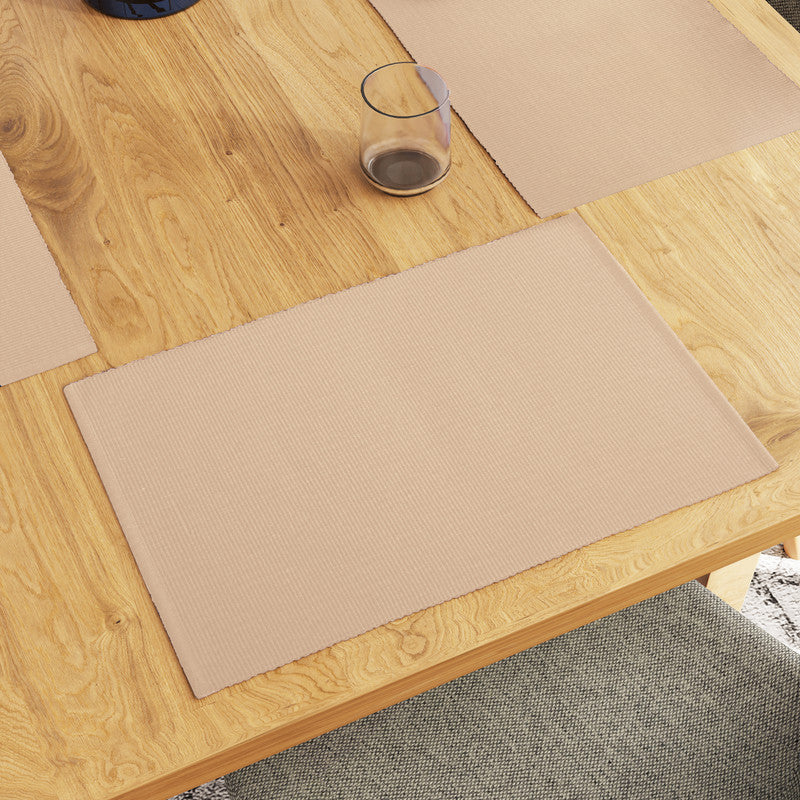
The colour sorting step is quietly one of the most useful parts. Shred only the navy offcuts together and the fibre that comes out is navy, so you can spin and weave a navy cloth without sending it through a dyehouse at all. That is what the yarn in our ribbed table linen is: recycled cotton that skips wet processing.
One distinction to know before anyone quotes a percentage at you. Pre-consumer recycled cotton is factory waste, the offcuts from cutting tables, which never reached a customer. Post-consumer is genuinely used clothing and household cloth. Post-consumer is the better claim, and also the more technically awkward one.
India sits at the centre of this trade. Panipat in Haryana, which the BBC and others have dubbed the cast-off capital of the world, is a cluster built after Partition and rebuilt in the 1990s on second-hand Italian machinery from Prato. Container loads of the world's discarded clothing land at Kandla port, travel north, and are pulled apart by hand and machine into fibre that gets spun again a few hundred kilometres from where Indian cotton grows. How much passes through is anyone's guess: published estimates range from about a hundred thousand tonnes a year to more than ten times that, which tells you something about how informally the trade is counted.
Can you feel the difference?
Probably not. Recycled cotton is cotton. It absorbs, breathes, creases and washes like cotton, because it is the identical fibre with a shorter working life behind it. There is no plastic hand, no synthetic slickness, none of the faint clamminess of a polyester imitating a natural fibre. Put a recycled cotton napkin next to a virgin one and the difference is not something a hand picks up.
What the label does not tell you is that shredding costs fibre length. A 2022 study in Heliyon by Arafat and Uddin measured it: virgin cotton at 28.3 mm, pre-consumer recycled at 22.2 mm, post-consumer at 18.9 mm. More telling is the share of very short fibres, those under about 12.7 mm, which rose from 10 per cent in virgin cotton to 35 per cent pre-consumer and 45 per cent post-consumer.
Short fibres are what make a yarn hairy. Hairy yarn is what pills, sheds lint and feels slightly rougher. So a fabric spun from nothing but post-consumer recycled cotton would, in fact, feel different, and not in a good way.
The reason your recycled cotton runner does not feel like that is partly the blend and partly the weave. A maker who knows the fibre is shorter can build the cloth to compensate with heavier ply and tighter construction. The mats and runners in our ribbed range use 12-ply yarns rather than the 4 or 5 ply typical of coarser ribbed mats, and that extra yarn is doing quiet work covering for a shorter fibre. On the solid beige placemats it is why the surface reads smooth instead of slubby.
How much water recycled cotton actually saves
This is where recycled cotton has its strongest argument, and where a lot of what you read overstates it.
Cotton is unusually thirsty in the way that matters. Mekonnen and Hoekstra's 2011 assessment in Hydrology and Earth System Sciences put cotton lint at just over 9,100 litres per kilogram: 5,163 litres of green water, 2,955 of blue and 996 of grey. What makes cotton stand out is not the total but the split. Green water is only 64 per cent of what the crop consumes. Across the fourteen crop categories in the same study that share never drops below 71 per cent, and most sit above 80, so cotton leans on irrigation harder than the crop groups it is counted alongside. The bed sheet above tilts further towards irrigation still, because that figure follows cotton back to the countries that actually export it, and those lean on irrigation harder than the world average does.
Indian cotton looks alarming in the 2006 figures, mostly for the wrong reason. They put Indian seed cotton at 8,662 cubic metres per tonne against a world average of 3,644. Seed cotton is the raw picked crop rather than spinnable lint, so those numbers are not comparable with the one above. And of India's 8,662, some 6,512 is green water. Its irrigation figure of 2,150 is lower than what the same table gives for Pakistan, Uzbekistan or Egypt. The gap is largely a yield problem: Indian fields produce less cotton per hectare, so the same rain is spread across fewer kilograms.
A 2016 life-cycle assessment by Miljögiraff, commissioned by H&M, is the fullest public comparison of recycled against virgin, measured per tonne of cotton fibre ready for spinning.
| Per tonne of fibre ready to spin | Recycled | Virgin (Cotton Inc. data) | Virgin (Ecoinvent data) |
|---|---|---|---|
| Water use, cubic metres | 635 | 2,740 | 10,801 |
| Climate impact, kg CO2 equivalent | 381 | 1,958 | 3,310 |
| Fossil energy, megajoules | 5,749 | 15,000 | 34,699 |
The two virgin columns are two published datasets for the same material, and they disagree by nearly four times. Recycled fibre therefore uses somewhere between 77 and 94 per cent less water, and that spread is a live argument between databases rather than carelessness by anyone. If you want a tie-breaker, Mekonnen and Hoekstra's own figure for finished cotton fabric, 9,982 litres per kilogram, sits close to the higher column. The carbon and energy rows point the same way and are less contested: 381 kilograms of CO2 against 1,958 even at the most conservative virgin baseline, and under half the fossil energy. The widely repeated claim that recycling a kilogram saves 20,000 litres does not appear to trace back to any published study.
Dyeing deserves a caveat of its own. Skipping the dyehouse saves real water, but less than you would think. On Mekonnen and Hoekstra's figures, going from lint all the way to finished fabric adds roughly 870 litres per kilogram, under a tenth of the total. So when the kitchen towels say recycled cotton reduces the waste of water and dyes, the dye saving is real but small beside the one that comes from never growing the cotton.
Why is there polyester in recycled cotton fabric?

Those fibre lengths are the reason. A ring spinning frame needs fibres long enough to be gripped, twisted and held against each other, because that friction is what stops a yarn pulling apart. Feed it 18.9 mm fibre with 45 per cent of it shorter than 12.7 mm and the yarn either breaks on the machine or comes off weak and hairy.
The fix is to blend. Mix short recycled fibre with something longer and the long fibres carry the load while the short ones fill in. That partner is either virgin cotton or polyester. Polyester gets the job because it is cheap and strong and its staple length is chosen rather than grown, so a modest percentage buys back a lot of tensile strength.
That sets a ceiling the industry does not advertise. In the Heliyon work the researchers could push a commercial ring frame to 30 per cent recycled content at most, and judged the limits for knitted fabric to be 25 per cent for pre-consumer waste and only 10 per cent for post-consumer. H&M's own statement in that 2016 assessment put its production limit at 20 per cent. Those are three different kinds of limit, a spinning ceiling, a fitness-for-purpose judgement and a company policy, and other spinning systems handle short fibre better than a ring frame does, so treat them as the shape of the constraint rather than a hard rule for every mill. What they do rule out is a fine, soft, ring-spun cloth that is genuinely 100 per cent recycled cotton.
There is a way round it, and India is good at it. Chindi rugs are made by weaving whole strips of offcut cloth instead of spinning them, so the fibre-length problem never arises, and a handwoven chindi rug can be almost entirely reclaimed cotton because it was never asked to become yarn. The trade-off is that the technique gives you a rug, not a shirt.
The polyester, then, is an engineering compromise rather than a corner cut. It is what using a fibre that has already lived once actually costs, and a modest recycled content in a cloth that survives years of washing does more good than a bigger number on one that does not.
What a recycled label has to prove
Two certifications from Textile Exchange cover most of what you will see. The Recycled Claim Standard applies to products with 5 per cent or more recycled content and tracks it through the supply chain. The Global Recycled Standard sets the bar at 20 per cent to certify, requires 50 per cent before a product can carry the GRS label itself, and adds social and chemical requirements on top. The 50 per cent threshold belongs to GRS alone, which is the detail most often garbled. And GRS covers less than people assume: its own manual states that it does not address chemicals already present in the reclaimed material or in the finished product. It governs how the recycling is done, not what the old clothes had on them.
For Indian shoppers there is now a legal backstop. The Central Consumer Protection Authority issued greenwashing guidelines in October 2024 requiring environmental claims to be specific and backed by verifiable evidence, with words like eco-friendly no longer usable as decoration. So ask any product page for three things: what percentage is recycled, whether it is pre-consumer or post-consumer, and who certified it. Our own table linen pages state that the yarn is recycled cotton and skips wet processing, but not what percentage.
Where recycled cotton earns its place at home

Recycled cotton suits things that are washed often, seen at close range and not asked to bear much load. Table linen is close to ideal. A runner or a set of mats gets wiped, spilled on and washed weekly, so the fibre never does anything structural, and the heavier construction that recycled yarn encourages is exactly what stops a mat curling at the corners. Because these sets fade together rather than separately, buying the runner and placemats from one dye lot saves you the mismatch you get when you replace whichever piece is ruined first.
Kitchen towels are the other easy win, for a reason specific to the fibre. A tea towel's whole job is absorbency, and a slightly hairier, shorter-staple yarn has more surface area to soak with. On the striped kitchen towels the technical drawback quietly becomes the functional advantage.
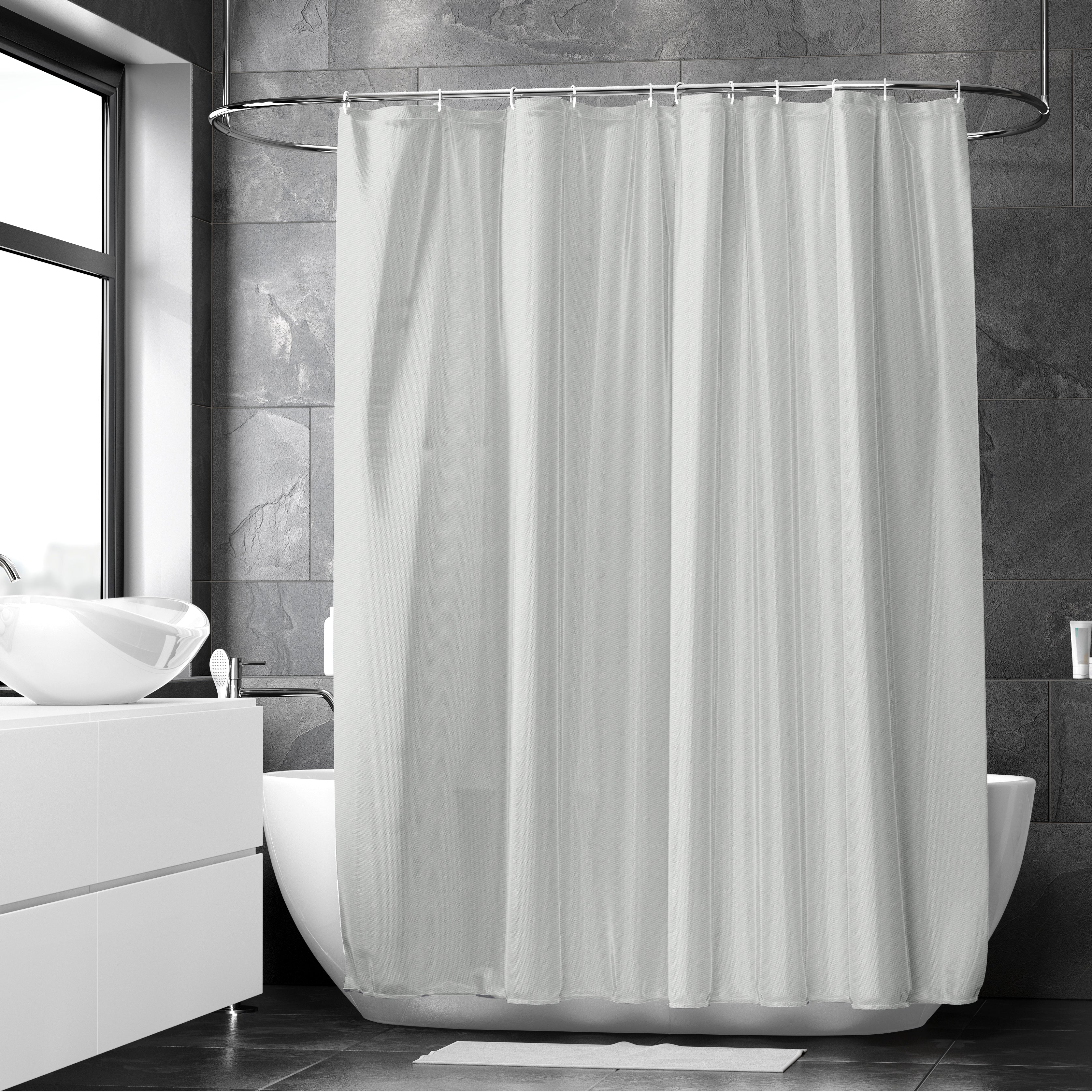
Anything large, heavy and expected to hang well for years needs more thought. A 200 gsm checked tablecloth works because the weight sits in the weave and the cloth lies flat rather than hanging under its own load. Curtains are the opposite case: a nine-foot drop puts fabric in permanent tension, which is the one thing shorter fibres are worst at. Recycled cotton curtains are rare for that reason.
Shorter fibre is also a reason to be careful the first time a piece goes through water, whatever the care label promises about minimal shrinkage. Cold wash it on its own, line dry, and buy a runner a few centimetres longer than the measurement you took.
Questions people ask
Is recycled cotton the same as organic cotton?
No, and they solve different problems. Organic cotton is grown without synthetic pesticides and fertilisers, so it is still a new crop using new land and new water. Recycled cotton is not grown at all. A fabric can be both, but organic certification tells you nothing about recycled content and the reverse is equally true.
Will recycled cotton pill more than regular cotton?
At the blend levels actually sold, usually not enough to notice, because most of the yarn is still full-length fibre. Pilling risk goes up with the recycled percentage and with post-consumer rather than pre-consumer waste, so the more impressive the claim on the label, the more you should look at how tightly the cloth is woven.
Does recycled cotton cost more or less?
Usually about the same, sometimes a little more. Collecting, sorting and shredding old cloth is labour-intensive, and the blending and extra quality control add cost, so recycled yarn is not automatically cheaper than virgin. What India has going for it is that the sorting and spinning happen domestically, which takes a long freight leg out of both the price and the footprint.
How can I tell if a fabric is recycled just by looking?
Usually you cannot. Occasional flecks of a contrasting colour in a plain cloth are a hint, since colour-sorted batches are rarely perfect. Beyond that you are relying on the label, which is why the percentage and the certification matter more than any hand test.

Leave a comment
This site is protected by hCaptcha and the hCaptcha Privacy Policy and Terms of Service apply.