
Pick up a pack of oven mitts and the photo on it is usually a roast tray coming out of a big oven. Look at what actually gets hot in an Indian kitchen on a weekday and the list is different: a kadhai with two small metal ear handles, a steel patila with no handles at all, a tawa, a pressure cooker letting off steam, and perhaps an OTG on the counter that comes out at the weekend.
For that list, a pair of potholders does more of the daily work than a pair of mitts. Potholders are flat, they fold around a small handle or a rim, and two of them let you lift a vessel with both hands. A mitt earns its place when your wrist and forearm have to go near the heat: into an OTG, over spitting oil, or close to steam. Most kitchens that use an oven at all end up wanting both, kept in different places.
What are you actually gripping?
The useful question is what shape of hot thing you hold most often. Indian cookware has a few common ones, and each wants a different grip.
A kadhai usually has two loop handles, one each side, made of the same metal as the pan. They get as hot as the pan does, and they are small, so you hold them between thumb and fingers. Lifting a full kadhai off the flame takes both hands.
A patila, a steel dabba or a handi often has no handles at all. You lift it by the rim, which is thin and hot. Many kitchens keep steel pincer tongs, sold as a pakkad or sandasi, for exactly this, and that works for draining or tipping. For carrying a full pot of dal across the kitchen, two hands on the rim feel safer.
A tawa's own handle is often wood or plastic and stays fairly cool. The hot moments come when the handle is metal, or when you steady the far edge to tip a roti out.
A pressure cooker's handles are usually plastic. The danger there is steam, at the whistle and again when the lid comes off, and steam reaches the wrist and forearm as easily as the palm.
An OTG or oven is the odd one out. The tray is easy to hold, but your hand, wrist and part of your forearm go into a hot box with heating rods above and below, and that is where a mitt makes sense.
Why a pair of potholders suits stovetop cooking

Look back at that list and most of it is small handles and thin rims, gripped for a few seconds, close to the flame. A flat square is good at that. It folds around a kadhai's ear handle so your fingers can still feel where the metal is. It pinches a patila's rim. It can sit over a hot lid knob while you lift the lid. You can drop it on the counter in a second when you need your hand back for the ladle.
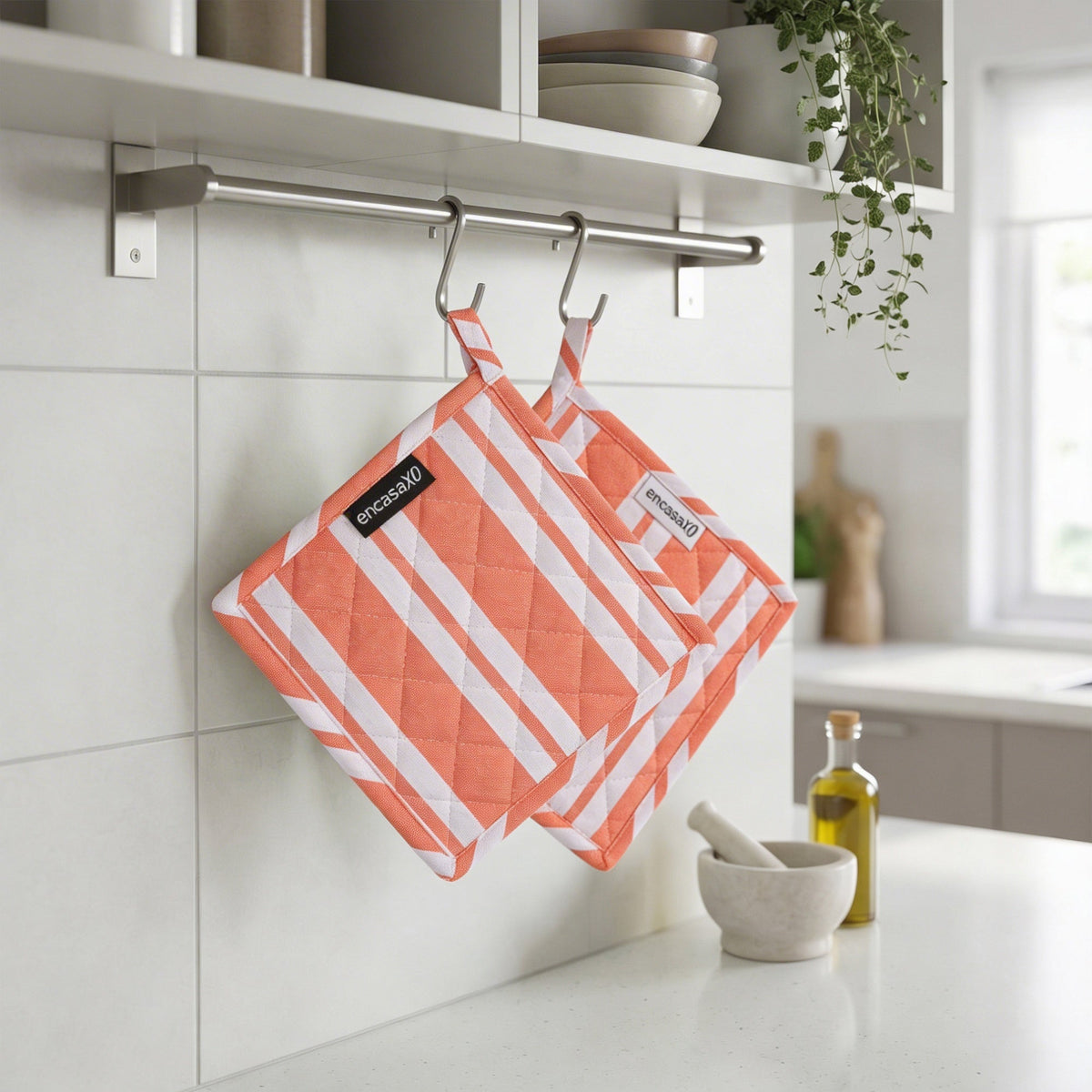
And because potholders usually come as a pair, like the Franca orange stripes potholders pictured, you have two hands. This matters more than people expect. One easy way to get burnt is to wear one mitt, lift the kadhai by one ear handle, then reach for the other handle with whatever is nearby: the end of a dupatta, or a dish towel that is a little damp from wiping the counter. The mitt did its job; the second hand had nothing.
What a potholder cannot do is cover your wrist. During a tadka, when cumin and mustard seeds go into hot oil and start to spit, or while you deep-fry puris, the oil lands on the back of the hand and the wrist. A square of cloth in your palm does nothing for that.
When is an oven mitt worth it?

When your forearm is near the heat, or when the heat comes at you from more than one side. That means the OTG tray, the grill rack, a dish from a larger oven like the blue leaf-print mitts above are lifting, and a hot bowl out of the microwave. It also means standing over a kadhai of hot oil, where a cuff that reaches past the wrist keeps the spatter off skin.
The price you pay is feel. A mitt puts four fingers in one pocket and a thick layer between you and the handle, so pinching a thin rim or a small ear handle is clumsy, and you feel less of whether the grip is secure. For a weekday kitchen with no oven in use, a mitt can end up being the thing you reach past.
How thick a mitt needs to be, and why a damp one stops protecting you, is covered in our oven gloves buying guide. The short version that matters here: dry and quilted beats thin and pretty, for potholders as much as for mitts.
Which tool for which job
| Job | Better tool | Why |
|---|---|---|
| Lifting a full kadhai off the flame | Two potholders | Two small metal handles, both hot, gripped with fingers |
| Carrying a handleless patila or handi | Two potholders, or a pakkad for tipping | You grip a thin rim, and a mitt is too bulky to pinch it |
| Lifting a hot lid by its knob | Potholder | Quick, small grip; a mitt works but is slower |
| Tadka or deep-frying | Oven mitt on the hand holding the kadhai | Spitting oil reaches the wrist |
| Taking a tray out of an OTG | Oven mitts | Hand and forearm go into a hot box |
| Hot bowl out of the microwave | Either | Short reach; a mitt covers more, a potholder grips the rim better |
| Setting a hot vessel down on the table | A trivet | Neither is built to sit under a pot through a meal |
Terry or quilted cotton for a potholder?
You will see both. A terry potholder is towel fabric, thick and soft, and it soaks up water easily. That is the problem with it at the stove: hands are often wet, and a potholder that absorbs water carries heat through much faster than a dry one. The oven gloves guide explains why.
Quilted cotton is a flat woven face over a layer of padding, stitched through in lines or squares. The stitching holds the padding in place, so after many washes the filling does not drift into one corner and leave a thin spot in the middle.
Either way, the test is the same one you would use on a mitt. Pinch the middle of it between two fingers and feel how much is there. A thin, single-layer square that looks nice on a hook is decoration.
Picking a potholder and a mitt from Encasa's range

For the stovetop, the newer Franca potholders pictured earlier come as a pair of 8 x 8 inch (about 21 cm) quilted cotton squares with thick cotton padding and a 2 inch hanging loop, at ₹299 for the two. Eight inches leaves enough cloth to fold around a kadhai's ear handle. The same line comes in yellow and lime stripes as well as the orange. If two people often cook at once, or you want one pair in the wash and one on the hook, the potholder range also has packs of four.
For the OTG and the frying, the Franca beige stripes oven gloves are 30 cm long, which the listing says reaches past the wrist onto the forearm. They are built in three quilted layers and rated for up to 220°C, at ₹499 a pair. Check the oven gloves collection for other prints if the beige will not suit your kitchen.
Where they hang matters as much as which ones you buy. Put the potholders on a hook right by the hob, away from the sink, so they stay dry and are in reach when the kadhai is already hot. The mitts can live next to the OTG.
Common questions
How many potholders does a kitchen need?
Two at the very least, because a kadhai and a handleless patila both need two hands. Four is easier to live with: one pair in use and one pair drying after a wash, so no one reaches for a damp towel while the clean pair is still wet.
Can I use a potholder as a trivet?
It will do in a pinch, and some potholder listings suggest it. Through a whole meal, though, a hot pot sitting on it presses the padding flat and heats it through, and that padding is the part your hand relies on next time. A trivet is cheap and built for that job.
Potholder or pakkad for a steel patila?
A pakkad grips the rim with one hand, so it is good for tipping a patila to drain it or pour out tea. For carrying a full, heavy pot, two potholders and two hands on the rim are steadier, because the pakkad can slip if the vessel swings.
Are oven mitts any use without an oven?
Yes, for frying and tadka, and for a hot microwave bowl. If none of those happen in your kitchen, a pair of potholders alone will cover almost everything a stovetop asks of you.
Encasa XO is our own brand, and the potholders and oven gloves named here are ours.

Leave a comment
This site is protected by hCaptcha and the hCaptcha Privacy Policy and Terms of Service apply.