
Second evening of Diwali, fourteen people in a room that seats six. The sofa has gone to the aunts and two cousins are perched on its arms. Everyone under thirty has drifted down to the floor, backs against the sofa base and plates on their knees, and by half past nine somebody has fetched folded razais from the bedroom, because an hour on cold tiles stops being funny.
Sitting on the floor is not an emergency measure in an Indian house. It is what happens when the room fills up, and nobody buys a second sofa for one week in November. What the floor is short of is a seat.
A floor cushion is that seat: a thick, filled square or circle that goes straight on the ground and lifts you a few inches off it. In the Encasa range it comes in three sizes, 40, 50 and 60 cm across, and it arrives already filled, so there is no insert to buy and nothing to stuff. For general adult use, 50 cm is the sensible starting size, though the right size follows from how you plan to sit rather than from how big the room is.
What you are buying, and what it is not
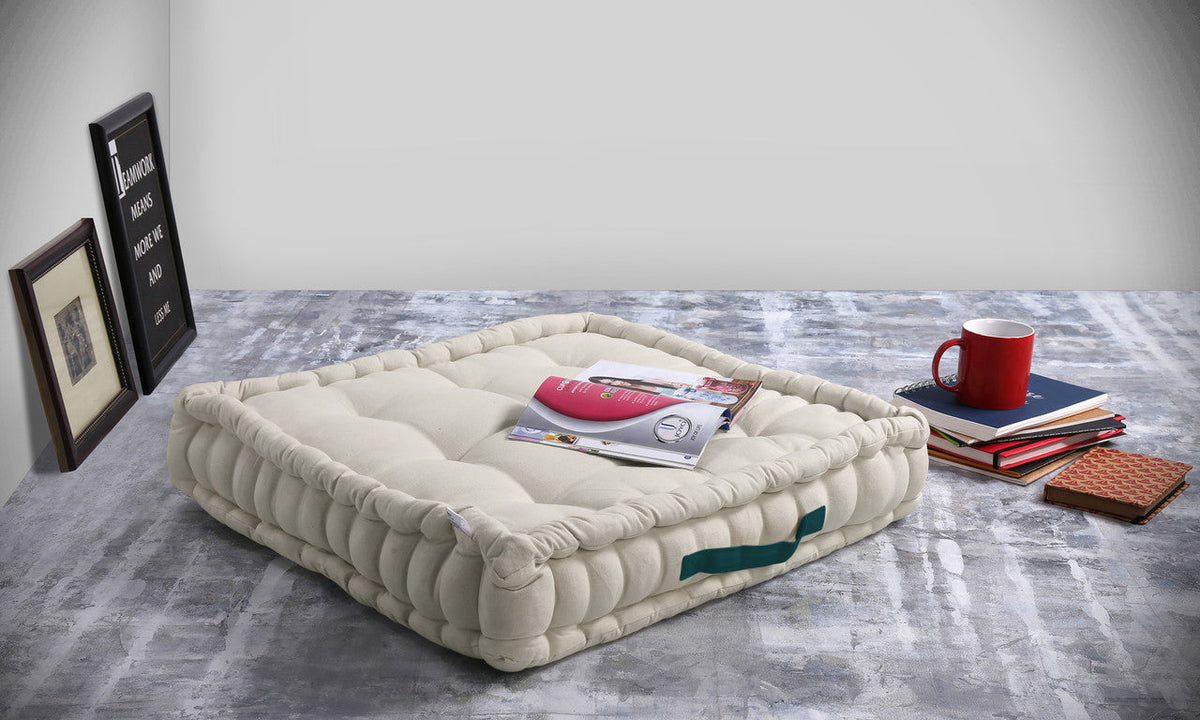
A floor cushion looks like a large cushion cover and behaves like a small mattress. The Encasa ones are half panama cotton, filled with micro-fibre and stitched through the face at five points so the filling cannot migrate to the edges the first time somebody drops onto it. The sides are boxed rather than rounded, which is why the shape holds when you sit near an edge instead of folding under you.
That construction separates this product from the thing most people picture when they hear the word cushion. A cushion cover is an empty bag of fabric in 30 to 60 cm sizes that you fill yourself with an insert, and if that is what you are shopping for, the cushion cover size guide is the right page. A floor cushion is finished. You take it out of the packet and sit on it.
What size floor cushion should you buy?
| Size | Depth | Who it seats | Typical price |
|---|---|---|---|
| 40 x 40 cm | 8 cm | One adult sitting upright and cross-legged, a child, or a pad on a hard chair | under ₹1,000 |
| 50 x 50 cm | 10 cm | General adult seating: floor dinners, an evening in front of the TV | about ₹1,200 to ₹1,400 |
| 60 x 60 cm | 10 cm | The widest seat in the range, with room to shift your weight around | about ₹1,600 to ₹1,900 |
Round costs a little more than square at the same size, on the order of ₹200, for the same fabric and the same filling. Two colours, purple and egg blue, sit outside the ladder: they stop at 50 cm and offer a slimmer 8 cm version of it, so check the shade you want against the size you want.
The 60 cm cushion is about 24 inches across, the same footprint as the largest sofa cushion cover commonly sold here. At that size you sit comfortably cross-legged with room to lean. You do not stretch out on it or share it. Guides written for other markets can leave a different impression: the New Zealand home brand Wilson and Dorset calls 36 by 36 inches, or 91 by 91 cm, the standard size for a floor cushion. That describes the market it sells into, where a floor cushion is closer to a beanbag or a low daybed. At more than twice the area of a 60 cm cushion it is a different object, priced accordingly, and nothing in the Encasa range is trying to be it. If you want to lie down, you want a gadda.
Meditation cushion, or something to sit around on?

Search for floor cushions and a fair number of the results that come back are meditation cushions. They are not the same thing, and the difference is physical.
A traditional zafu is small and deliberately firm. Its only job is to raise your hips above your knees so a cross-legged spine can stack up straight and stay there without your lower back complaining. Soft is the enemy: if it compresses to nothing, your hips drop and the posture goes. A lounging floor cushion has the opposite brief. It is wider, softer, and meant for slouching against a wall with a phone.
Encasa's round cushions are sold for both uses. In the photograph above, which is the brand's own, the sitter is upright, her hips sitting high on the cushion and her knees dropping below them past its edge, and that is what a hip lift looks like in practice. For seated practice the smallest round cushion at 40 cm is the closest match, because a wider seat pushes your feet further out and works against the posture. For sitting around on, go up a size. Micro-fibre gives underneath you either way, so a cushion that feels firm when you sit down settles softer as the evening goes on. The Cotton Mint Green round comes in all three sizes on the same build, so the decision there is only about posture.
Round or square?

Round cushions sit alone well. They have no orientation, so a round cushion left at an angle still looks placed rather than shoved aside, which matters for the ones that stay out: a single seat beside a low chowki, the corner where somebody sits for pooja, the spot by the balcony door where one person reads. In a narrow room you also walk around a circle more easily than a square.
Squares are for lining up. Put four along the wall below a diwan and the edges meet, so the row reads as a bench rather than as cushions that happen to be near each other. Squares also tuck into corners without leaving triangles of empty floor, and they stack flat.
The handles differ too. The square cushions carry a flat strap in a contrasting colour on one edge, easy to grab from standing; the round ones have a loop in the same fabric on the side wall, less visible and less convenient. If the cushions get carried between rooms a few times a year, the strap earns its keep. On the Cotton Natural and Azul Blue square that strap and the tufting threads are both dark teal against an off-white body, so the contrast is clearly deliberate.
Where floor cushions actually go in an Indian home
The seating traditions here already assume the floor. A baithak is a low seating area built on a mattress or diwan base with a dhurrie underneath, cushions to sit on and bolsters to lean against, arranged around a low table. A floor cushion fills the sit-on-it role in that arrangement and nothing more.
Put something under the seating area. A cushion on bare polished tile or marble will skate the moment somebody lands on it at an angle, and cotton on stone gathers dust from the whole room; a dhurrie or cotton rug settles both. Give people something to lean on as well, because sitting upright is fine for a meal and tiring for a film, which is why a baithak has always had a wall, a diwan base or a bolster behind the cushions.
Then buy for the crowd rather than for the average evening. The eight people who arrive for Diwali or a griha pravesh are the reason this purchase exists, not the two who live there. Four or six identical cushions read as seating; the same number in four colours reads as clutter, and a floor cushion is big enough that its colour is a room decision rather than an accent. If they will be out for a week at a time with tea going round, a dark neutral such as Cotton Charcoal Grey takes that better than an off-white and disappears against most rugs the rest of the year. Bright shades make more sense for cushions that come out for one evening and go back in the cupboard. Either way you are buying one colour several times over, so the check before ordering is whether that shade exists in the size and the quantity you need: the range runs to roughly two dozen solids and a handful of two-tone combinations.
Filling and care: why you wipe these rather than wash them

Floor cushions are filled with several different things, and they do not feel alike. Foam holds its shape and sits slabby, closer to a low stool than a cushion. Buckwheat hulls shift under you and pack down firm, which is why many meditation cushions use them, but they are heavy to carry and they rustle. Kapok, a fibre from a tree that grows in parts of India, is naturally water-repellent. Micro-fibre, which is what these are filled with, is the light and soft end of that range: it springs back, and it flattens where a person sits, so a cushion that has held a guest all evening wants shaking out rather than being left compressed under the coffee table.
These are not machine washable, and the reason is physical rather than fussy. A 10 cm block of fibre fill takes in a lot of water and gives it back slowly, and fabric that stays damp at the core starts to smell. Try it during a coastal monsoon, when thick things struggle to dry indoors at all, and you are working against the weather. Encasa's instruction is to wipe with a damp cloth, hand wash in cold water if it really needs it, and dry under a fan rather than in direct sunlight. The maker also states that the colours will not run, while advising that dark shades be washed separately, which is sensible treatment for any deep dyed cotton in its first wash.
Treat it the way you would an upholstered seat rather than a cushion cover: shake it out, vacuum it lightly, and deal with spills at once rather than soaking it later.
The filling that makes washing awkward is also what lets them store well, because it holds its own shape and a stack does not slump: Encasa puts four to six of the 8 cm cushions on top of one another, which is a pile of mint green rounds roughly knee high in a corner. That is why six of them are liveable in a two-bedroom flat where they are wanted a few weeks a year.
A short checklist
- Posture first: cross-legged and upright points to 40 or 50 cm, leaning and lounging to 50 or 60 cm.
- Count the guests, not the residents.
- Round for a seat that stands alone, square for a row along a wall.
- A rug or dhurrie underneath if the floor is tile or marble.
- Buy a colour you can live with dirty. There is no cover to take off and wash.
Common questions
Can floor cushions be washed?
Not in a machine. Wipe the fabric with a damp cloth for ordinary marks, hand wash in cold water only if you must, and dry under a fan rather than in the sun. The filling is sewn in, so anything that soaks the cushion has to dry out of a 10 cm thickness, which takes days in humid weather.
What is the difference between a floor cushion and a meditation cushion?
A meditation cushion, or zafu, is small and firm, and exists to tilt your pelvis forward so a cross-legged spine stays upright. A floor cushion is wider and softer and exists to keep you off a hard floor. The smallest sizes overlap, which is why one product is often sold for both.
How many floor cushions do I need for a floor seating area?
Work backwards from the arrangement rather than from a rule. Four along the wall below a diwan or sofa gives a bench for four; two loose ones get pulled up to a low table or handed to whoever arrives late. That is where a set of six comes from, and since they stack, the spares cost cupboard space rather than floor space.
Do floor cushions slide on tiled floors?
Cotton on polished tile has very little grip, so yes, particularly when somebody sits down at an angle. There is no rubber backing on these. A rug or dhurrie under the seating area is the fix.

Leave a comment
This site is protected by hCaptcha and the hCaptcha Privacy Policy and Terms of Service apply.