
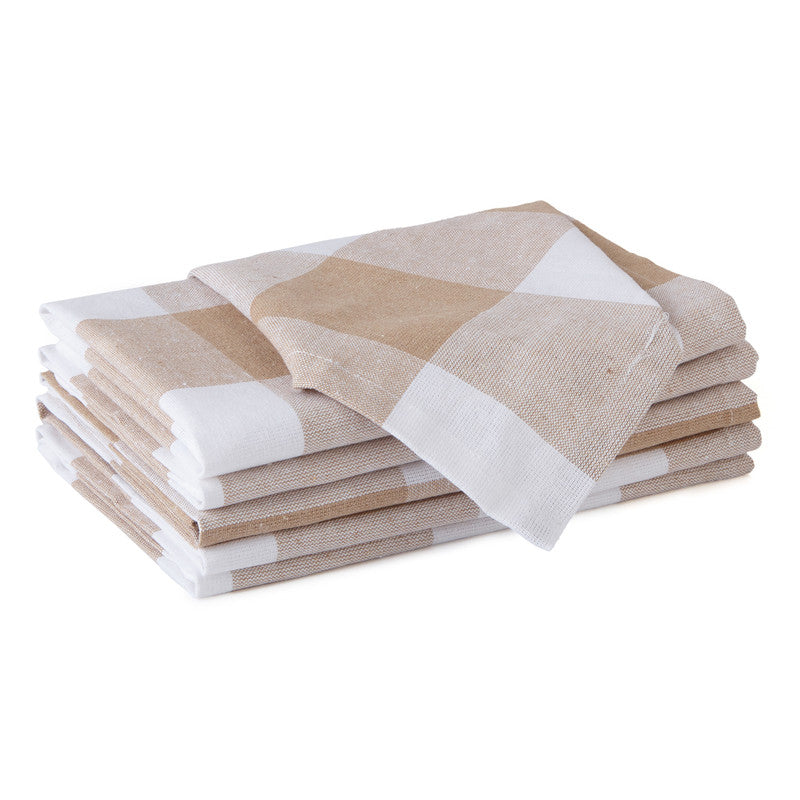
A family of four that uses a paper napkin at every lunch and dinner goes through more than 2,900 of them in a year. That is four people, two meals, 365 days. Nobody notices the number, because it arrives a packet at a time.
Cloth napkins turn that running cost into a one-time one. A good set is cotton, 43 cm square for meals and 23 cm for drinks, and a home needs roughly two to three napkins per person plus a few spare for guests. The rest of this guide is about why those numbers work, and where they stop working.
Cloth vs paper napkins: what a year actually costs
The paper side of the sum depends on what you pay, so do it with your own packet. Take the price of one pack, divide by the count, and multiply by the 2,920 napkins above. Whatever your brand, that figure repeats every year.
The cloth side is mostly paid once. At current prices a pack of twelve 43 cm cotton napkins costs ₹999 on this site, which is about ₹83 a napkin. A pack of six yarn-dyed check napkins is ₹759, about ₹127 each. A family of four needs one pack of twelve to start, so the upfront cost is about the same as a few months of mid-priced paper napkins.
What cloth adds is washing. Napkins are small and go in with a normal load of towels or kitchen linen, so they rarely need a wash of their own. The real cost is the bit of water and detergent they take up in a load you were running anyway, and the time to fold them.
There are two catches. First, cloth does not suit every job. Wiping up spilt dal from the floor, or a toddler's hands after mango, is still a paper or old-rag job, because you do not want turmeric or mango sap setting into a napkin you put out for guests. Second, a cloth napkin used once and thrown in a damp basket for three days will smell and may spot with mildew in monsoon. The saving only holds if you wash on a rhythm.
Which fabric is best for cloth napkins?
A napkin has one job, which is to take moisture and grease off hands and lips. That makes absorbency the first test and how the fabric behaves after many hot washes the second. Looks come third.
| Fabric | Absorbency | After many washes | Feel | Best use |
|---|---|---|---|---|
| Cotton (plain weave) | High | Softens, may shrink a little on the first wash | Soft, matte | Everyday meals |
| Mercerised cotton | High | Keeps a slight sheen longer | Smooth, a little lustre | Guests, festive tables |
| Yarn-dyed cotton checks | High | Pattern stays on both faces | Thicker, homespun | Daily use that hides stains |
| Linen | High, dries fast | Gets softer, creases easily | Crisp, then soft | Dry heat, if you like the crumpled look |
| Polyester | Low, tends to smear | Holds shape and colour well | Slippery | Decorative folds, not wiping |
| Cotton-poly blend | Middle | Fewer creases than cotton | Firm | Catering, high-wash use |
Cotton wins for most Indian homes, and the reason is food more than climate. Our meals are oily and often eaten by hand. A napkin that smears ghee around instead of soaking it up is close to useless, and that is what polyester tends to do. It does have one place: a polyester napkin holds a sharp fold for a fan or a bishop's hat better than cotton does, so it works for display.
Linen is the lovely one and also the awkward one. It handles moisture well and dries quickly, but it creases the moment you look at it, and it costs more. If you iron nothing, you will either learn to like the crumpled look or stop using it.
Weight matters too, though less than people think. The plain dyed cotton napkins here state 180 gsm on the product page, and the yarn-dyed checks state 225 gsm. The heavier check feels thicker in the hand and the woven pattern shows on both sides, which helps hide the faint turmeric shadow that sometimes survives a wash.
How many cloth napkins does a home need?
Work from how often you wash, not from how many people sit at the table. If napkins go in the machine twice a week, each person needs enough for three or four days, plus a buffer for the batch drying on the line.
Here is the rough sum, assuming one napkin per person per day (a napkin can do lunch and dinner if it is only used for hands and lips) and a wash twice a week:
| Household | Daily napkins | Plus guests | Sensible total |
|---|---|---|---|
| Couple | 6 to 8 | 4 | 12 |
| Family of four | 12 to 14 | 6 | 18 to 24 |
| Family of six, or joint family | 18 to 20 | 6 to 8 | 24 to 30 |
The worked case: a family of four that washes on Wednesday and Sunday needs four napkins a day for four days, which is 16. A pack of twelve covers daily use only if you are disciplined about washing. Add a pack of six for guests, ideally in a different colour, and the everyday set never gets raided when people come over.
A household that uses a fresh napkin at every meal should double the daily column. Children under ten often do, because their napkin is done by the end of lunch.
Sizes, briefly
There are two sizes worth owning. The dinner napkin is 43 cm square, about 17 inches, big enough to cover a lap. The cocktail napkin is 23 cm, 9 inches, made to wrap round a glass or hold a samosa. A 45 cm size exists and is barely different from 43 cm. The full breakdown, with drawings to scale and the price bands, is in the table napkin size guide, so there is no need to repeat it here.
Do you need cocktail napkins?
Most homes can skip them for daily use. Where they earn their place is the evening with drinks and snacks, when a full dinner napkin feels like too much cloth to hand someone holding a glass. If you host often, a pack of twelve is enough, since guests rarely use more than one each.

The useful trick is to buy cocktail and dinner napkins in the same design. The grey chambray napkins are sold in 23, 43 and 45 cm on one listing, so the small ones match the dinner set when drinks turn into dinner. For a plain set in one of many colours, the cocktail napkins collection has the solid-dyed cotton in 23 cm packs of twelve.
Putting it together for your table

So the choice for most homes comes down to two packs. For the everyday set, a family that eats with their hands and cooks with oil should pick cotton, and a check or stripe hides marks better than a pale solid. The beige buffalo check six-pack is the 225 gsm yarn-dyed cotton in 43 cm, and at ₹759 it is one of the cheaper cotton options in the table napkin range.
For the guest set, pick something you would not mind seeing stained once a year. A plain solid in 180 gsm cotton, like the azul blue pack of twelve, reads as dressed up without being precious, and comes in 43 cm or 23 cm.

Festivals are the one time to go further. The embroidered festive napkin is mercerised cotton with a gold and silver lotus stitched in one corner, sold as a set of six at 45 cm. At ₹3,499 it is not a daily napkin, and it is not meant to be. Keep it for Diwali dinner and wash it on its own.
Once you have the napkins, folding and placement are their own small skills. The guide to how to fold napkins covers the folds that hold in cotton, and how to set a dining table shows where the napkin goes.
FAQ
Are cloth napkins hygienic for daily use?
Yes, as long as each person has their own and the set is washed every few days. Wash at the temperature on the label, 30°C for the plain dyed cotton and 40°C for the yarn-dyed checks here, and dry fully, ideally in sun. A napkin left damp in a basket is the real hygiene risk, not the cloth itself.
How do you get oil stains out of cotton napkins?
Treat them before the wash. Rub a drop of dishwashing liquid into the mark, leave it for ten minutes and then wash as normal. Dish soap is made to break up grease, which plain laundry detergent handles less well on a set stain.
Should cloth napkins be ironed?
Not if they are for everyday use. Fold them flat while still slightly warm from the line and most of the creases fall out. Iron only the guest set, and only if you want a crisp fold.
Can I use kitchen towels as napkins?
You can, but they are usually larger and rougher, made to dry dishes rather than touch a face. They work for a casual meal outdoors. For the table, a proper napkin is softer and the right size.

Leave a comment
This site is protected by hCaptcha and the hCaptcha Privacy Policy and Terms of Service apply.