
The coir mat at the front door earns its keep for ten months of the year. Then the rains arrive, it soaks through by the second week of June, and instead of scraping mud off your shoes it starts pushing a wet brown smear across the threshold. That mat has not failed. It is being asked to do a job it was never built for, in weather it cannot handle. A doormat's whole job changes with the door it guards and the season it is guarding it in, so "which doormat should I buy" is really three or four separate questions wearing one search box.
In an Indian home, most people already own more mats than they think, and most of them are the wrong ones. So before any brand names, it helps to sort out what actually separates a good mat from a bad one for each spot in the house.
What makes a doormat good depends entirely on the door
A mat at the main entrance has one job: take the dirt off shoes before it reaches your floor. That means a coarse, stiff surface, coir or rubber, something that scrapes. Softness is beside the point out there. A mat at the bathroom door has almost the opposite job: it meets bare, wet feet on a hard tile floor, so grip, quick drying and a soft landing underfoot matter far more than scraping power, and those needs do not always arrive in the same mat. In monsoon, the front-door mat needs to shed water rather than hold it, or it turns into a soggy sponge that spreads mud instead of stopping it. Stopping grit at the door is also the cheapest way to cut what settles indoors, which how much house dust walks in through the door works through in more detail.
One trap worth naming before you shop, because a lot of marketing copy blurs it. Anti-skid and absorbent are two different properties, and a mat can have one without the other. Buyers who compare anti-skid mats online keep landing on the same surprise: one person will report that a mat sold as anti-skid did nothing to dry their feet, while another finds a genuinely absorbent mat too thin and flat to grip a wet floor properly. A rubber-backed mat can grip beautifully and still not soak up a drop through its plastic face. A plush cotton mat can drink water and still slide on tile. Decide which one you actually need for a given door, because the label on the pack will not always tell you.
With that framework in hand, here are the picks, sorted by the door rather than ranked one to seven.
The best doormats for Indian homes, sorted by the door
Best combo pack for the whole home: Saral Home jute set
Three small mats in one order costs less than solving every doorway separately, and sellers bundle them for exactly that reason. If you are furnishing a home from scratch, a set that covers the front door, the back door and a bathroom together is the sensible first buy. Encasa doesn't make a mixed household bundle like this, so the pick here is Saral Home. Its Rosella range is jute with an anti-skid backing, sold in sets of two or three, in the 40x60 cm size that suits most secondary doors and in a few colourways including blue, green, grey and red. A two- or three-piece set sits comfortably under ₹600. One thing to know before you buy: jute is softer and less scratchy than coir, so these earn their keep a step inside the door rather than out on a gritty porch taking the first hit of mud.
Best anti-slip mat for the bathroom door: Home Centre bath mats
A bathroom-door mat's most important feature is that it will not slide out from under wet feet, and for that you want a mat whose maker explicitly builds and labels it as anti-slip. Home Centre does exactly that across a deep range: its Pristine Melange, Titania TPE, Bask and Corsica lines run from roughly ₹200 to about ₹1,400, in sizes from 40x60 cm up to 80x50 cm, with the anti-slip property called out on the product itself. Encasa sells plenty of absorbent microfibre and cotton bathmats that feel lovely and dry fast, but our own product pages make no anti-slip claim. If a guaranteed non-slip grip on wet tile is what you are after, this is a segment to buy from a maker who labels for it.
Best large mat for a wide main entrance: OnlyMat coir
At 120x60 cm, the tree-printed natural coir mat from OnlyMat is close to double the floor coverage of an ordinary mat, and that scale is the whole point of it. Most mainstream doormats cluster around 45x75 cm, which looks lost in front of a double door or a wide apartment entrance. This one is 100% coir, so it scrapes well and suits a covered porch, and it sits in a price band around ₹1,400 to ₹1,900. Encasa's own coir range tops out well short of that size, so for a genuinely wide doorway this is the tier to look at.
Best classic coir for the front door: Encasa coir

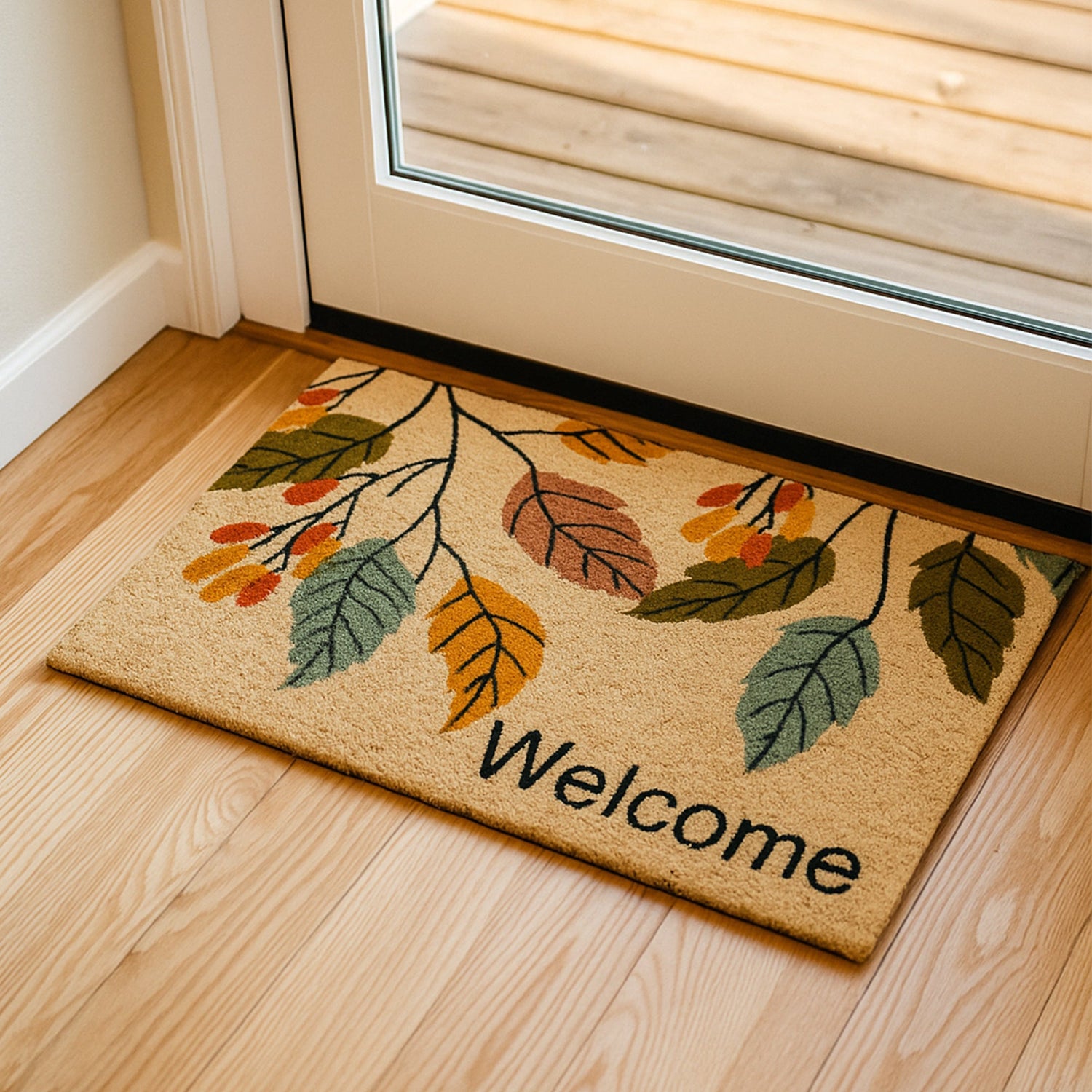
For the ordinary front door of an ordinary flat, the traditional coir mat is traditional for good reason: stiff coconut fibre is about the best thing going for knocking grit and dried mud off a shoe sole. Here we back our own catalogue, and the case rests on breadth. The Coir Welcome Leaf Door Mat is one of a wide coir range, Greek key, half-round, plain colourways and more, all with an anti-skid PVC backing so the mat itself stays put, in sizes 60x40 cm and 75x45 cm and price bands from roughly ₹550 to ₹1,450 depending on size and design. The full door-mat collection has the depth of colour and pattern choice a single competitor rarely matches. One aside for landlords and offices: there is also a pack of ten of a plain coir mat, which is a bulk quantity for kitting out many doors at once rather than a mixed household set. Whether a coir mat needs that backing at all, and the doors where coir is the wrong buy, are covered in our guide to coir doormats.
Best mat for monsoon mud: Encasa rubber

Come June, coir has a weakness: it holds water. A soaked coir mat stays damp for hours and starts to smell. This is where rubber earns its place, as a matter of material rather than any special claim about one product. A moulded rubber mat sheds water off its surface instead of soaking it in, wipes clean under a tap, and its raised pattern knocks mud off shoe soles. The Rubber Black 1 Door Mat does this job in a 60x40 cm size, price band around ₹750 to ₹1,450. It is not pretty in the way a coir welcome mat is, but for four months of the year that is not what you are optimising for. In a covered spot a coir-and-rubber pairing also works well: rubber outside to shed the worst of the water, coir just inside to finish the drying.
Best bathroom mat set: Encasa cotton

If you would rather dress a whole bathroom in one go than buy mats one at a time, a matching set does the job. Encasa's Cotton Beige Bathmat set comes as four pieces: standard woven cotton mats plus contour mats cut to sit around the base of a commode, all in one colour so the room reads as a set. Cotton is soft and absorbent underfoot, the whole set is machine-washable, and it comes in the 80x50 cm size at a price band around ₹1,500 for the four. If four pieces is more than your bathroom needs, the same cotton bathmat line sells in pairs and in singles at a smaller 60x40 cm size, across a range of colours.
One thing this set does not do, and it matters here: it makes no anti-slip claim. If a firm grip on wet tile is your real priority, say for elderly parents or small children, the Home Centre range above is the one to buy rather than this. What the Encasa set wins on is softness and absorbency, plus the convenience of dressing a bathroom in a single order. Grip is a different mat's job.
Best durable mat for a balcony or outdoor step: IKEA OPLEV
For an uncovered balcony or an outdoor step that takes sun and rain directly, natural fibres struggle and a plastic-based mat lasts longer. IKEA sells the OPLEV mat for this, made of EVA plastic with a polypropylene surface, around ₹800, in a 50x80 cm size. Its honeycomb structure lets grit fall through rather than sit on top, which is a sensible design for a spot that gets rained on. Describe it by what it is, a moulded plastic mat, and it makes sense: plastic does not rot the way coir does when it is permanently exposed.
How many mats does a home actually need, and what size
Most homes are fine with two doormats to start: one coarse mat at the main entrance and one grippy, absorbent mat at the most-used bathroom door. A back or kitchen door, a balcony, and a bedroom doorway each add one more only if that spot genuinely sees dirt or wet feet. Buying a matched set is tempting, but a jute combo pack at the front door and a purpose-made anti-slip mat at the bathroom will serve you better than four identical mats spread around the house. None of these is a rug: a doormat is bought for scraping and grip, while a living-room rug is a decision about size and softness in a room that never sees shoes.
Sizing is where cross-brand shopping gets confusing, because Indian sellers quote both centimetres and inches and rarely convert. It helps to fix on centimetres first, since that is what most of the mats above are labelled in, and treat inches as a rough cross-check.
| Where it goes | Common size (cm) | Roughly (inches) | Material that suits it |
|---|---|---|---|
| Bathroom door, small entry | 40x60 | 16x24 | anti-slip TPE, cotton, microfibre |
| Standard front door | 45x75 or 40x60 | 18x30 | coir, rubber |
| Wide or double main door | 60x120 | 24x47 | coir, coco-rubber |
| Balcony, outdoor step | 50x80 | 20x31 | EVA plastic, polypropylene |
| Bathroom, in front of the shower | 50x80 | 20x31 | soft cotton |
On the anti-skid question again, because it is the one that trips buyers up most: check whether the maker actually claims non-slip performance, not whether the mat merely looks rubbery. And if you need a mat that both grips and dries feet, accept that you may need two thin layers, a gripping mat under an absorbent one, rather than one product that promises both.
Doormat questions Indian shoppers ask
Is coir or rubber better for a monsoon doormat?
Rubber, for the wettest months. Coir scrapes mud well but soaks up water and stays damp, while a moulded rubber mat sheds water off its surface and wipes clean under a tap. Many homes keep both and swap coir back in once the rains ease.
Do anti-skid doormats also soak up water?
Not necessarily. Anti-skid describes how well a mat grips the floor beneath it; absorbency describes whether its surface drinks up water from your feet. A mat can do one and not the other, so read the product page for both properties separately rather than assuming a non-slip mat is also a drying one.
What size doormat suits a standard Indian door?
A single front door is well served by a mat around 45x75 cm or 40x60 cm. Wider or double entrances look better with something closer to 60x120 cm. Bathroom-door mats are usually smaller, around 40x60 cm, since the space in front of a bathroom is tighter.
Can I use a coir doormat indoors?
You can, at an entrance-facing spot where its scraping surface is useful, but coir is stiff and sheds fibre, so it is not what you want underfoot in a bathroom or anywhere you stand barefoot. Soft cotton is kinder to bare feet.
Encasa XO is our own brand, so a word on how these picks were made. We sell doormats, bathmats and cotton mats, and we have named our own where our range is genuinely strong: classic coir, monsoon rubber, and the cotton bathroom set. Where another brand serves a segment better, we have said so. The combo pack, the explicitly anti-slip bathroom mat and the oversized entrance mat are all slots we do not lead in, and our own bathmats carry no anti-slip claim, so we pointed you to makers who do.

Leave a comment
This site is protected by hCaptcha and the hCaptcha Privacy Policy and Terms of Service apply.