
The question turns up on Reddit in a dozen phrasings: I bought blackout curtains, so why is the room still bright? A night-shift worker on r/sleep put it precisely, saying light still bled through at the edges, bright enough to see clearly by while trying to sleep.
Nothing went wrong at the shop. They bought a fabric and expected darkness, which is fair from a product with blackout written on it. But darkness is not sold by the metre.
A bedroom stays bright because of what the curtain fails to cover, not what it is made of. Fabric decides how much light passes through the panel; coverage and fit decide how much travels around it. Get the second part right and an ordinary blackout panel beats an expensive one hung badly.
1. The light is getting in around your curtain, not through it
Look at a closed curtain at six in the morning and the glow has a shape. It runs down the strip between panel and wall, spills over the rod, and pushes through the seam where two panels meet. Reddit threads about blackout curtains keep returning to those three paths. People pin the panel edges to the wall with industrial-strength Velcro and the adhesive gives up within days, and one r/HomeImprovement poster with streetlights outside had light from a gap falling straight onto their pillows.
Before buying anything, map your own leaks. After dark, switch the bedroom light on, close the curtains and go and look at the window from outside. Every seam that glows is a path light will use in the other direction at sunrise, and they are rarely where you assumed.
2. Two panels that only meet in the middle will always leak down the middle

Curtains sell in pairs, and a pair pulled shut meets in a straight vertical line. That line is a gap. In one r/HomeImprovement thread about it, a poster who had sewn magnets onto both panels said they almost seemed to make it worse; the suggested fixes ran to a second rod for overlap, or sewing the halves shut.
The cheaper fix is to buy for the rod, not for the window. Say the opening is 120 cm and the rod runs 15 cm past the frame each side, which is what kills the edge leak. That leaves 150 cm to cover, and two 44 inch panels give you 224 cm of fabric across it, enough for a gathered fall plus a hand's width of overlap in the centre. Hang the rod closer to the ceiling than the frame and the top gap closes as well.
Length does the same work vertically: of the 5, 7 and 9 ft drops Indian curtains come in, the right one is usually a size longer than the window suggests. The curtain size guide has the measuring method.
3. A curtain can block the sun and still let the room cook
By four in the afternoon the room is dim and stuffy at once, which feels like a contradiction until you touch the curtain and find it warm. The fabric absorbed the sun's energy and is radiating it into the bedroom from a metre away. An r/BuyItForLife request for a thermal curtain summed it up: theirs could block the sun but was unable to block heat. Another thread there describes a west-facing guest room at 87°F, around 30°C, eleven degrees hotter than the rest of the floor.
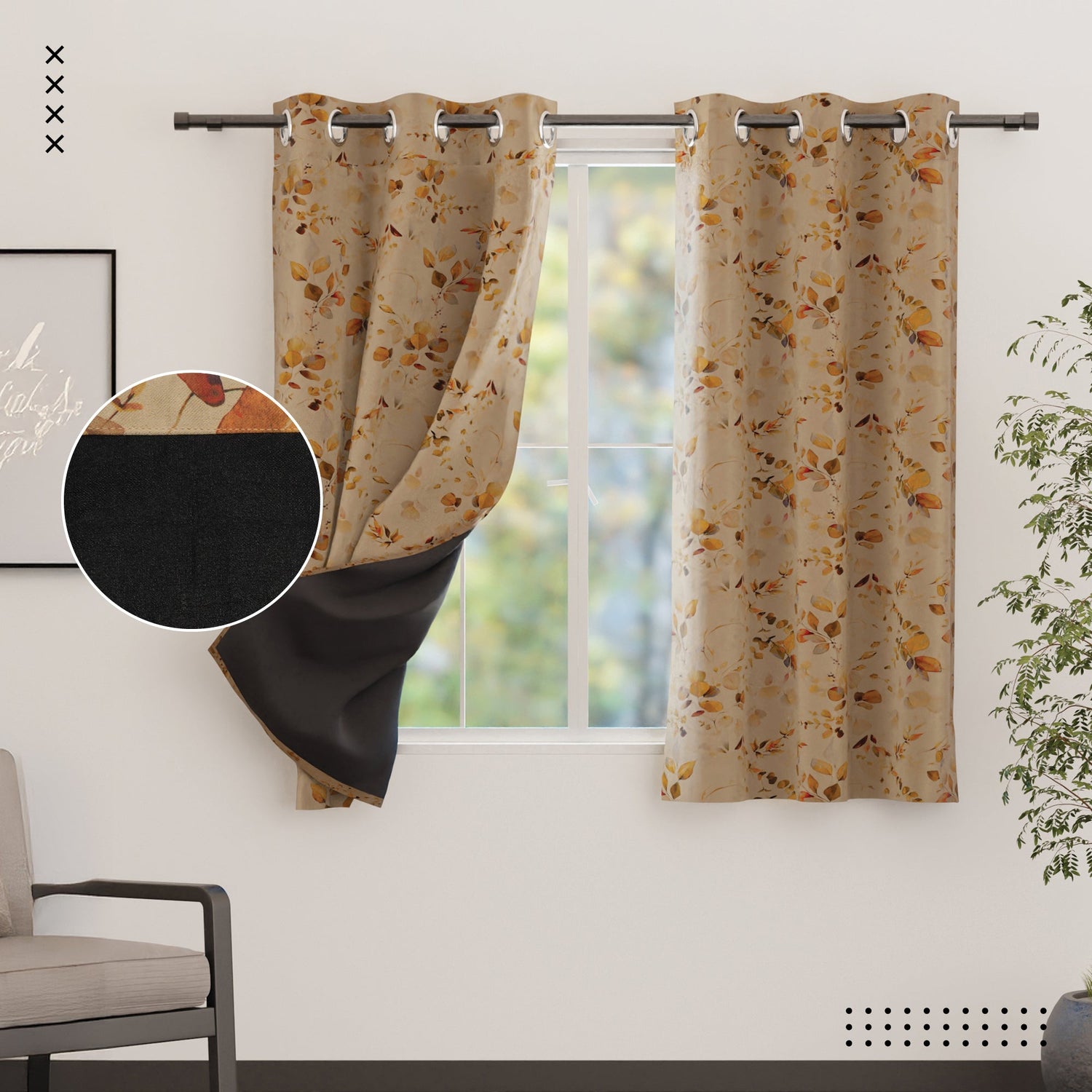
Heat and light travel differently, so the fabric has a different job. A dense, multi-layer construction slows the transfer rather than intercepting light, and the air trapped between panel and glass becomes part of the barrier. The twigs beige pair is a triple-weave polyester built for that, cutting daylight by 85 per cent while working as a thermal layer, and the same density takes 10 to 20 dB off outside noise. Timing matters too: a curtain slows heat coming in but cannot remove heat already in the room, so close it before the sun reaches the glass.
4. Dust settles into curtains, and the care label stops people washing them
Curtains hang still for months, catch what the window lets in, and get washed less often than anything else in the room. A long r/laundry thread shows what stops people: someone with a dust mite allergy needed a 60°C wash, the seller insisted on dry cleaning only at a price they called exorbitant, and the comments split between warnings that a hot wash would wreck the coating and reports of machine-washing dry-clean-only blackout curtains cold and gentle with no damage.
That argument exists because the label is doing two jobs depending on how the curtain was built. Panels that get their darkness from a sprayed backing genuinely are fragile in a machine; woven ones are not, which is why our own labels are unfussy. The twigs pair is cold washable and needs no ironing, and the L1 Gold blackout pair machine washes and tumble dries on low. Our curtain washing guide covers eyelets and drying.
5. A sprayed-on blackout layer sheds, and you find it as dust on the sill

There are two ways to make a panel dark: weave the density in and add a lining, or spray a coating onto the back of a thinner cloth and sell it for less. The second route is where the horror stories come from. In one r/BuyItForLife thread, white chemical powder was coming off the window side of the curtains and going everywhere; a commenter elsewhere found their panels disintegrating on the outward-facing side, black dust seeping into the wall paint behind.
Once that starts there is no fix, because washing only accelerates it. Check the window side of any cheap full-blackout curtain first. Woven construction sidesteps the problem by not depending on a surface film: the T1 Timeless pair is built like the L1 Gold, a triple weave carrying a separate black lining, with rust-resistant steel grommets so the hardware does not stain the fabric either.
6. Blackout curtains for a bedroom are a different buy from curtains for the rest of the house

Blackout is a range rather than a switch, and rooms need different points on it.
| Room | Real problem | Darkness needed | Encasa line |
|---|---|---|---|
| Bedroom, east-facing | Sunrise on the pillow | Near-full | L1 Gold or T1 Timeless |
| Kids' or nap room | Daytime sleep, bright house | Near-full | L1 Gold, darker shade |
| Guest or study room | Dim to rest, not a cave | 85 per cent | Twigs Beige |
| West-facing, 2 to 7 pm sun | Heat as much as light | 85 per cent, thermal weave | Twigs Beige |
| Rented single window | Cheap test first | 80 per cent, fixed size | Teal, 44 x 60 inch |
| Living room or balcony | Glare, daytime privacy | Filtering, not dark | Cotton sheer |
The last row is the one people get wrong in the other direction, treating a sheer as a budget blackout. The slubbed weave on the cream cotton sheer pair interrupts glare while keeping the room bright, and on a double rod it hangs in front of a blackout, so one window can be bright by day and dark by night. The rest of that range is in the cotton sheer collection.
7. If you sleep while the sun is up, this is the cheapest change available to you
Shift workers and night owls carry this hardest. One r/sleep poster described the sun screaming in through inadequate bedroom curtains at 6 am, and a much-discussed r/sleep write-up of six months of sleep hygiene experiments ranked blackout curtains and earplugs top for immediate difference.
Set against the sleep at stake, the outlay is modest: a near-full blackout pair runs roughly ₹1,565 to ₹2,199 by drop, printed semi-blackout pairs around ₹1,969 to ₹2,539, and the fixed-size budget pair about ₹1,200. Those are per-window numbers for something that hangs for years.
So work backwards from your own window. If it faces east and you want to sleep past sunrise, go lined and near-full, in the longest drop your rod allows, hung wider than the frame. If it is a rented room and you are not yet sure darkness is what is keeping you awake, the fixed-size Teal panel answers that for about ₹1,200 before you spend more. The whole range sits in the curtains collection.
Frequently asked questions
Should curtains be wider than the window, and by how much?
Yes, in both directions. The rod wants to run past the frame on each side so the panel edge sits against wall rather than glass, and the panels together want to be wider than the rod, so they overlap in the centre rather than meet edge to edge.
How dark does an 85 per cent blackout curtain actually make a room?
Dim rather than dark. You can make out furniture and read a phone comfortably, which suits a study or a guest room. For sleeping past sunrise, look for a lined build that gets closer to full, and remember the edges decide as much as the fabric.
Can blackout curtains be washed at home without ruining them?
It depends on how the darkness was made. Woven and lined panels usually machine wash cold and gentle. Panels darkened with a sprayed backing are the ones that crack and shed, so check the construction before the label, and vacuum instead if you are unsure.
Why does the room still feel hot when the curtains are shut?
A curtain deals with one surface only. It slows what arrives through the glass and does nothing about heat already stored in the walls and floor, which is why a room that has baked since lunchtime stays warm after you draw the panels.
Encasa XO is our own brand; the curtains named above are ours.



Leave a comment
This site is protected by hCaptcha and the hCaptcha Privacy Policy and Terms of Service apply.