
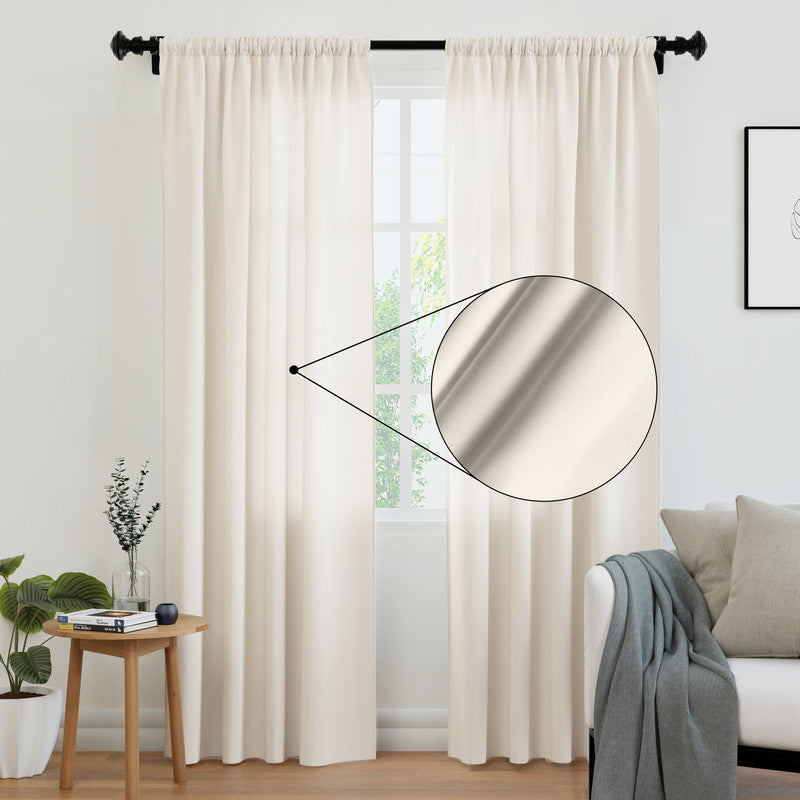
The sheer went up first, on the rod that was already there. It looked lovely all through March. Then the summer mornings started at half past five, a pair of blackout curtains arrived, and there was nowhere to put them. The only rod was taken, a second rod screwed in just above it sat too close, and the blackout dragged across the sheer every time it moved.
That is the usual way layering goes wrong, and it comes from treating the two curtains as equals. They are not. The layer nearest the glass hardly moves: it stays drawn through the day and simply gets covered at night. The layer nearest the room opens and closes at least twice a day. Once you decide which layer has which job, the order, the rod, the heading and the sizes all follow.
Which curtain goes in front, sheer or blackout?
The common arrangement puts the sheer at the back, close to the glass, and the blackout in front. By day the blackout is pushed to the sides and the sheer covers the window, softening the light and blurring the view in. At night you pull the blackout across over it. The curtain you handle every day is the one in easy reach, and the one you leave alone is out of the way.
The reverse order is also used, and you will see it recommended. With the blackout at the back and the sheer in front, the room always shows the soft, pale layer, and the heavier curtain stays hidden behind it. It looks lighter and more finished. The cost is daily use: to close the blackout you reach behind the sheer, or pull both together, and the sheer gets crushed and handled far more than a thin fabric likes.
So the order is a question of how the room is used:
- If the blackout opens every morning and closes every night, put it in front.
- If it stays shut most of the day anyway, say in a bedroom used for daytime sleep, or a west room closed against the afternoon sun, the reverse order costs you little and looks softer.
There is a light-blocking point too. With a blackout, much of the light that reaches the room comes round the curtain rather than through it: over the top, down the sides and through the gap where two panels meet. A blackout in front, on a rod that runs wider than the window, can close over the whole opening and overlap in the middle. Behind a sheer, close to the glass, the same blackout has less room to wrap round the sides.
Double rod bracket or two single rods?
A double bracket carries both rods off one wall plate: a short inner arm for the sheer and a longer outer arm for the blackout. Both rods end up at the same height, 10 to 15 cm above the frame, the same as for a single curtain. The guide to hanging curtains covers that height and the wall plugs for brick and concrete. What a layered window adds is the space between the arms.
Bunch your sheer up in your hand and hold it against the wall where it will hang, then note how far out the folds stand. The outer rod has to clear that depth with room to spare, or the blackout brushes the sheer every time it moves and slowly drags it out of shape. And since the heavier curtain hangs on the longer arm, that arm pulls hardest on its screws. On plastered brick, use every fixing hole the bracket gives you, and add a centre bracket to any rod long enough to sag.
Two single rods, the fix many people try when the sheer is already up, tends to fail. The outer rod has to sit higher to clear the inner bracket, so the two curtains end at different heights, and the rods are rarely far enough apart. Unless you can measure that the new rod clears the old curtain's folds, take the old rod down and put up one double bracket.
Layering curtains: sizing each layer
Width first. Both layers hang from rods that run past the frame, 15 to 20 cm each side, so a 120 cm window takes rods of roughly 150 to 160 cm. The outer rod should be the longer of the two. When the blackout is open it bunches up at each end, and you want that bunch resting on wall, not on the edge of the glass and not on top of the sheer.

Fullness works the other way round from what you might guess. A sheer can take more gathering than a blackout because it never has to slide. It also needs it, because thin fabric pulled nearly flat looks like a bedsheet on a string. A heavy blackout hides a little under-fullness, as the fullness maths explains, but it does need enough width to overlap in the middle, since that centre gap is where a lot of the morning light gets in.
Take the 120 cm window again, with a 150 cm inner rod. Encasa's cream semi-sheer panels are listed at 113 cm wide each in the size chart, so one pack of two gives 226 cm of fabric, almost exactly 1.5 times the rod. That is the minimum gather, and on the back rod it is enough. These are rod-pocket panels with no eyelets. The listing says they are opened by tying back rather than sliding. In front that would be a nuisance; at the back, where the curtain stays put, it does no harm. The close-up marks the sleeve at 3 cm. If that is its flat depth, the sleeve goes round about 6 cm, which means a slim rod of about 19 mm or less. Measure the inner rod's thickness before you thread anything.
Length is where layered curtains catch people out. Two panels both sold as 7 ft will not end at the same height on rods at the same height, because the heading changes where the rod takes the weight. An eyelet panel hangs from the top of each ring, and a rod-pocket panel hangs from its sleeve. If the back layer ends up longer, a strip of sheer shows under the blackout at night. Hang both and look at the hems before you decide anything. The usual fix is to raise the inner rod slightly, or to let the sheer sit just short of the floor.
What does a layered window cost?
Prices are the current selling prices for a pack of two panels, so they will drift. Rods and brackets are extra, and Encasa does not sell them.
| Setup | 5 ft window pair | 7 ft door pair | What you get |
|---|---|---|---|
| Semi-sheer alone (cream poly) | ₹849 | ₹999 | Soft daylight, no darkness |
| Lined blackout alone (L1 gold) | ₹1,565 | ₹2,199 | Dark when shut, a dim room by day if left closed |
| Semi-sheer + lined blackout | ₹2,414 | ₹3,198 | Bright days, dark nights |
| Semi-sheer + semi-blackout print (T1) | ₹2,818 | ₹3,308 | Bright days, dim rather than dark nights |
The surprise in that table is the last row. The printed semi-blackout costs more than the fully lined one, and its own listing says it blocks 85 per cent of light. That suits a living room, where you want to cut glare and heat. It is the wrong buy for a bedroom that has to be dark at 6 am.
Choosing the pair for a bedroom or a living room

For a bedroom, the front layer has one job: darkness. The L1 gold blackout is a triple-weave print with a black lining sewn behind it. Its listing claims it blocks all sunlight and notes that darker shades block more. That lining makes it the heavier curtain of the pair, so it goes on the long outer arm, so fix that bracket well. Behind it, the cream semi-sheer is enough for daytime. In a room where only you sleep late, lined blackout in front and sheer behind is the pairing to copy.
A living room is less strict. Nobody sleeps there in the morning, but the TV screen catches glare, the afternoon sun heats the sofa, and the window looks onto the next building. Full blackout makes the room feel shut up. Two front layers make more sense here.

If heat and glare are the problem, a semi-blackout print such as the twigs beige panels works well in front. They hang on six eyelets per panel with a 4 cm ring, so they slide easily on an ordinary rod and cut most of the light without making the room dark. If you mainly want privacy and colour, try a front layer from the cotton curtains collection instead. These are cotton panama, 4.5 ft wide a panel, and the listing describes them as reducing outside light moderately without being see-through. Over a sheer, that gives a room that looks finished by day and private at night, without the blackout feel.
One thing not to do is buy the two layers months apart without writing down the rod sizes. Measure both rods and the gap between them before the first curtain goes up. Then any panel in the full curtains range can be checked against those numbers, heading included, before you order it.
Frequently asked questions
Can I put a sheer and a blackout curtain on the same rod?
You can, but you lose the point of layering. On one rod both curtains slide together and the sheer is crushed behind the blackout in the daytime. Some people hang a light lining on the same rod for warmth, but for day and night control you need two rods, ideally on one double bracket.
Do layered curtains keep a room cooler?
Somewhat. Two layers trap a pocket of still air in front of the glass, and that slows heat moving through the window. This works best when the front curtain reaches the floor and runs well past the frame. There is more on this in the thermal curtains guide.
Should the sheer be longer or shorter than the blackout?
Slightly shorter, or level. A back layer that hangs lower shows as a pale strip under the blackout when it is closed. Since heading types hang differently, check the two hems after hanging rather than relying on the label length.
Is a double curtain rod worth it in a rented flat?
If you can drill, yes: one double bracket means one set of holes. If you cannot drill, layering is hard to do well. Tension rods and adhesive hooks are only suitable for the light sheer, not for a lined blackout.


Leave a comment
This site is protected by hCaptcha and the hCaptcha Privacy Policy and Terms of Service apply.