
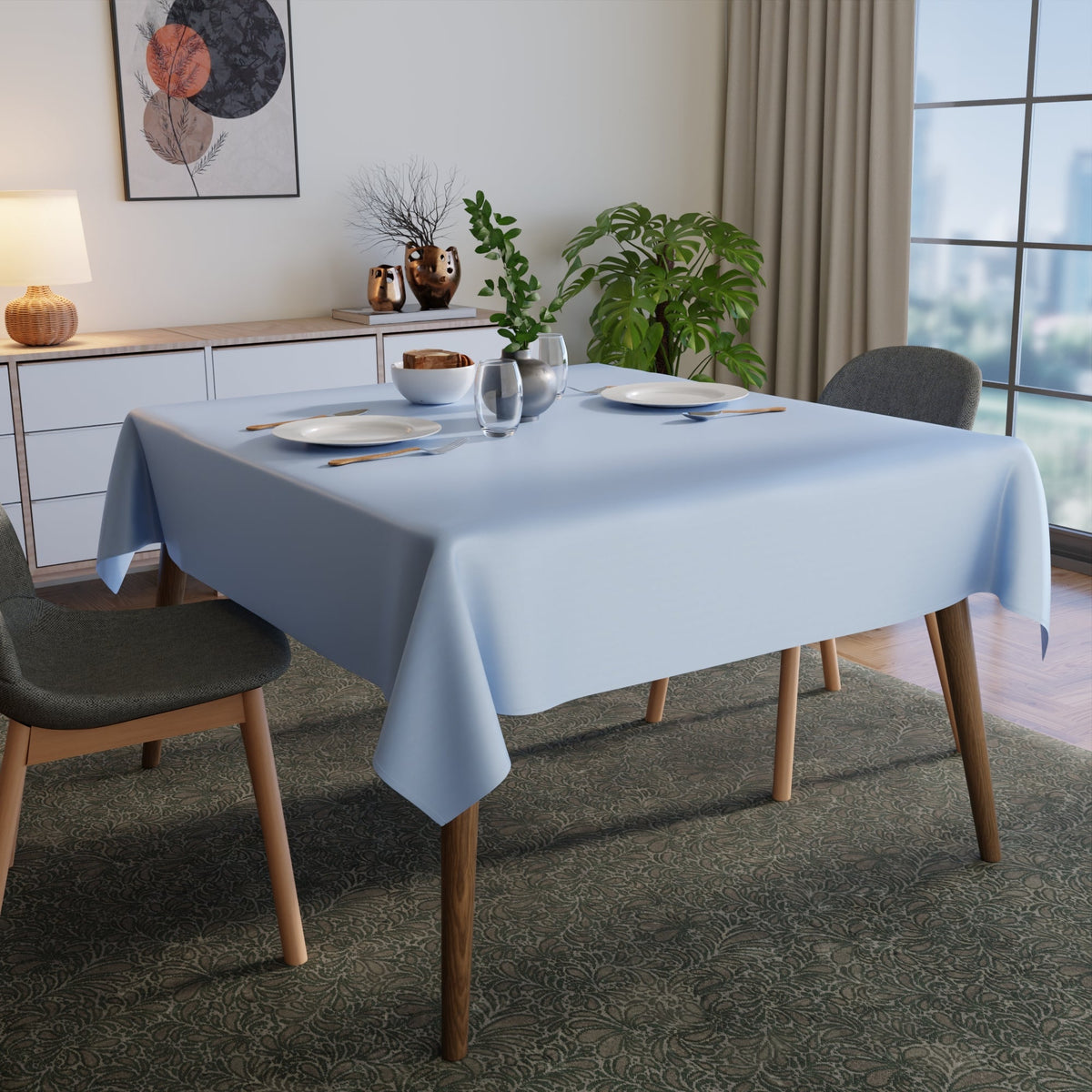
Many people shopping for a waterproof table cover have already worked out the cure. Water gets through cloth, so buy something water cannot get through, and that means a plastic sheet. It sounds airtight, and it is why many homes go through one PVC cover after another, each thrown out sticky, stiff or split along the folds.
The water itself is rarely what ruins a table. The time it sits there is. A spill damages a table, and the cloth on it, by staying wet long enough to soak in. A water-repellent tablecloth is woven polyester with a finish that makes spills sit on top as drops for a while, long enough to wipe them off, and then it goes in the washing machine like any other cloth. It is not waterproof, and it is weak on oil, but it fixes the problem the plastic sheet was bought for without the problems the plastic sheet brings.
Is a waterproof table cover the right fix for spills?
It fixes one thing very well. Liquid does not soak through an intact PVC sheet, and for a few hundred rupees that is hard to argue with. The trouble is what the sheet does to itself while it sits on your table.
PVC on its own is rigid, the stuff of water pipes. A table cover bends because the maker adds a softening chemical called a plasticiser. That chemical does not stay put. It slowly moves out of the sheet, and as it leaves, the plastic turns hard and brittle and starts to crack, while the plasticiser that reaches the surface can leave it oily or tacky. Heat makes the molecules move faster, so the process speeds up in warm rooms. A chemical supplier's explainer on plasticiser migration sets out the mechanism in plain terms.
Now put that sheet in an Indian dining room, with the kitchen next door and the May sun across the table. One shop selling vinyl tablecloths warns on its own product page that hot pots can make the vinyl brittle or crack it, and that it hardens in direct sun. A dining room near a hot kitchen asks for exactly what that sheet handles worst.
The cotton cloth that came before the plastic failed the opposite way. Cotton loves water, so a glass of nimbu pani tipped onto it is a dark, spreading patch before anyone can stand up, and every mark means a wash. The full plastic-or-cotton trade-off is in our guide to choosing a table cover for the dining table. This page is about a third option.
Back on the plastic sheet, the signs come in an order, and heat sets the pace. Early on it is small things: a plastic smell, plates that cling to a tacky surface on a warm evening. Later the sheet stops lying flat, a knife nick turns into a tear, and crumbs collect underneath where nobody wipes. After a summer beside the stove or in afternoon sun, the sheet can turn stiff at the fold lines and crack where it hangs over the edge, and a new one comes home from the market to start the same run again. All that time the table it was bought to protect sits hidden under plastic.
How a water-repellent cloth buys you time

Polyester takes in very little water, which is why it dries fast and barely shrinks (our polyester vs cotton guide covers the fibre itself). A plain polyester weave still lets a spill creep between the threads, though. The finish changes the surface so water does not spread out and wet the weave; it pulls into round drops instead, the way rain sits on a freshly polished car. The gaps in the weave are still there, so this delays the spill rather than sealing it out. But while the drops sit on top, a kitchen napkin lifts them off.
Our Polyester Grey tablecloth is made this way. Its listing describes a water-repellent finish, and its gallery shows the cloth being wiped clean with a damp cloth. The grey on the product page is pale and warm, close to greige, so it hides a faint mark better than white does. The same cloth comes in a powder Polyester Blue, and every colour is sold in 56 x 56, 72 x 56 and 91 x 56 inches and a 56 inch round, at about ₹500 to ₹760 depending on size.
Walk the same spill across three surfaces, as the mechanism predicts rather than as a lab test. A glass of water tips over at lunch. On cotton it soaks in and spreads in a ring. On a PVC sheet it stays wet and runs, and on a table slightly out of level it finds the edge and someone's lap. On the repellent cloth it breaks into drops near where it fell, and a napkin lifts them off. The photo above is a product render, but it shows the same thing.
When the cloth does get dirty, it goes in an ordinary machine wash and dries quickly on the line. Picture Sunday lunch: a child knocks over a glass, someone wipes the drops with a napkin, and the meal carries on. On Monday the cloth goes in the wash, and by evening it is back on the table, still looking like a tablecloth rather than a plastic sheet.
Which one to get

If the table gets used three times a day, get a plain solid in grey or blue from the polyester range above, in the size that matches your table. A plain colour makes a missed drop easy to spot and wipe, and grey or blue forgives the faint mark that white would show. If you would rather a print hid things for you, the Polyester Chintz Blue is a white ground with a dense blue and sand paisley, and its listing names a water-repellent finish too. It comes in a 56 inch round, 56 x 56, 72 x 56 and 94 x 56 inches, at about ₹690 to ₹1,000. More prints sit in our water-repellent tablecloth collection; pick one whose own page says water-repellent.
The real risk in this purchase is the size, not the fabric. Measure the length and width of the table top before you order, then check the drop each cut gives in our tablecloth size chart. If your table top is longer than about 2.1 metres, the 91 inch solids leave very little hanging over the ends; the Spun Polyester White goes up to 118 x 56 inches, and its listing says spills bead up and wipe away.
Where the finish stops helping

Not every mess on a dining table behaves like that glass of water. Oil does not bead the way water does, and polyester tends to hold on to oil once it gets in, so a drop of ghee needs attention straight away, not at the end of the meal. The finish also gives way to pressure and time: a wet bowl parked on one spot for a whole meal can push moisture through. Colour helps with what is left behind: a sandy Polyester Beige tends to hide a faint yellow mark that white would show.
| Spill | What the cloth does | What to do |
|---|---|---|
| Water, juice, chai | Sits on top as drops for a while | Lift it with a napkin; dab, do not rub it around |
| Dal, sambar, gravy | The watery part beads and the solids sit on top; any oil in it behaves as in the next row | Scoop the solids, blot, then wipe with a damp cloth |
| Ghee, tadka oil, pickle | Oil can soak in where water would not | Blot at once; work a little dish soap into the spot before washing |
| A wet glass or bowl left on one spot | Pressure and time can push moisture through | Lift it and dry the spot; use a coaster for drinks that stand for hours |
| A hot tawa or kadhai straight off the flame | Not a spill problem: polyester cannot take direct heat | Always use a trivet |
Curry oil with haldi in it is the worst case on any fabric; our guide to removing oil stains explains why the yellow often stays after the grease has gone.
The finish also wears. Water-repellent finishes in general lose strength with rubbing and repeated washing, and detergent left in the fabric can make water spread again instead of beading. Wash with a mild detergent, rinse well, dry on a line, and skip bleach; the spun polyester cloth's care card rules out bleach and dry cleaning and asks for a low iron. Leave the oil until laundry day, though, and the cloth ends up with the same yellow patch a cotton one would have.
A hot dish that gets through to the wood leaves the white ring explained in our guide to white marks on a wood table, so the trivet stays even with the cloth on.
Questions before you buy
Is a water-repellent tablecloth waterproof?
No. It is a woven cloth with a finish, so spills sit on top for a while rather than for ever. Wipe them while they are still beads and the table stays dry. Leave a puddle under a plate all evening and some of it can get through.
Will it stop oil and haldi stains?
Not on its own. Oily spills are its weak point, and a turmeric-coloured curry is usually an oily one. Blot quickly, put a little dish soap on the mark, and wash it soon. Printed or darker cloths hide what is left better than pale solids.
Can I put a hot pan or pressure cooker on it?
Use a trivet. Polyester softens under direct heat, which is why the spun polyester cloth's care card asks for a low iron. A pan straight off the flame can mark the cloth and the table underneath.
Does the water-repellent finish wash out?
It weakens over time with washing and rubbing, as these finishes do in general. A mild detergent, a good rinse and line drying slow that down; bleach speeds it up.
Which size fits a 6 seater?
Six-seater tables vary more than the name suggests, so measure the top first. Our tablecloth size chart matches common table sizes to each cut and shows how far the cloth hangs over the edge.
Plastic sheet or repellent cloth
A PVC sheet is still the right buy in a few places. On an outdoor table, a craft table covered in paint and glue, or the corner where a toddler eats with both hands, the only job is that nothing gets through, and nobody minds how it looks or how soon it needs replacing. Buy the cheap sheet there and keep it out of the sun.
The dining table is a different job. People sit down to eat there every day, a spill needs a minute's grace, and the cover should look like a cloth, not a sheet from the market. For that table, start with the Polyester Grey tablecloth in the size your table needs. Wipe the drops when they happen, and the wood underneath stays the way it was when the table came home.
Encasa XO is our own brand, and the tablecloths named above are ours.


Leave a comment
This site is protected by hCaptcha and the hCaptcha Privacy Policy and Terms of Service apply.