
It is ten at night in Lucknow or Delhi in early January. The heater has been on for an hour, the room finally feels fine, and then you sit down on the sofa by the window and feel cold air on the back of your neck. The curtain is closed. It is just not doing much.
So do thermal curtains help? Yes, but less than the word "thermal" suggests, and mostly in one way: a dense, heavy panel slows the air that moves past a cold window and puts a still layer of air between you and the glass. How well it does that depends far more on how the curtain is hung, and how tightly it closes off the window, than on any label. A good blackout panel hung well beats a "thermal" panel hung badly.
What does "thermal curtain" actually mean?
There is no Indian standard for the word. On a listing it usually means one of three things: a dense triple-weave polyester, a fabric with a lining stitched or bonded to the back, or both. Sellers also use "thermal" and "energy saving" loosely on ordinary blackout curtains, because the same density that stops light also slows air.
That last point is the useful one. Light and air move through fabric in a similar way, through the gaps between the yarns. A tight weave with few gaps lets through less of both. So the darkness of a curtain is a rough, free test of how much it will do in winter. Hold it up to a bright window. If you can see shapes through it, cold air will pass through it too.
How a window loses heat, and where a curtain fits in
A single-pane window, the kind most Indian flats have, is the coldest surface in a winter room after dark. Heat leaves the room in two ways here. Warm air touches the glass, cools, gets heavier and sinks, then spreads across the floor. That sinking cold air is the draught you feel, even when every window is shut. And air also leaks in through the gaps around the frame, which in older flats with sliding aluminium windows can be wide.
A curtain does not insulate the glass the way a wall does. What it does is trap a layer of air between itself and the window and slow down that loop of cooling and sinking. For that to work, the trapped air has to stay trapped. If the curtain stops above the floor, hangs a hand's width off the wall, or leaves a gap at each side, the cold air simply spills out from behind it and the loop carries on. Thick fabric with open edges is like a quilt with your feet sticking out.
This is also why the honest answer on numbers is vague. How much heat a curtain saves has been studied in sealed, centrally heated Western homes, and those figures do not carry over to a Delhi flat with one oil heater, a gap under the balcony door, and walls that were built to stay cool. What does carry over is what you can feel: sit by the window with a dense curtain drawn properly, and the cold patch shrinks.
Blackout vs thermal vs lined curtains
These terms overlap, and a single product can be all three. The table sorts them by what is doing the work.
| Type | What it is | What helps in winter | Where it falls short |
|---|---|---|---|
| Regular cotton or canvas | A single layer of plain-weave fabric | Cuts some draught, looks warm | Air passes through the weave; little still-air effect |
| Blackout (triple weave) | Polyester woven densely in three layers of yarn | Very little air passes through the fabric itself | Unlined panels can still be thin at the edges and hems |
| Lined or "thermal" | A face fabric with a separate backing layer | Two layers trap air between them as well as behind | Heavier, needs a stronger rod; can hold damp if kept shut all day |
| Sheer | Open weave, light fabric | Nothing much in winter | Pair it with a heavier panel |
Weight gives a rough guide before you touch the fabric. Our curtain GSM guide puts regular curtains at around 150 to 250 gsm and blackout panels at around 200 to 320 gsm. Those ranges overlap, and in the overlap the lining decides more than the number. Many listings do not state gsm at all, so the light test and the feel in the hand often end up doing the job.
The gaps that matter more than the fabric

Take a common bedroom window: 120 cm wide, frame about 140 cm tall, sill at hip height. Here is how a heavy panel loses most of its value, and how to get it back.
The sides come first. A rod that ends at the frame leaves a gap at each edge, and cold air pours out of it. Run the rod 15 to 20 cm past the frame on each side, so the closed curtains overlap the wall. For a 120 cm window that means a rod of roughly 150 to 160 cm, and enough fabric to cover it with some folds. Two panels about 117 cm wide each cover that, with a little fullness left over.
The top is next. A rod mounted well above the frame on long brackets leaves an open space above the curtain, and warm room air drops in behind it there. Mount the rod close above the frame and keep the brackets short, so the curtain top sits near the wall.
The bottom matters most on a window with a sill. A 5 ft panel on this window ends near the sill, and the cold air that slides off the glass falls straight out from under it. A 7 ft door-length panel carries on to near the floor and closes that exit. In a room where the family sits in the evening, this one change often does more than moving up a weight class.
The middle is last. If the two panels only just meet, they part a few centimetres as soon as the fan or someone walking past moves them. A bit of overlap, or a clip, keeps them shut.
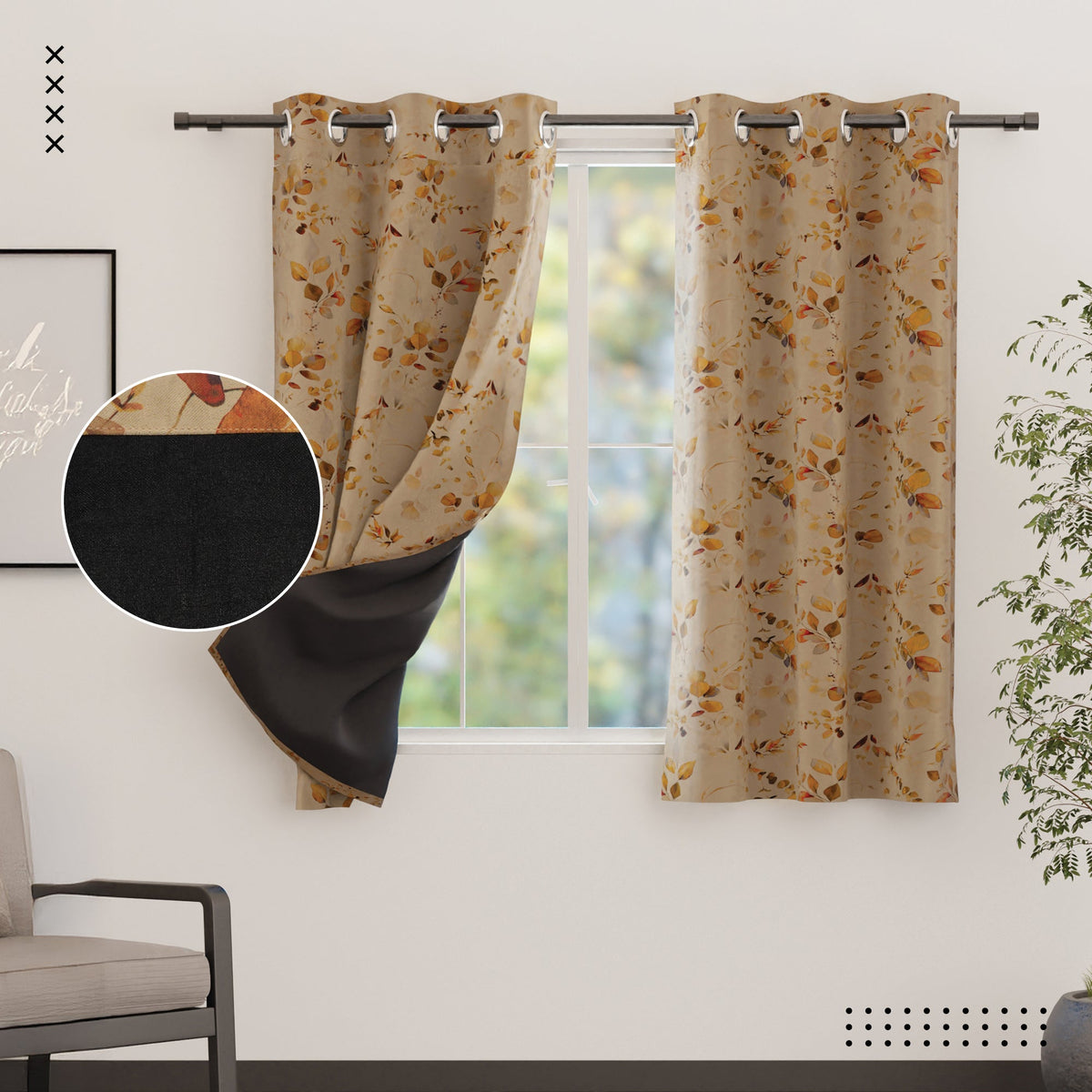
The blackout grey twig-print curtain in the photo is a fair example of the fabric half of this. Its listing describes a triple-weave polyester satin that cuts daylight by 85%, which tells you the weave is tight. On a rod that stops at the frame, as it does here, that density is wasted at the edges.
Choosing a thermal curtain for your room

Start with what you need from the room in daytime, because a winter curtain still has to live there in March.
For a bedroom that gets cold at night and also needs to stay dark in the morning, a lined blackout is the strongest choice. The Blackout L1 curtain has a triple-weave face with a black lining and 16 grommets, and the listing claims it blocks all sunlight. Two layers plus a full drop is about as much as a curtain can do at a window. The trade-off is weight: lined panels pull on a light rod, so check the brackets before you hang them.
For a living room, where you want the room bright in the afternoon, pure blackout can feel heavy and dark. A dense cotton panel is a fair middle ground. The cotton charcoal grey curtain is a Panama-weave cotton that the listing says moderately reduces light and cannot be seen through from outside. It will not stop air as well as a triple weave, but in the door length, pulled wide in the day and closed at dusk, it does a decent job and looks warmer than satin polyester under lamplight.
For a room where you mainly want draught relief and do not care about the look, an unlined blackout from the curtain collection in the 7 ft length, on a rod that runs past the frame, is the cheapest way to get most of the benefit.
One thing to watch in fog and damp spells. A heavy curtain kept closed all day on a north-facing window leaves still, cold air against the glass, and that is where damp and a musty smell start. Open it for a few hours on clear days, even in a room no one uses. On a south or west window, open it fully when the sun is on it and close it before the light goes, so the room keeps what the sun gave it. The wider picture of rugs, cushions and the order to buy things in is in our guide to winter home textiles.
Thermal curtains: questions people ask
Are thermal curtains worth it in India?
In the north, for rooms used on winter evenings, a dense curtain with a full drop is worth it, mostly for comfort near the window rather than a lower bill. In the south and along the coasts, where winters are mild, the same curtain earns its keep by keeping summer heat and light out instead.
Is a blackout curtain the same as a thermal curtain?
Not always, but they overlap a lot. Both depend on a dense weave. A thermal curtain usually adds a lining. A well-hung blackout often does most of what a thermal curtain does.
Do thermal curtains work on a balcony door?
They can do more there than on a window, because balcony doors are often the leakiest opening in a flat. Use a floor-length panel, overlap the frame on both sides, and add a draught stopper at the base if air comes in under the door.
Can I just add a lining to the curtains I already have?
Yes. A separate lining hung on the same rod, behind your existing curtain, gives you a second layer of trapped air. It is a cheap fix for curtains you like the look of but find too thin in January.

Leave a comment
This site is protected by hCaptcha and the hCaptcha Privacy Policy and Terms of Service apply.