
To remove a lipstick stain from clothes, lift off what sits on top with a blunt knife, then lay the stained part face down on a clean white cloth and dab dish soap into the back of it, so the colour moves out onto the cloth below. If a pink shadow is left, blot it with rubbing alcohol after a test on a hidden spot. Then wash, and keep the iron, the dryer and hot sun off it until the mark has gone.
That covers most marks. The rest of this guide explains why each step is there, what to do when a mark has already been washed in, how foundation and kajal differ, and how to deal with a pile of napkins after a wedding dinner.
Why lipstick is hard to get out
Ariel's India guide to lipstick stains describes lipstick as oils, waxes and pigments, and warns that the pigment can dye fabric for good. That mix is why one product rarely does the whole job. Each part needs its own move, in order.
The wax is the part you can see standing on the surface. It should be lifted off, not rubbed in. The oil helps carry the colour into the threads, and plain water does little to oil. Ariel's rinse is done with the garment turned inside out, so the water runs through from the back. Dish soap and alcohol both break up oil, so they come next. The pigment is the colour left behind. Once the oil holding it has been loosened, a rinse and a wash can carry it away.
Heat works against you at every stage. Tide says plainly not to dry a garment until the lipstick has gone, because heat can set it permanently, and Ariel says to wash again before the cloth dries. Many Indian homes have no dryer, so the heat comes from somewhere else. The iron is the obvious one. A hot terrace is the quieter one: it dries the cloth fast, and Ariel's point is that a mark which dries before it has gone is harder to shift.
How to remove lipstick stains from clothes, step by step
- Lift what is on top. Scrape the surface lipstick off with a blunt knife or the edge of a spoon, moving towards the middle of the mark so you do not widen it. Pressing a strip of tape on and peeling it away also picks up loose bits, one of the tips in Cleanipedia's guide.
- Turn it face down. Lay the stained part face down on a clean white cloth or a folded paper towel. This is the Clorox method: you work from the back so the colour leaves the way it came in, instead of being pushed further through.
- Dab dish soap into the back. Put a little dish soap on a second cloth and dab the back of the mark. Do not rub. Lift the garment every few dabs. When the cloth below turns pink, move to a clean patch. Keep going until no more colour comes off.
- Rinse, then look. Rinse the spot and hold it up to daylight while it is still wet. A faint shadow is common at this stage.
- Blot what is left with alcohol. Ariel and Cleanipedia both suggest rubbing alcohol for a stubborn mark. Test it inside a hem first, then dab it on with cotton wool, blot from the back onto a paper towel, and rinse in cool water. Alcohol catches fire easily, so keep it well away from the gas stove.
- Wash, and check before it dries. Wash as the care label allows. Before the garment goes on the line, check the spot again in daylight. If anything is left, go back to step 3 while it is still damp.
Alcohol is not safe on every fibre. It can damage acetate and acrylic, which turn up in linings and some party wear. Our guide to ink stains on clothes has a short table of which fixes harm which fibres, and our guide to care label symbols explains the label itself.
Hot or cold water? The makers do not agree
This is where the big laundry brands part ways. Ariel, Clorox and Tide all tell you to wash a lipstick stain at the hottest temperature the care label allows. Unilever's Cleanipedia says the opposite for lipstick: wash on a cool setting, because hot water can make the stain bleed. Even Ariel's own page uses cold water for bed sheets.
Both sides agree on one thing: the stain should be treated before the wash, not by it. So we would do the pre-treating with cool or lukewarm water and keep at it until no more colour comes off. Once the mark has gone, the wash itself is an ordinary wash at whatever the care label says. If a bright mark is still there, we would not put it into a hot wash, given Cleanipedia's warning that heat can make it bleed. Treat it again first, and wash that piece on its own until you are sure it is clean.
When the mark has already been washed in
A lipstick mark that went through the wash unnoticed is harder, but it is often worth one more try, especially if it has not been ironed. Go back to step 3 and expect more rounds. If the mark is fading with each round, keep going. If two rounds of soap and one of alcohol change nothing, home treatment has probably done what it can, and more rubbing will only wear the cloth.
Some clothes should go straight to a dry cleaner without any home attempt. These include anything marked dry clean only, silk, zari or heavy embroidery, and heavy wedding outfits. Tell the cleaner it is lipstick and say what you have already tried, so they know what is already in the cloth.
Foundation, kajal and powder on clothes
Lipstick is rarely the only make-up on a collar after a wedding. The other marks behave differently, so the first move changes. For food, ink and everything else, our stain chart for clothes has a row for each.
| Make-up | What it is like | First move | Source |
|---|---|---|---|
| Lipstick | Wax, oil and colour | Lift the excess, dish soap from the back, alcohol for what is left | Ariel, Clorox, Cleanipedia |
| Liquid foundation | Oily or water-based, depending on the formula | Blot, work in liquid detergent, leave 5 to 10 minutes, then wash | Cleanipedia, Tide |
| Kajal, eyeliner, mascara | Dark colour that smears easily | 1 part washing-up liquid to 2 parts cool water, sponge and blot | Cleanipedia |
| Compact powder, blusher | Dry powder | Lift it off dry with a lint roller or tape, then liquid detergent and a wash | Tide, Cleanipedia |
A beige foundation smear on a white collar looks mild, but it is hard to tell from the bottle whether the formula is oily. The University of Georgia Extension's stain notes split cosmetics into water-based and oil-based kinds, with detergent for the first and a cleaner before the wash for the second. Liquid detergent worked in by hand, as in the table, is a reasonable start for either. Powder needs the reverse order: lift it off while it is dry, before any water, or it becomes a paste in the weave.
Lipstick on cloth napkins after a party

After a sangeet dinner or a family lunch, you will have a pile of napkins, some with gravy, some with ghee and a few with a clear pink print. The mistake is to put the whole pile in one hot load.
Sort them first. Pull out the ones with lipstick and treat each from the back, as in step 3, on a folded towel. A napkin is one flat square with no collar or pocket, which makes it easier to work on than a shirt collar. The food ones need a different first move: dish soap works on oil and ghee, and our guide to cloth napkins has a short answer for oil stains. Wax from candles on the same table is another job again, covered in our guide to candle wax and diya oil on table linen.
Read the care card before reaching for bleach on white napkins. The card for our white cotton napkins (43x43 cm, pack of 6, ₹869) shows do not bleach, machine washable and easy to iron, so bleach is off the list for those. Soap first, then alcohol after a test on a corner.
Which napkin colour hides lipstick?

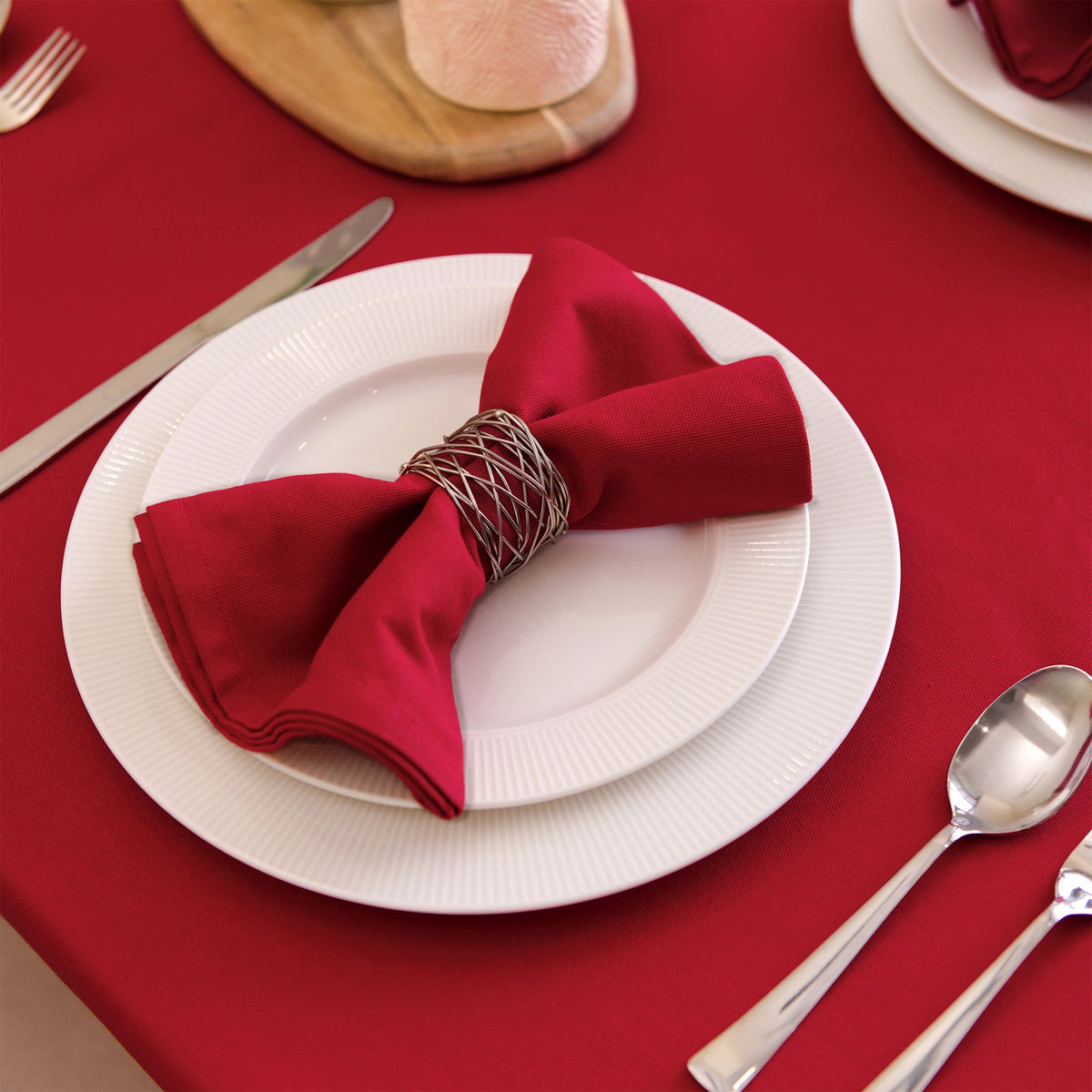
White shows every mark. A red or wine napkin hides a red lipstick much better, because the mark and the cloth are close in colour, so a faint shadow left after washing is hard to see. Our deep red cotton napkins photograph as a true red, and the rich maroon ones as a darker wine, at the same size and price as the white set.
There is a catch. A dark napkin that hides red lipstick will show a pale foundation smear more clearly, and a nude or brown lipstick can stand out on red. No colour hides everything. So match the napkin to the make-up you expect. For a wedding dinner with a lot of bold red lipstick, the red or maroon set is the easier one to keep looking clean. If the shades will be mostly nude and brown, pick a mid-tone from the table napkin collection that sits close to those shades, so neither the lipstick nor a foundation smear stands out much. And if you would rather not risk a dinner napkin at a drinks party, hand out the small 23 cm squares from the cocktail napkins collection with the drinks. They are quick to lay flat and treat the next morning.
Questions people ask about lipstick stains
Does hairspray remove lipstick?
Clorox suggests a quick spray to stop a fresh mark setting, and Cleanipedia's method is to spray, leave it for up to 15 minutes, then wipe with a damp cloth. Ariel calls it a quick fix that works less well than detergent. Hairspray formulas vary, so treat it as a stopgap at a party and do the proper soap treatment at home.
Can I use hand sanitiser instead of rubbing alcohol?
Cleanipedia names hand sanitiser gel as an option for stubborn lipstick. Check that alcohol is on the bottle, test a hidden spot, blot from the back, and rinse well, because a gel leaves other ingredients behind.
How do I get lipstick off a white shirt?
Use the same steps as for any shirt, with one extra check. Bleach is only an option if the care label allows it, and it should come last, after the soap and alcohol have taken out the oil. Some labels allow only non-chlorine bleach, so read the triangle before using anything from a bottle.
Will lipstick come out of a napkin that has already been washed?
It is worth a try, especially if it has not been ironed. Treat it again from the back while the napkin is damp. A faint shadow on a white napkin may stay. On a red or maroon one it is much harder to see.


Leave a comment
This site is protected by hCaptcha and the hCaptcha Privacy Policy and Terms of Service apply.