
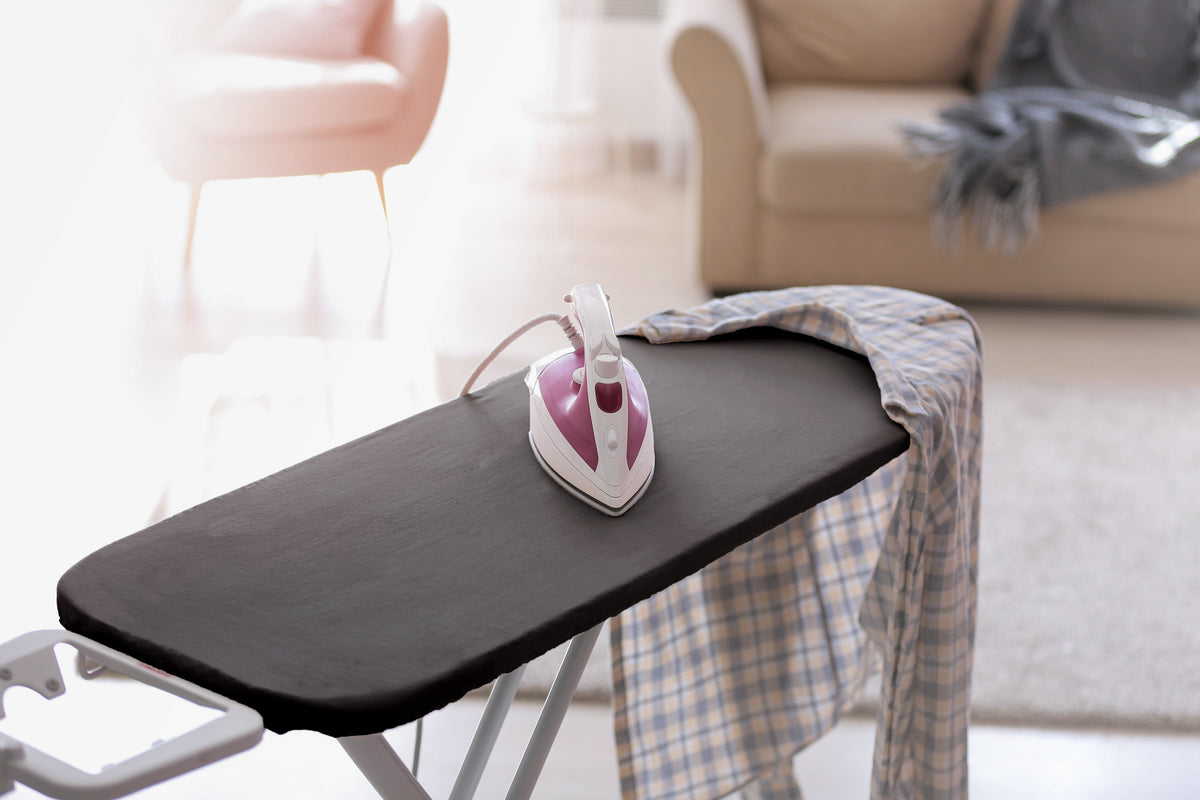
Picture a silk saree coming off the board with a glossy strip down one side and a dull, dark line along the zari. The iron was working fine. The setting was a guess, the right side of the cloth took the heat, and several metres of saree hung off the board, pulling the hot section out of place while it was being pressed.
To iron a saree, follow the iron dots on the care label and test on the inside hem or fall first. Press delicate cloth from the reverse, under a thin cotton cloth, one section at a time, with the pallu first and the border last. Keep the rest of the saree supported, so that hot cloth is never pulled or left in a heap.
Read the label first, because the dots are the instruction
Under the international care-label convention, one dot on the iron symbol means up to about 110°C, two dots about 150°C, and three dots about 200°C. A crossed iron means do not iron. These are ceilings, and you can always stay below them. Our guide to fabric care symbols covers the rest of the label.
If the label shows one dot, keep the iron cool, whatever a fabric chart says. Many sarees are blends, and a fibre name cannot tell you that. If the tag is missing, start at the lowest setting and go up slowly.
Then test on the inside hem, or on the saree cloth where the fall is stitched, so any mark stays out of sight. Press once, let it cool, and look for shine or a change in colour. Test the zari too if there is some at a hidden end, because a saree that passes on plain silk can still fail on its border.
How do you iron a silk saree, and how is cotton or synthetic different?
The dots on your own label set the heat. The second column shows what labels commonly carry for each saree, and the rest is how to handle the cloth once you have the setting.
| Saree | Common label (yours wins) | Which side | Cloth over it | Steam |
|---|---|---|---|---|
| Silk | Two dots | Reverse | Thin cotton | Safer without, if unsure |
| Silk-cotton | No common figure: follow the label, or treat it as silk | Reverse | Thin cotton | Test first |
| Cotton | Three dots | Reverse if dark | Only if a test shows shine | Yes, with the cloth lightly damp |
| Synthetic, poly-georgette | One dot | Reverse | Use one if shine or colour change appears | None on light cloth; heavier polyester may need a little |
| Zari or tissue | Follow the label, at the lowest setting that works | Reverse | Double layer of cotton | None |
Do not read your iron's dial as if it were the label, because the marks differ between makers. The Philips HI478 manual, for a US model, puts silk and lightweight synthetics in a section marked with one dot, starts you at the beginning of it, and says some durable silks may need more. Its cotton setting sits past its three-dot position. So start low and go up only until the creases lift, never past what the label allows.
Heat and pressure on the face of the cloth are what give it a gloss. The same manual says to iron delicate fabrics on the wrong side "to avoid shining or glazing", and says the same of dark fabrics.
Zari needs the most care. Saree sellers' care guides advise the reverse side, a double layer of cotton and no steam, because too much heat can darken metallic threads for good.
Steam on plain silk is where those guides disagree. Some allow a light steam setting, while others say to iron dry if you are unsure and not to let the saree get wet. Go by your test spot. If water leaves a mark there, you have your answer.
Some sarees should not go under a home iron at all. A crossed iron on the label settles it. So does velvet or other raised pile, which the Philips manual does not recommend ironing. Hand-painted work and heavy embellishment are poor risks too, and a bridal saree is better sent to a professional dry cleaner.
The saree is longer and wider than your board
A saree is usually about 5.5 to 6.5 m long and about 44 to 48 inches (112 to 122 cm) wide. These are sellers' figures and no standard exists, so handloom pieces can differ. A Large board is about 120 to 127 cm long and 37 to 40 cm wide. So the saree is more than four times the board's length and about three times its width.
Lay a saree lengthwise on a Large board and it cannot stay flat. About 36 to 43 cm of its width hangs off each side, and more than 4.5 m of a 6 m saree has nowhere to go but the floor. The weight pulls the hot section, the far side folds on itself, and the next press sets those folds in.
Folding the saree in half lengthwise to fit a narrow board means pressing one long fold down the whole saree, which can show in the pallu and the pleats. Lay it across instead.
Run the saree's width along the long side of the surface, so one single layer lies flat from border to border. On a 120 cm mat, a 122 cm saree leaves 2 cm over the edge, so slide the cloth sideways to reach that strip, and do the same on a board where it narrows at the nose. Press that stretch, then feed the next stretch across. The rest stays gathered in a clean, loose stack on a cotton sheet on a table or chair, and the finished part moves to the other side the same way.
Take a 6 m saree. Each lay-down covers only the short side of the surface, so a 70 cm mat needs about 9 lay-downs (600 ÷ 70), a Wide board 13 or 14 (600 ÷ 48 or 44), and a Large board 15 to 17 (600 ÷ 40 or 37). On a real board the count is a bit worse, because the nose narrows and the full width does not sit on the wide part. No home surface holds a whole saree, so you will work in sections either way. A wider surface just means fewer sections.
How to iron a saree at home, in order
Laundry advice for a cotton saree gives the order as pallu, then the pleat area, then the border. Use it as a starting order for other sarees: the pallu and pleats show most, and a border with zari is easier to leave until you can turn the iron down.
- Clear the surface, spread a clean sheet for the loose cloth, and test on the inside hem or fall.
- Start with the pallu, turned to the reverse, under the cloth if the table above calls for one. If the pallu is heavy with zari, use the zari setting from the start. Lift and press. Sliding a hot iron over delicate cloth can pull it.
- Move to the stretch that will become the pleats, then the plain run that gets tucked in, which needs the least attention.
- Leave the border for last. If it has zari, turn the dial down first and give the iron time to cool, since it will not drop in temperature straight away.
- Let each stretch cool before you move it, so that you do not crease it again while it is still warm.
How do you iron saree pleats?
Iron the whole saree flat first. Pleating comes after that. One tutorial on preparing a bridal silk saree lays the gathered, pinned pleats on the board with the outside facing down, then irons only the inside folds, lightly, and leaves the outside folds soft. The fold you see is the one you least want flattened into a shine. Pin the stack before you press, so that the pleats stay even when you lift the iron.
Which surface suits a saree?
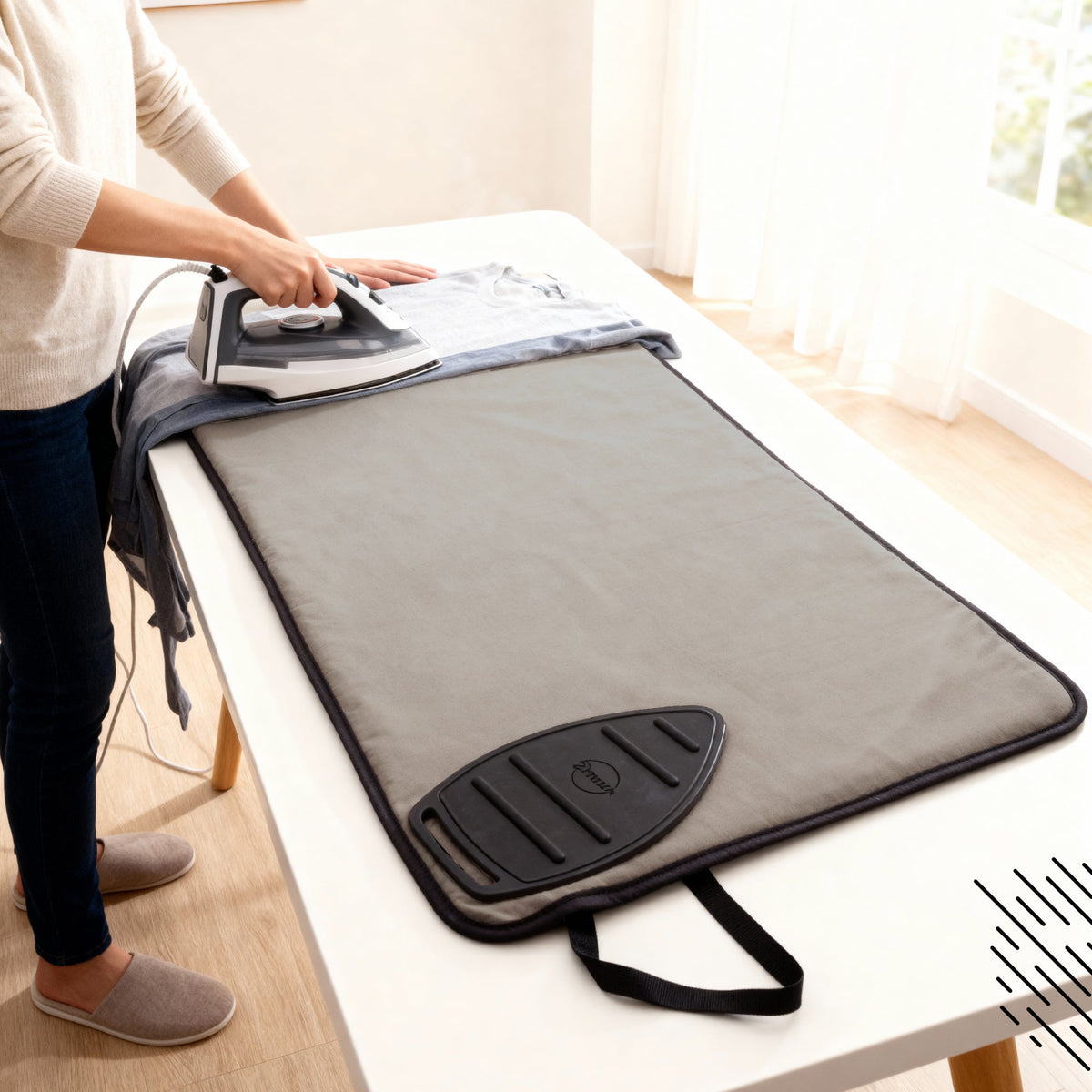
If you have a table with a clear 120 cm, a large mat gives you the 120 x 70 cm used in the sums above, and the table takes the weight of the loose cloth.

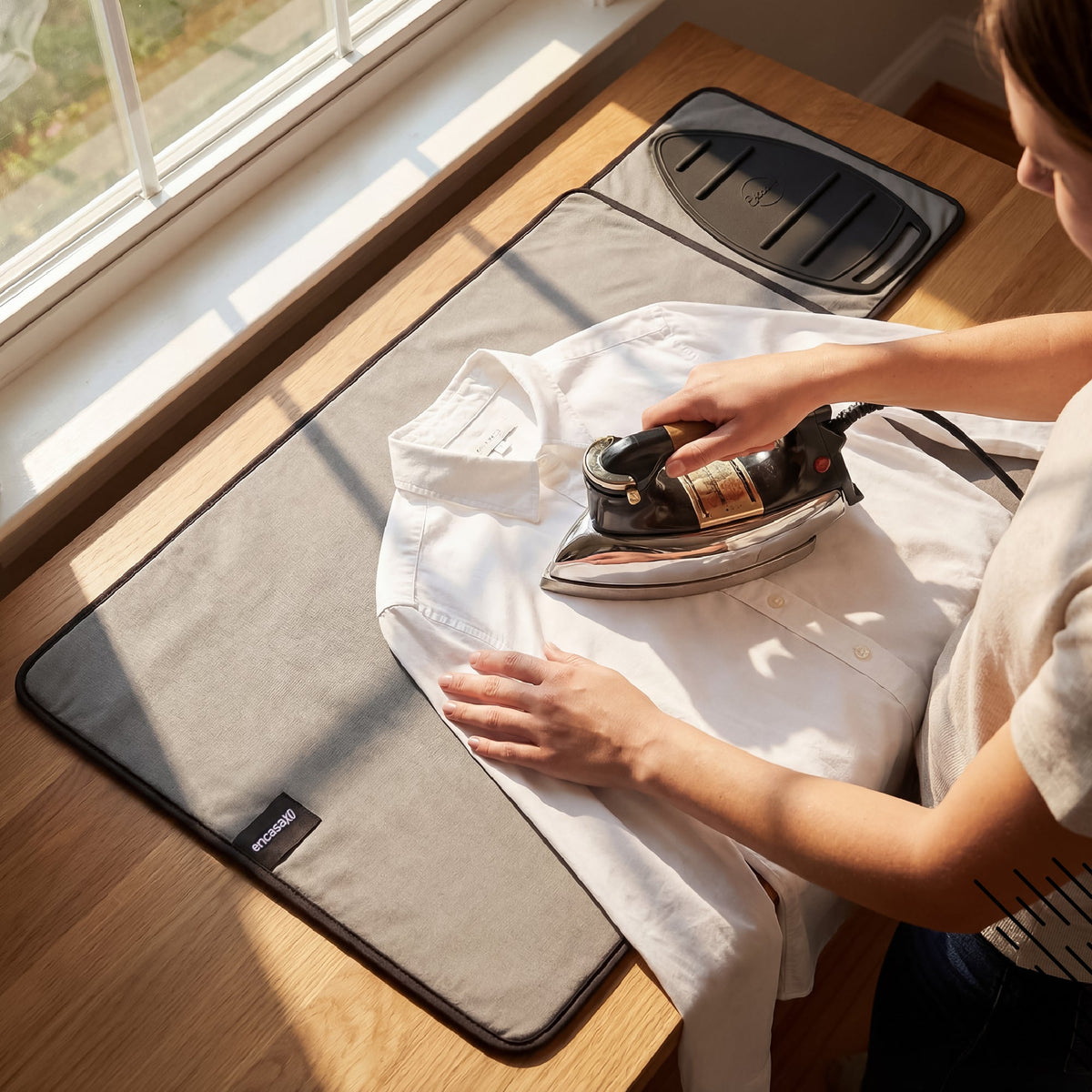
For sheer sarees and pale georgette, choose a plain surface. A printed mat like the Big Leaves Blue at ₹999 for the large size, pictured above, can show through thin cloth and make small creases harder to see. It is fine for an opaque cotton or silk.
Grip matters more with a saree than with a shirt, because several metres of loose cloth can tug at the mat. The Cotton Grey mat, ₹1,299 for the large size, is plain grey, and its images show non-slip dots on a black base. The Big Leaves gallery does not show its underside, so on a polished table the grey is the one whose base you can see before you buy, for ₹300 more. For another print, pick the 120 x 70 cm option in the ironing mat range.

If you are keeping your board, measure its length and its widest point. A board 123 to 127 cm long and 44 to 48 cm across takes a Wide cover, and for sheer sarees the plain Canvas Grey at ₹999 has the same advantage as the plain mat. Its images say it will not fit wall-mounted, over-door, cabinet or hinged boards. For every other size, use the board cover size guide, then choose from the ironing board covers once you have your numbers.
If a mark appears anyway
Stop, and do not press over it again to see if it fades. A glossy patch, a brown scorch and a rust spot have different causes and need different handling. The iron stains guide listed at the end of this page goes through them. On a silk or zari saree that matters, take it to a professional cleaner before trying anything at home.
Common questions
What temperature should I use for a silk saree?
Use what the label allows, not a number for silk in general. Silk labels commonly show two dots, which allows up to about 150°C, but a silk saree marked one dot stays under about 110°C. Many home irons show settings and not degrees, so start low and go up only if the creases stay.
Can I iron a saree without an ironing board?
Yes. A firm padded surface on a table works, and it is often easier because a table can be longer and wider than a board. Avoid a soft bed for pleats and pallu. Our guide to ironing without a board covers the options.
Should a saree be ironed inside out?
For silk, dark colours, synthetics, zari and anything delicate, yes. Pale, sturdy cotton tends to be more forgiving and can be pressed on either side if your test on the inside hem stays clean.
How do I iron a cotton saree with a zari border?
Press the cotton first and stop short of the border. Then turn the dial down, give the iron time to cool, and press the zari from the reverse under a doubled cotton cloth with no steam. If the label's dots are lower than your cotton setting, the label wins for the whole saree.

Leave a comment
This site is protected by hCaptcha and the hCaptcha Privacy Policy and Terms of Service apply.