
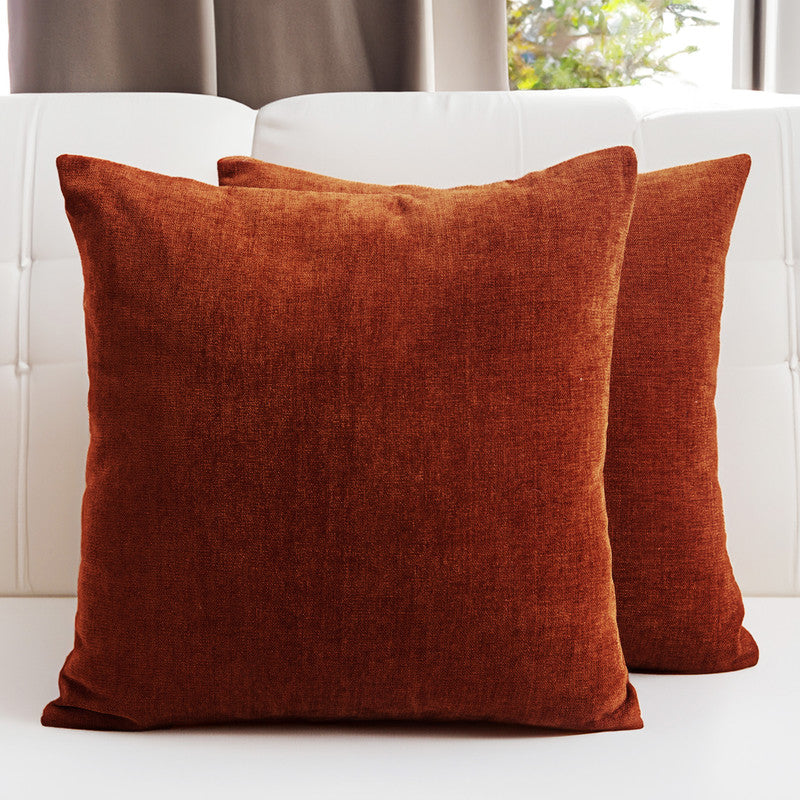
You zip a new 45 cm cover over the 18-inch filler from your old set. The numbers look like a match, so you expect a neat, full cushion. What you get has empty corners and a soft dip in the middle, and by the weekend it has folded over on the sofa like a tired sandwich.
The cover is fine, and the filler is not faulty. The pair is wrong, in a way the labels hide.
A cushion holds its shape only when the filler is pushing outwards against the cover all the time. So the filler has to be a little bigger than the cover, and it has to be made of something that keeps pushing for months. Microfibre gives the softest, fullest look, plain polyester fibre is cheaper and springier but goes lumpy sooner, and foam keeps an exact shape but feels like a block, which suits seat cushions far better than sofa cushions.
What actually gives a cushion its shape?
Think of the cover as a skin with a fixed size that cannot stretch much, and the filler as what pushes it out from inside. If the filler is the same size as the cover, there is nothing left over to press into the corners, so the corners stay empty and the centre has room to slump. Give the filler a few extra centimetres and it is squeezed in on every side. That squeeze is what fills the corners, rounds the face and makes the cushion spring back after someone leans on it.
Every filler loses some of that push over time. Fibres get pressed flat, foam gets softer, and the extra size you started with is slowly used up. So the two choices go together. The material decides how fast the push fades. The size decides how much push you start with.
Microfibre, fibre and foam, side by side
| Microfibre | Polyester fibre | Foam | |
|---|---|---|---|
| What it is | Polyester spun very fine, blown loose | Thicker polyester strands, often hollow | A solid block or sheet of PU foam |
| Feel | Soft, sinks a little, then rises | Bouncier and firmer | Firm and even, little sink |
| Look in a cover | Rounded face, full corners | Full at first, lumpier with age | Flat face, square edges |
| Snug-fit rule | Applies | Applies | Does not apply; match the size |
| After washing | Dries slowly, fluff by hand | Can come back lumpy | Avoid soaking it |
| Best use | Sofa and bed cushions | Budget sets, cushions used now and then | Chair pads, floor seats, firm back cushions |
Is microfiber cushion filler worth paying more for?
On a sofa you sit on every day, usually yes. The strands are much finer than ordinary fibre, so more of them fit in the same space and they tend to slide past each other instead of knotting. That is why a microfibre cushion looks full and smooth, and why it takes a punch in the middle and slowly rises again.
The catch is that microfibre is soft by nature. If you want a cushion that props your back up while you work on a laptop, a microfibre one will sink further than you expect. At the same size, the filler with more grams in it has more to give before it goes flat. Many sellers print the fill weight on the pack or the listing, so compare grams at the same size rather than trusting the word "premium".
Polyester fibre
This is what many low-cost fillers are, and it is not a bad buy. The fibres are thicker and often hollow, which gives a bouncier feel, and a new fibre cushion can look as full as a microfibre one.
The difference shows up later. Thick fibres catch on each other, and over months of daily use they gather into clumps with thin patches between them. You feel it first as lumps under your hand, then you see it as a wavy face on the cushion. Washing speeds this up, because wet fibres press together and dry in whatever shape they ended up in. For cushions on a guest bed or a chair that is mostly decoration, none of this matters much, and the lower price wins.
Foam: does it belong in a cushion cover?
Foam is the odd one out. A foam block does not squash into corners or round out a face. It sits inside the cover at the size it was cut, so the snug-fit rule does not work with it. A foam piece cut bigger than the cover just buckles and pushes the zip open. For foam, measure the cover and match it.
That makes foam right for jobs where you sit on the cushion rather than lean on it: a dining chair pad, a floor seat around a low table, a firm back cushion on a diwan where the shape must stay square. On a sofa it looks stiff, and the flat edges show through thin covers. A "foam cushion" sold for sofas is sometimes a foam core wrapped in fibre, which behaves more like a fibre cushion and is fine.
The inch-and-centimetre trap
Fillers in Indian shops are often sold in inches: 12, 16, 18, 20 and 24. Our covers, like many others, are sized in centimetres: 30, 40, 45, 50 and 60. The common advice is that the filler should be an inch or two bigger than the cover. The trouble is that the conversion makes some pairs look bigger when they are really the same size.
Take the most common case. A 40x40 cm cover is 15.7 inches across. A "16-inch" filler is 40.6 cm. On paper the filler is bigger. In practice it is 6 mm bigger, which is nothing once the fibres settle. This is the pair that looks like the right match and goes flat within weeks.
The same thing happens one size up. A 45 cm cover is 17.7 inches, so an 18-inch filler is barely 7 mm over. That is the pairing in the opening scene. For a full look, skip to the next filler size:
- 30 cm cover: a 14-inch filler (5.6 cm over). A 13-inch one gives a softer look.
- 40 cm cover: an 18-inch filler (5.7 cm over), the usual full sofa cushion.
- 45 cm cover: a 20-inch filler (5.8 cm over).
- 50 cm cover: a 22-inch filler if you can find one. If not, a 20-inch filler with plenty of fill weight is the fallback.
- 60 cm cover: a 26-inch filler.
Those gaps sit at the full end of the "inch or two" rule. If you like a softer, squashier cushion, aim for 3 to 4 cm instead. Do not go much past 6 cm. Beyond that the zip is under strain each time someone leans back, and the seams wear faster.
Choosing covers around the filler you already have

Many people do not buy filler and cover together. They own six fillers from the last set and want new covers. In that case, turn the rule around and pick the cover size from the filler.
If your fillers are 18 inches, the cover you want is 40x40 cm, not 45. A 45 cm cover is the size that sounds right and leaves the 18-inch filler loose. Our cotton ticking navy stripes covers come in both sizes, and this is the one choice on that page where the fillers already in your cupboard should decide for you.
If your fillers are 20 inches, the 45 cm cover is the snug one. The chenille in mustard is a heavy fabric that sits smoothly over a tight fill, and it is sold in 40, 45, 50 and 60 cm, so you can match it to whichever fillers you own.
The awkward one is the 24-inch filler, a common size for large back cushions. A 60 cm cover is the same size, so it sags. A 55x55 cm cover is about 6 cm smaller, which is right. Our cotton canvas covers in charcoal grey are made in 55 cm as well as 40, 45 and 60. They are sold as covers only, with a concealed zip, which is what you want when the fillers are already sorted.
Thin covers show lumps, thick ones hide them

The cover fabric changes how forgiving the filler needs to be. A thin cotton cover sits close to the filler, so every lump in a tired fibre filler shows on the face. Under a cotton cover, microfibre is worth the extra money. A thick or padded cover covers a lot of that up. The quilted velvet in dark grey is quilted on both sides, so small lumps in a budget fibre filler are much harder to spot. If you are trying to make old fillers last another year, that is the kind of cover to put over them.
So the order you buy in matters. With brand-new microfibre fillers, any fabric in the cushion cover range will look good, thin cotton included. With fillers that are two or three years old, stay with the heavier chenille covers, velvet or quilted ones until you replace them.
Bringing a flat cushion back
Start by working out what failed. Take the filler out and hold it up by one corner. If it is still the right size but the fibres have packed down, the cushion can be saved. If it is visibly smaller than the cover, it cannot.
For packed-down fibre or microfibre, open the filler up again by hand. Squeeze it from all sides, pull the clumps apart through the casing, and leave it in the open air, out of direct sun, for a few hours. Put it back by folding it in half, pushing it into the far corners of the cover first, and then letting it open out.
If the filler is clean but has shrunk, one cheap fix is to keep the filler and buy the next cover size down. A sagging 45 cm cover becomes a full 40 cm one. Lumpy fibre that will not pull apart, or a filler that smells musty after drying, is past saving. Replace it, and this time go one size up from the cover.
Common questions
Can you wash a cushion filler?
Fibre and microfibre fillers can usually take a gentle hand wash, but drying is the hard part. The middle stays damp long after the outside feels dry, and damp filler in a closed cover can smell. Dry it flat in a breezy spot and turn it often. Never soak foam. Wipe it and let it air.
How long does a cushion filler last?
It depends on how often the cushion is used, not on time. A cushion that someone leans on every evening flattens much sooner than one on a bed that is mostly decoration. Replace it when fluffing no longer brings it back to full size.
What filler is best for a floor cushion?
For a cushion you sit on, foam or a firm, heavy fibre fill. Microfibre is too soft for that job and you sink right through it to the floor. For a big floor cushion you lean against, a full microfibre filler is more comfortable.
Is cotton filler better than microfibre?
Traditional cotton filling is firm and breathes well, but it packs down hard and is difficult to fluff again. It also does not like getting damp. For sofa cushions in a modern home, microfibre is easier to live with.
Related guides
- Cushion cover sizes for Indian sofas, which matches each cover size to the seat it suits.
- How many cushions for a 3-seater or L-shaped sofa, once you know the sizes.
- Cushion cover mistakes that make a sofa look cheap.

Leave a comment
This site is protected by hCaptcha and the hCaptcha Privacy Policy and Terms of Service apply.