
A double bedsheet on an ironing board usually goes wrong like this. You press a strip in the middle and it looks good. Then you pull the next strip onto the board, and the part you just ironed slides off the far side and hangs there, bending over the edge under its own weight. One corner has been on the floor the whole time. By the end, the sheet has nearly as many creases as when you started. They are just in new places.
The sheet is far bigger than the board, so most of it was always hanging.
To iron a bed sheet, fold it in half lengthwise first, so it is half as wide and two layers thick. Lay that folded width along the long side of your surface, iron one face section by section, then turn it over and iron the other. Give the rest of the sheet somewhere flat to wait while you work, so the only folds it gets are the ones you put in at the end.
Why a bedsheet fights the board
Take a sheet sold as a double in 90 x 100 inches, which is about 229 x 254 cm. Indian sellers do not agree on sizes: one shop's double is another's queen, and kings run from 104 to 108 inches on a side. Measure your own sheet before you trust a label.
A Large ironing board is about 120 to 127 cm long and 37 to 40 cm across. Our board size guide has the full set. Even folded in half, that sheet is about 115 cm wide and 254 cm long. Lay it on the board and roughly 40 cm of its length is on the board at any moment. The rest, about 2 m of it, hangs off the two sides.
That hanging cloth does the damage. Its weight pulls at the warm section you are pressing, the finished part creases where it bends over the edge, and the corners pick up dust from the floor.
Some guides say you only need to iron the top quarter of a sheet. That advice assumes a duvet or quilt covers the rest of the bed all day. On many Indian beds the flat bedsheet is the top layer by day, so the middle shows too, and a crease down the centre is the first thing anyone sees.
Should bed sheets be ironed damp or dry?
A slightly damp sheet gives up its creases far more easily than a bone-dry one. Guides written for homes with a tumble dryer say to take the sheet out early, but many Indian sheets come off a line, often bone dry and a little stiff after the sun.
So bring the sheet in slightly before it is fully dry if you can. If it is already dry, sprinkle it with water or use a spray bottle, roll it up loosely and leave it a while so the damp spreads evenly. In the monsoon the problem reverses: sheets often come in still damp, which makes this a good time to iron them. Just let the ironed sheet air over a chair or a rod before it goes into the cupboard, because warm, damp cloth folded away tightly can start to smell musty.
Before you start, check the iron symbol on the label. Under the international care-label convention, three dots allow up to about 200°C, the cotton and linen setting. Two dots mean about 150°C, and one dot means about 110°C, the setting for polyester and microfibre sheets. For a blend, follow the label. If it is missing, start low and go up only if the creases stay. Our guide to care label symbols covers the rest.
How to iron bed sheets, in order
- Clear the surface and the space around it. Spread a clean cloth wherever the waiting part of the sheet will rest: the far end of the table, a chair, or the floor beside you.
- Fold the sheet in half lengthwise, long edges together, right side out. For a dark or block-printed sheet whose colour you want to protect, fold it wrong side out instead, since dark cloth is safer ironed on the reverse. Smooth the fold flat with your hands.
- Lay the folded width along the long side of your surface, starting at one hem. Iron the top layer in long strokes. The layer underneath is the other half of the sheet, and its outer face gets its own turn in step 5.
- Move the next section onto the surface. The finished part goes onto the clean cloth flat, or loosely gathered along the fold. Do not let it hang.
- At the far hem, turn the whole folded sheet over and work back the other way. Because the sheet is folded right side out, these two faces are the entire right side, and every part of it has been under the iron.
- Once the last section has stopped steaming, fold the sheet to cupboard size, flat and once. Folds you make on purpose are fine; it is the accidental bends over an edge while the cloth is hot that set. Press the new folds lightly, or not at all if you dislike crease lines on a made bed. Brabantia, which makes laundry goods, advises against ironing along the crease, or the sheets will look as if they have "just come out of the pack" on the bed.
- Do the pillow covers last. Lay each one flat, iron one face, turn it, iron the other, and smooth the opening flap flat with your hand before you press it.
How many moves each surface takes
The number of times you shift the sheet is the number of chances it has to crease again. Here is the same 229 x 254 cm sheet, folded in half, on four common surfaces.
| Surface | Size | Lay-downs for one face | Both faces |
|---|---|---|---|
| Large ironing board | About 120–127 x 37–40 cm | 7 | 14 |
| Wide ironing board | About 44–48 cm across | 6 | 12 |
| Small ironing mat | 70 x 50 cm | 12 (two per section, since the fold is wider than the mat) | 24 |
| Large ironing mat | 120 x 70 cm | 4 | 8 |
The counts assume the folded 115 cm runs along the surface's length, the 254 cm is fed across its width, and each count is rounded up. On a board the count is a little worse in real life, because the nose narrows and the folded width does not all sit on the wide part. A king sheet of 108 x 108 inches (about 274 cm) folds to about 137 cm, which overhangs a 120 cm mat by about 17 cm. Slide the sheet sideways to reach that strip, the same way you would with a saree on a mat. The length still takes four lay-downs a face.
What about fitted sheets?
Iron only the flat top panel and keep the iron off the elastic, since heat can weaken it. The corners sit under the mattress, so smoothing them by hand is enough.
Some home sites suggest putting the fitted sheet on the bed and ironing it in place. House Digest, which describes the trick, also says to take off any mattress protector first and to avoid it on memory foam or latex mattresses. Even on a plain mattress, a bed gives way under the iron, which is why ironing without a board works better on something firm.
How do you iron a bed sheet without an ironing board?
On a large mat, on a dining table or a clean floor. A table needs a clear 120 cm for the mat, plus room at one end for the waiting sheet. The floor gives you the most room of all. Many Indian homes already iron sitting on the floor, and for a sheet that is 2.5 m long it is the easiest place to keep the whole thing flat. Sweep first, because grit under the mat presses into the cloth.

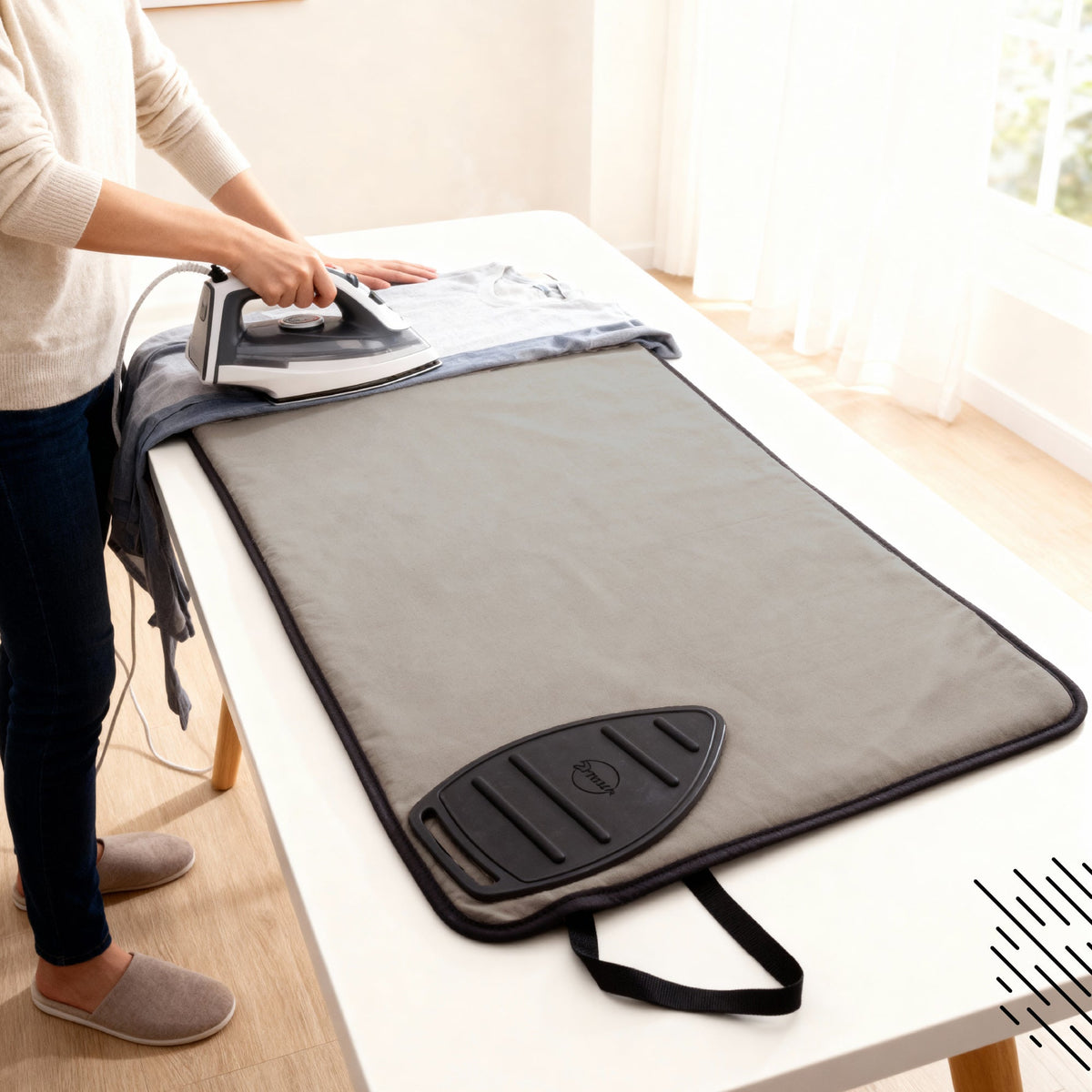
The 120 x 70 cm size is the one that brings a double sheet down to eight lay-downs. The Daisy Beige ironing mat, pictured above with a pair of trousers for scale, is ₹999 in that size. It is cotton over 3 mm of felt padding, with a silicone iron rest, and it rolls up with a strap. If you iron mostly white or pale sheets, a pale mat like this one is the better pick, because a dark print can show through thin cotton such as mulmul. The print makes no other difference to a sheet, so if you prefer another one from the ironing mat range, the only thing to check is that you are buying the 120 x 70 cm option. Several prints also come in a small size, and the large size of some has sold out.

What if nothing in your home clears 120 cm? Then the small 70 x 50 cm mat still works, with the 24 lay-downs from the table: about three times the moving, but no hanging cloth if the rest waits on the bed or a chair. On a polished counter, grip matters more than print. The Cotton Natural anti-slip mat in 70 x 50 cm, ₹999, has a dotted base that its photos show clearly, and the iron rest sits on a fold-out flap so it takes none of the ironing area.
If you are keeping your board, it will do the job with more lay-downs. A Wide board saves one move a face over a Large one. If its pad has gone flat and lumpy, long strokes on a sheet will catch on it. A replacement ironing board cover in a Medium or Large size costs less than a large mat. The mat, board and silicone pad comparison covers the wider choice.
Common questions
Do you need to iron bed sheets at all?
Not if the creases do not bother you; plenty of people never iron them. You can get some of the effect by taking the sheet off the line slightly damp, shaking it out hard and folding it flat straight away. Ironing earns its time where the cloth shows: the top of a flat sheet that stays uncovered by day, and pillow covers.
What temperature should I iron bed sheets at?
Whatever the label's dots allow. Cotton is usually three dots, up to about 200°C, and takes steam well. Polyester and microfibre sheets are usually one dot, up to about 110°C, and turn shiny or melt if pressed hotter. Iron dials differ between makers, so read the dots, not a number on the dial.
How do you iron linen sheets?
The same way as cotton, with more water. Linen usually carries the same three-dot ceiling as cotton, but it creases deeply and dries stiff, so iron it properly damp and give it steam. It will crease again in use; a soft rumple is simply how linen behaves.
Why does my sheet crease again right after ironing?
It moved while it was still hot. Cloth that hangs over an edge or gets bundled up straight off the iron sets new creases as it cools, and so does a sheet folded tightly while still damp. Let each section lie flat for a moment after you press it, make the storage folds only once the steam has gone, and keep heavy things off the pile in the cupboard.


Leave a comment
This site is protected by hCaptcha and the hCaptcha Privacy Policy and Terms of Service apply.