
Most guides on this open with the same fact: the standard ironing board cover is 137 × 38 cm, or 54 × 15 inches. That figure has been copied across so many pages it reads like a law of physics. It is the size commonly quoted in US and UK guides, and it often does not match the board sitting in an Indian home. Buy to it blind and you can end up with a cover that either flaps loose at the tail or will not stretch over the nose.
The fix is not a better number to memorise. It is measuring the board you actually own. A cover fits when four things about it match, and none of them is the brand name printed on the frame.
What you need before you buy
To size a cover, take four measurements off the board itself: its length from nose to tail, its width at the widest point, its thickness with the existing pad on, and whether the nose is pointed or rounded. Match those to a size rather than to a brand, because a single manufacturer can span many lengths. Bathla alone makes boards from roughly 109 cm to 143 cm, so "a Bathla cover" tells you almost nothing until you have the tape out.
The four measurements to take
Lay the board flat and open, and work in centimetres, because that is how Indian covers are labelled.
Length runs from the very tip of the nose to the square end at the tail. Measure the ironing surface only. Many boards have a small perforated iron rest that folds off the back edge, and if you include it you will read the board as longer than it is and buy a size up. Ignore the rest plate entirely.
Width is taken across the broadest part, which on most boards is a little in from the tail rather than dead centre. Run the tape at right angles to the length and note the widest number you find.
Thickness is the one people skip, and it is the reason a cover that should fit sometimes will not cinch closed. Measure straight through the board and its existing pad together. A worn board with a fat old felt pad has a deeper edge to wrap, and that depth eats into the drawstring or elastic you have to close underneath.
Nose shape is the last check and it is simply pointed or rounded. A pointed nose needs a cover cut with a matching point, or the fabric bunches at the tip and never lies flat. Look at your board end-on and note which it is.
No tape measure to hand? Stand the board on a sheet of newspaper and trace around the surface with a pencil, then measure the outline later, or lay a broomstick along the length and mark it. When you are genuinely unsure and stuck between two sizes, order the larger one. A cover that is slightly big can be cinched down, whereas one that is too small will never reach.
Ironing board cover size chart for India
There is no universal standard here, whatever a product label claims. What there is, is a set of footprints the boards sold in India tend to fall into. The chart below maps them to the cover sizes Encasa stocks, in centimetres, so you can match the two numbers you just measured against a row.
| Size | Fits a board of (length × width) | Where you tend to see it |
|---|---|---|
| Mini / tabletop | 70–74 × 28–32 cm | Compact tabletop boards for small flats |
| Bathla-fit | 109 × 38–40 cm | Sized to fit compact Bathla boards with an antenna hole, such as the X-Pres Ace Plus |
| Medium | 110–114 × 32–36 cm | Narrower free-standing boards |
| Large | 120–127 × 37–40 cm | The most common full-size board sold in India |
| Wide | 123–127 × 44–48 cm | Wide-top boards such as the Peng Essentials Maxima and Yolo |
| X-Large | 133–137 × 44–48 cm | Larger hotel and commercial boards such as the Bathla X-Press Lite |
Two things worth calling out from that table. The Large is the row many home boards land on, which is a good part of why the 137 × 38 cm "standard" leads people astray: it is longer and narrower than what a lot of people here are actually measuring. And the Bathla-fit is the odd one out. Some compact Bathla boards have a hole moulded into the surface for the iron-cord holder, so a flat cover cannot sit right over them. The Bathla-fit cover is cut with a matching opening for that antenna. It is a shape match, not a brand endorsement, and if your compact board has no such hole you want the Medium or Large instead.
Your two numbers will not always land in the same row, and that is the case worth planning for. If your length reads Large but your width is up at 44 cm, size to the wider row, the Wide, and let the fastening take up the small length difference rather than forcing a cover that cannot reach across the board. When both numbers sit near a boundary, the ironing board cover collection lists the exact centimetre window for each size, so you can match against the tighter of your two measurements.
Should you measure with the old cover on or off?
Off. An old cover has stretched, and its own drawstring channel and hem add a couple of centimetres of fabric that were never part of the board. Strip it back to the bare board and pad, then measure. The one thing the old cover is good for is telling you the nose shape and roughly where the board is widest, if it is too awkward to eyeball. Read the board, not the thing you are replacing.
Elastic or drawstring: which forgives a rough measurement
How a cover closes matters as much as the size on its label. Two covers can list the same dimensions and behave very differently at the edges depending on the fastening, and that decides how much room your measurement has to be slightly off.
Drawstring-and-lock covers thread a cord through the hem that you pull tight and clamp. Cinched properly they pull the fabric drum-tight for a crease-free surface, which is what you want if you iron a lot of shirts. The trade-off is that they expect a closer match. The Big Leaves Blue cover states its window plainly: it is made for a board 119 to 124 cm long and 36 to 40 cm wide. Land inside that and it sits perfectly. Stray far outside it and no amount of pulling saves you.
Elasticated covers run a stretch band around the whole hem, sometimes with a fitted nose pocket, so the cover grips itself onto the board and self-adjusts within a range. That makes them the forgiving choice when your measurement sits near the edge of a size, or when you are buying for a board you cannot measure precisely. The Canvas Powder Pink cover is the elasticated kind, with a nose pocket and a 4 mm felt pad. If you are between sizes and would rather not fuss with a cord, this is the safer bet.
Why pad thickness changes the size you need

Padding does more than soften the surface under the iron. It changes the effective edge the cover has to wrap around, which is why the thickness measurement earns its place among the four.
A thinner fibre pad of around 3 mm keeps the board edge slim, so the cover has less depth to fold under and closes easily. A thicker felt pad of 4 mm or more, like the one on the Powder Pink, gives you a plusher, more even surface and better heat spread for heavier cotton and linen, but it deepens the edge. That extra depth uses up drawstring slack. So if you are re-covering a board that already carries a thick pad, or planning to keep that pad under a new cover, read your thickness generously and lean towards the more forgiving elasticated fit rather than a drawstring cut for the tightest match.
When a mat beats a cover

Sometimes no cover is the right buy at all. If the board is warped, the frame wobbles, or the surface is so far gone that a fresh cover would only dress up a bad base, re-covering is throwing good money after bad. The same goes for boards that are not free-standing at all: wall-mounted, over-door and cabinet units that a drawstring simply cannot wrap around, and the growing number of small flats with no room for a board in the first place.
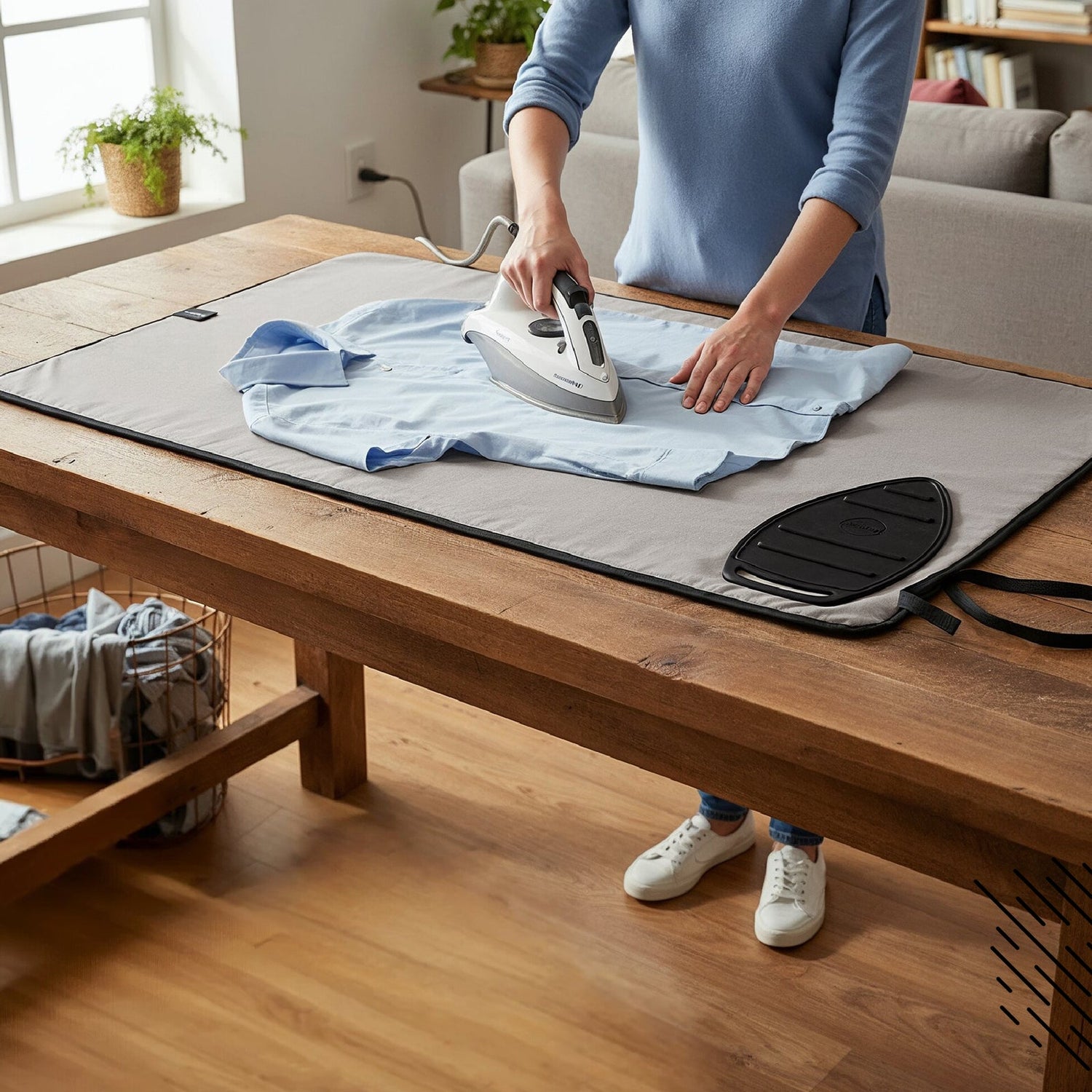
An anti-slip ironing mat solves all of those. It lies flat on any firm surface, a dining table, a kitchen counter or a bed, grips so it does not slide, and rolls away when you are done. The Cotton Grey ironing mat comes in a large 120 × 70 cm and a small 70 × 50 cm, which covers everything from a full bedsheet press to a quick collar touch-up. If a cover is a headache to size for your setup, browse the ironing mats instead and skip the measuring entirely.
Buying in bulk for hotels and laundries
A single home has one board to measure. A property with thirty rooms usually has a mixed fleet, a few board models bought over several years, and sizing them one by one is a waste of a housekeeper's afternoon. The safer route is to match by measurement across the fleet, group the boards into two or three size bands, and order against those. Very compact hospitality boards with 77 to 90 cm surfaces, and the wall-mounted units common in hotels, rarely take stock covers and are better served by mats or made-to-size runs. The bulk ironing covers and mats page carries the full India size chart and handles mixed-fleet orders, so commercial buyers can size once rather than guessing per unit.
Common questions
What is the standard ironing board cover size in India?
There is no single official standard. In practice most full-size boards sold in India fall around 120 to 127 cm long and 37 to 40 cm wide, which maps to a Large cover. The 137 × 38 cm figure quoted on many international guides is a US and UK convention and tends to run longer and narrower than boards here.
Should I take the measurement with the old cover on or off?
Off, always. A used cover has stretched and its hem adds fabric that was never part of the board, so measuring over it reads a size too big. Strip it back to the bare board and pad first.
What is the difference between elastic and drawstring covers?
A drawstring cover has a cord you pull tight and lock, which gives the tautest, most crease-free surface but wants a close size match. An elasticated cover grips itself around the hem and self-adjusts within a range, so it forgives a measurement that sits near the edge of a size.
Can I use an ironing mat instead of a cover?
Yes, and for some setups it is the better choice. A mat suits a damaged board, a wall-mounted or over-door board a cover cannot wrap, or a home with no room for a board at all. It lies on any firm surface and needs no sizing beyond picking a mat larger than what you press.

Leave a comment
This site is protected by hCaptcha and the hCaptcha Privacy Policy and Terms of Service apply.