
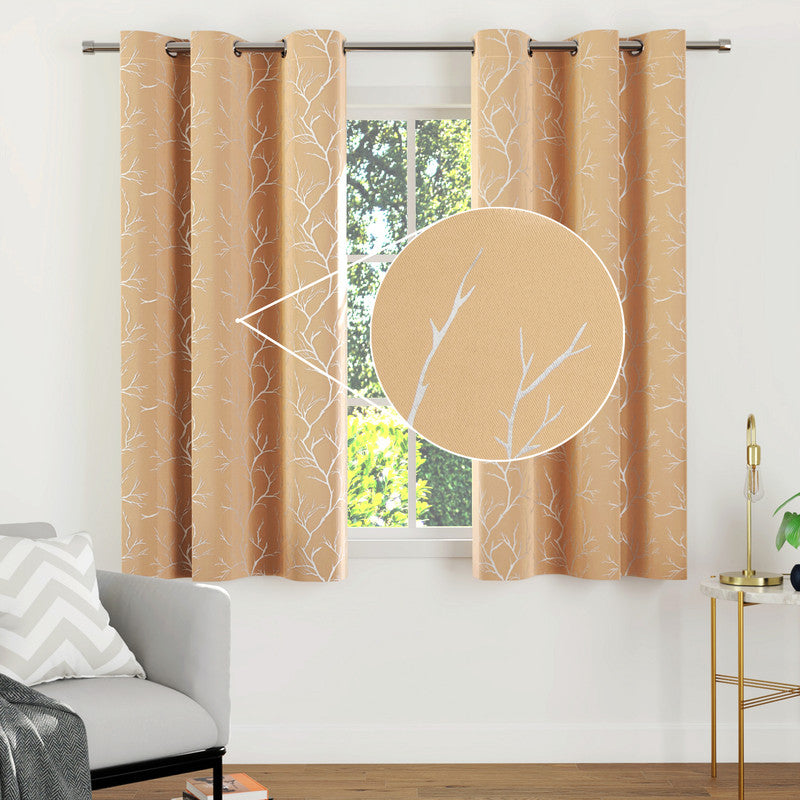
A curtain order goes wrong more often than it should. The panels arrive, the eyelets go on the rod, and the hem stops a hand's width short of the floor, or worse, pools in a heap because it was cut too long to begin with. Almost every time, the buyer measured the window. They should have measured the rod.
Measuring for curtains comes down to two numbers: the drop, from where the rod will actually sit down to where you want the hem, and the width, from end to end of that same rod. Both are taken with the rod's real position already decided, not guessed from the window frame, and both get rounded up to the next ready-made size, never down. Everything else in this guide is about getting those two numbers right the first time.
What exactly are you measuring?
Length and width sound obvious until you notice that neither one refers to the window. The drop is a vertical line from the rod to your chosen hem point, floor, sill or somewhere in between. The width is the horizontal length of the rod itself, finial to finial or bracket to bracket, not the glass it covers. A window that is 120 cm wide might sit under a rod that is 150 cm wide, because the rod should run well past the frame on both sides.
Use a metal tape measure, not a fabric or dressmaker's tape. Fabric tape stretches slightly under its own weight on a long vertical run, and on a drop of two metres that stretch is enough to read a couple of centimetres short. A retractable steel tape or a laser measure holds its length under any conditions, which matters more here than it would for a cushion cover.
Where does the drop measurement actually start?
This is the step that trips up most first-time measurers, and it depends on the hardware. Ready-made curtains in India are almost always eyelet style, metal rings sewn directly into the fabric that the rod passes through, and that changes where the true top of the panel sits.
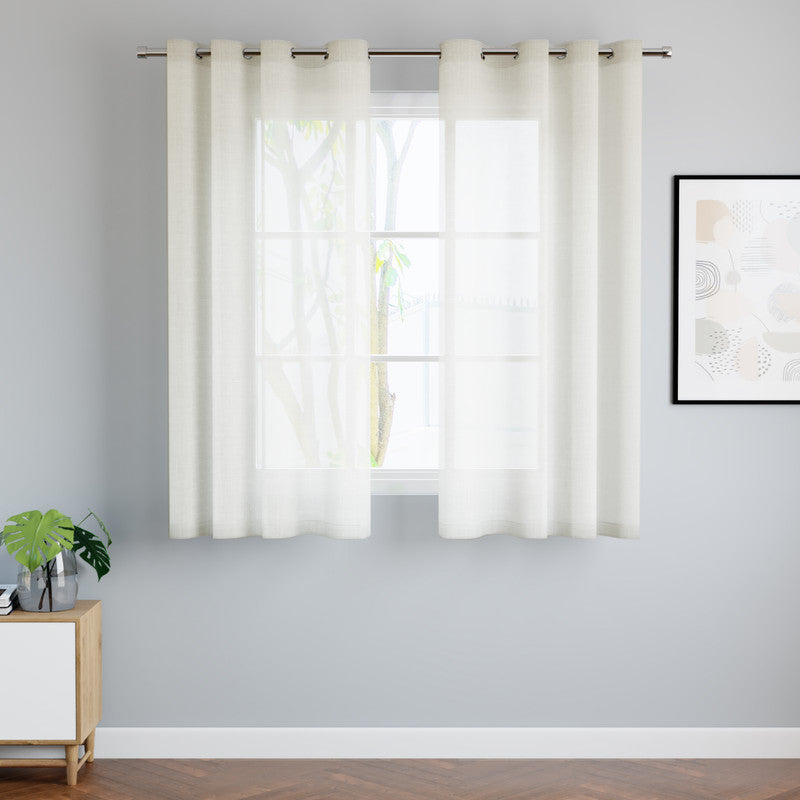
For an eyelet curtain, the kind most ready-made panels here are, hold your tape at the rod line itself. The take-up through the rings is small, about 2 cm, so the finished panel length you need is very close to the raw rod-to-hem number. A cotton soft grey panel shows the arrangement clearly: the rod passes straight through the metal rings, and the fabric starts just under them. If your curtains hang from separate rings with clips instead, that gap is much bigger, typically 6 to 8 cm between the rod and where the fabric proper begins, and skipping that allowance is exactly how a clip-hung panel ends up puddling on the floor when the same drop was measured for eyelets. Check which hardware you actually have before you commit to a number.

How do you measure a window for curtains, step by step?
Work through these in order. Skipping the first one is the single most common reason the final number is wrong.
- Decide the rod's position first. Mount it, or at least mark where it will go, about 10 to 15 cm above the window frame and 15 to 20 cm past each side. If the rod is already up, measure from where it is.
- Measure the drop from that rod line down to your hem target, keeping the tape vertical and flat against the wall, not at an angle, all the way to the floor, sill or wherever you want the hem to land.
- Adjust for the hardware: subtract roughly 2 cm for eyelets, or roughly 6 to 8 cm for rings and clips, since that fabric doesn't start exactly at the rod.
- Round up to the next ready length. Ready-made curtains come in a small number of fixed sizes, so a number that falls between two of them always takes the longer one. You can raise a rod a little to use up slack; you cannot stretch fabric that was cut short.
- Measure the rod's own width, finial to finial, for the width side of the equation.
- Check both ends of a wide window or door, not just the centre. Older frames and freshly plastered walls are rarely perfectly level, and the longer of your two readings is the one to buy for.
A worked example
Take a bedroom window whose opening is about 120 cm tall, with its top edge 195 cm above the floor, so the sill sits at 75 cm. Both are fairly typical in an Indian flat. The rod goes up 12 cm above the frame, and the curtains are the usual eyelet style, hemmed to just clear the floor.
| Step | What it accounts for | This example |
|---|---|---|
| Rod height from floor | frame-top height plus rod clearance | 195 + 12 = 207 cm |
| Eyelet allowance | fabric starts just below the rod line | − 2 cm |
| Hem clearance | gap kept above the floor | − 1 cm |
| Required drop | rod height minus both allowances | 204 cm |
| Ready length to buy | rounded up, never down | 7 ft (213 cm) |
Someone who measured the window itself rather than the rod would have read the 120 cm opening and reached for the 5 ft (152 cm) curtain. Hung from a rod at 207 cm, that panel covers the glass and stops around 53 cm above the floor, which looks like a half-curtain in a bedroom. The 7 ft (213 cm) length only shows up once the rod position and the hardware allowance are both in the sum. If a full breakdown of what the 5, 7 and 9 ft sizes are each meant for would help, the curtain size guide sets it out with a chart.
Taking the width measurement
Width follows the same logic as the drop: measure the rod, not the window. A rod mounted 15 cm past each side of a 110 cm frame comes to about 140 cm, and 140 cm is the figure you shop with. Turning it into a panel count is a separate calculation, worked through with examples in the guide to how many curtain panels a window needs.
Fabric weight changes how much the exact number matters once you're hanging the curtain. A heavy blackout panel that comes up even a couple of centimetres short shows daylight leaking along the bottom edge, so precision counts. A light cotton sheer from the cotton sheer range is more forgiving; a sheer that lands a touch above the floor still reads as airy rather than wrong, which is one of the differences covered in this blackout versus sheer comparison.

Common measuring mistakes
Most bad curtain orders trace back to one of a handful of habits. Measuring the window frame instead of the rod is the biggest one, and it is almost always what produces a curtain that stops short. Using a fabric tape on a long vertical drop is a smaller but real error, since the stretch adds up over two metres. Rounding a borderline number down instead of up is a mistake made under the belief that the seller's stated size is generous; it rarely is. And measuring only the centre of a wide opening, rather than both ends, misses the fact that most window frames are not perfectly level, so one side needs a longer drop than the other.
There's also a scale mismatch worth naming: a curtain rod is easy to eyeball wrong by 10 or 15 cm because there's no obvious edge to measure to, unlike a window frame with a visible border. Hold the tape to the actual rod, hardware and all, rather than estimating from where you think it sits.
Frequently asked questions
Do I measure before or after the rod is installed?
Either works, as long as you measure from the rod's real or planned position, not the window frame. If the rod isn't up yet, mark its height and endpoints on the wall with a pencil first, then measure from those marks. Measuring the frame directly is what leads to the wrong number. If the brackets are still to go up, how to hang curtains covers the height and width to mark before you reach for the tape.
Does the curtain length include the eyelets or rings?
For eyelet curtains, the fabric starts only about 2 cm below where the rod passes through, so the finished length is close to your rod-to-hem measurement. For curtains on rings and clips, the fabric hangs further from the rod, typically 6 to 8 cm lower, and that gap needs to come off your drop measurement before you round up to a ready size.
What if my measurement falls between two standard sizes?
Always take the longer one. A 190 cm requirement takes the 7 ft (213 cm) curtain, not the 5 ft, because a rod can be raised a little to take up any slack but a panel cut short can't be stretched. The extra length can also be adjusted by how high the rod sits.
Can I measure a window for curtains on my own?
Yes, though a second pair of hands makes long vertical drops easier. A tape with a locking clip, or hooking the end over a pin at your rod mark, lets you take the reading solo without the tape sagging or curling as you read the number at floor level.

Leave a comment
This site is protected by hCaptcha and the hCaptcha Privacy Policy and Terms of Service apply.