

Six in the morning on a fourth-floor balcony. The bamboo has been leaning against the grill since last night. The copper lota is washed and upside down on the kitchen counter, and the neem twigs are in a glass of water. On the chair is the saree meant for the gudi, a good silk one with a zari border, and it is far too long. Wrap it round a pole that only stands a metre and a half above the grill and it becomes a heavy bundle, not a flag.
Most of the cloth problem with a gudi is length. About one metre of bright cloth, pleated round the top of the pole under the pot, dresses a gudi on a balcony or beside a door. After that come the toran and rangoli at the door, which are flowers and colour powder, and the table for lunch, which needs a different cloth from the gudi.
In 2027, Gudi Padwa falls on Wednesday 7 April by Drik Panchang, Bhakti Bharat and officeholidays.com, the same day as Ugadi. A local panchang can differ by a day, so check yours.
How to make a gudi at home
A gudi is built from a handful of things, and only one of them is cloth.
- A bamboo or wooden pole, washed and dried.
- A bright cloth, often silk or a saree with a zari border, pleated and tied at the top.
- Neem and mango leaves and a garland of flowers, tied over the cloth.
- A garland of sugar crystals, called gathi.
- A copper, silver or steel pot or lota, placed upside down on the very top.
A common order goes like this. The cloth goes on first and is tied tight just below the tip of the pole. The leaves, flowers and gathi go on over it. The pot goes on last and holds the top of the cloth in place. Families add their own details, such as kumkum marks on the pot or a small rangoli at the foot, and those differ from one home to the next.
The gudi is mainly a Maharashtrian and Konkani custom. In Goa many families call the day Samvatsar Padvo. In Karnataka, Andhra Pradesh and Telangana the same day is Ugadi, which has its own customs, so the cloth advice here is about the gudi.
How much cloth does a gudi need?
Think of the cloth as a short skirt hung from the top of the pole. Cloth sold by the metre comes off a roll of fixed width, printed on the listing. The polyester satin we sell is 110 cm wide, so one metre of it is a piece 100 cm by 110 cm. Hang it with the 110 cm side running down the pole and pleat the 100 cm edge round the top. Say about 10 cm goes into the pleats and the tie. That leaves a drop of roughly a metre. On a pole that stands one and a half to two metres tall, that still leaves some bare pole showing below the hem.
Now the pleats. A bamboo about 4 cm thick measures about 12.5 cm round, so 100 cm of cloth gathered round it goes round roughly eight times over. That is a rough estimate, since pleat styles vary, but it is enough for deep folds that open out as the cloth falls, and thin enough for a lota to sit on. Gather the 2 m edge of a longer cut and the bundle under the pot is about twice as thick, which makes the pot harder to set level. A 2 m cut is only worth it hung the other way, for a longer drop.
| Cloth | How to hang it | Drop you get | Where it suits |
|---|---|---|---|
| 1 m of 110 cm cloth (100 x 110 cm) | 110 cm side down the pole, 100 cm pleated at the top | about 1 m | Most gudis: a balcony, a door or a terrace |
| 2 m of 110 cm cloth (200 x 110 cm) | 200 cm side down the pole, 110 cm pleated at the top | about 1.9 m | A tall bamboo in a courtyard, where the pole stands well above 2.5 m |
| One 43 x 43 cm cotton napkin | One side down, the other pleated round a thin stick | about 35 cm | A small gudi in a window or on a chowki |
The last row works because a napkin is already hemmed, so nothing frays. On a stick about 2 cm thick, which is about 6.3 cm round, its 43 cm edge goes round about seven times, close to the fullness of the big gudi at a smaller size.
A saree is many metres long, which is why it gets pleated over and over. If you would rather not fold a good saree round a pole, a metre of cloth is the cut-to-size option, and the saree stays something to wear on the day.
Which colour cloth for the gudi?

Saffron and orange, yellow, red and green are the colours you see most often, very often with a gold or zari border. None of them is the only right one. The pooja cloth guide goes through common colour customs for home worship, and the same rule holds here: your family's way comes first.
One thing is easy to forget in the shop: people see the gudi from below, against the sky. A bright, saturated cloth reads well from the street on a grey morning. A pale cream or pastel can disappear against a white building.
That is one reason people reach for satin. The orange satin is a bright, true orange that reads as saffron from a distance, and a 1 m cut costs a little over ₹300. The leaf green satin in the photo above is a deep emerald, darker than its name, and looks rich against neem and mango leaves. One colour name can mislead: "wine" photographs as a deep plum, not maroon. All of them sell in 1, 2, 3 and 5 m cuts on the fabric by the metre page.
This satin is polyester, even though the listing calls it silk. It drapes well and costs little, but it is slippery, and that matters on a balcony.
Where the gudi goes: the doorway, the balcony and the window

In many homes the gudi goes on the right side of the main door, so it is the first thing a guest sees. Stand it clear of the door's swing and of the shoe pile, because a drop that gets brushed by every visitor is crumpled and tilted by lunch. The toran of mango leaves and marigolds goes above the door and the rangoli at the threshold, so the gudi needs its own patch of floor to one side. Those two need a flower seller and a free hour, not a cloth shop.
In a flat, the balcony or a front window is the usual place, so the gudi can be seen from outside. Against a grey grill, a strong colour such as the rich red satin above reads from the road. Tie the pole to the grill in two places, not one.
Higher floors get wind. Smooth satin on smooth bamboo will slide down the pole a few centimetres at a time, and by noon the pot sits on bare wood. Two ties fix it. Tie the pleated top tightly with strong thread just below the tip, then wind the thread round the pleats once more about 10 cm lower. On very smooth bamboo, wind a few turns of thread round the top first so the cloth has something to grip.
For a window, go small: a short stick set in a pot of soil on the sill, dressed with a napkin as in the table above.
If a diya is lit near the gudi, mind the cloth. The satin here is polyester, and polyester melts and shrinks back when a flame reaches it. Keep the diya on a metal plate, keep it to the side rather than under the hem, and make sure the cloth cannot swing onto it in the wind. If the gudi stands on a chowki, put a plain cotton cloth on the chowki and keep the satin up on the pole.
The festive table: what goes under a ghee-rich meal

A Gudi Padwa lunch is often puran poli with ghee, shrikhand or amrakhand with puri, and a small bowl of the neem and jaggery mix. Satin is the wrong cloth for it: a drop of ghee can leave a dark spot on a shiny face that is hard to hide, and the slippery cloth lets a thali slide.
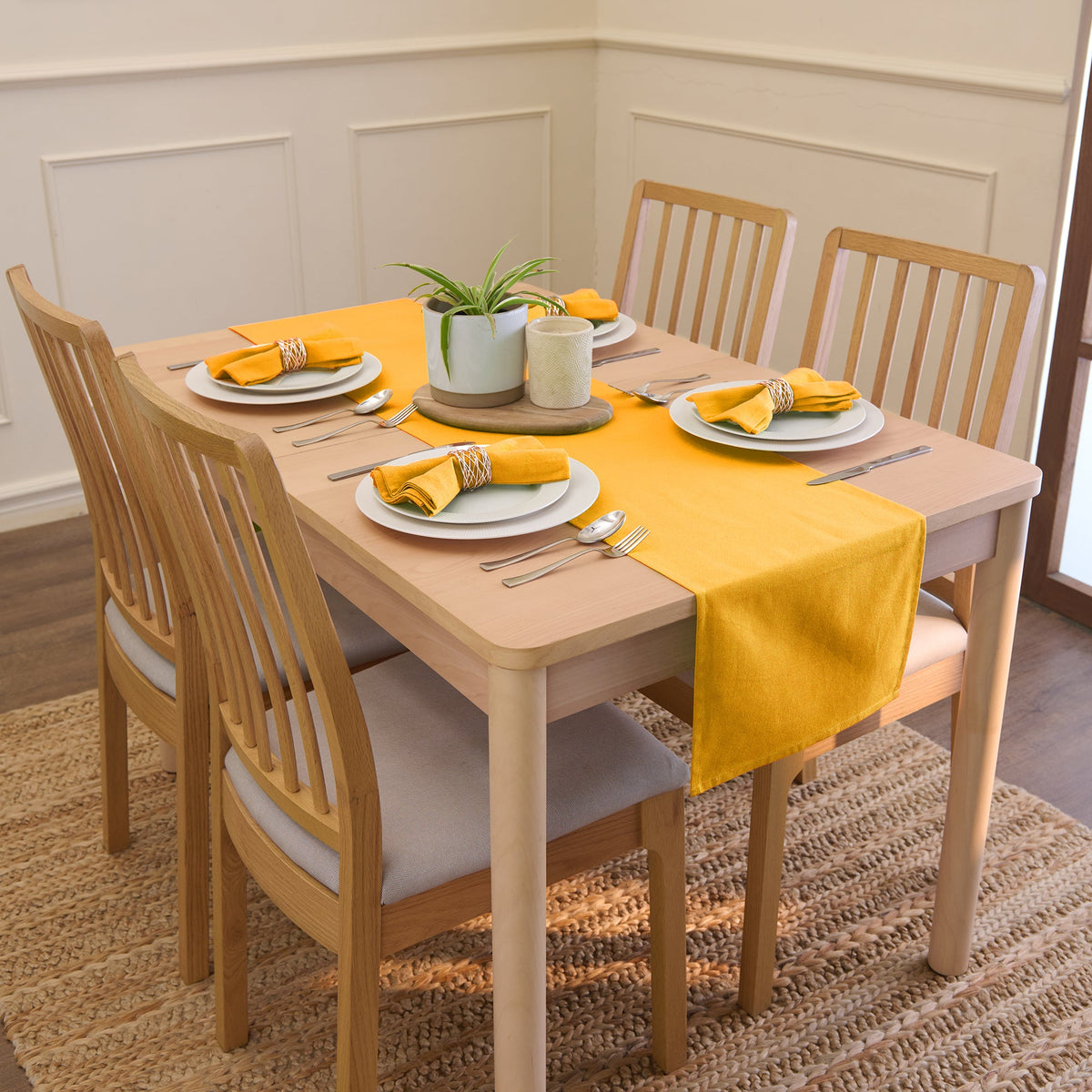
Use cotton on the table and keep the satin on the gudi. A cotton runner down the middle takes the serving bowls, and it goes in the machine that evening. The Cotton Mango Table Runner is a deep golden yellow, like a yellow marigold, that sits well beside a yellow or orange gudi, and the page lists machine washing in cold water. It comes in 32 x 122, 150 and 230 cm, all under ₹650 at selling prices on 27 November 2026, and the table runner size guide shows which length suits your table.
Puran poli is eaten by hand, so ghee goes from fingers to napkins. A dark colour hides a smear until wash day. The Cotton Leaf Green Table Napkins come as six 43 cm squares for under ₹900, and like the satin, their name is brighter than the cloth: in the photos they are a deep olive green, close to neem leaves. If you would rather match the runner, the table napkin range has mango and orange in the same 43 cm size, though a light colour will show the ghee sooner.
After the gudi comes down
Many families take the gudi down in the evening, though the timing varies by home. Untie the cloth before the leaves dry onto it, and shake out any flower petals and sugar. Wash the satin gently, by hand or on a gentle cycle as its page allows, and dry it in the shade. Iron it on the back at a low setting, as the satin care guide explains, because a hot iron can leave a glazed mark on polyester. A 1 m piece makes a chowki cover for the next puja, or a runner for a small side table. If you ever need more for a whole wall behind a puja, the backdrop cloth guide shows how to count the metres.
Common questions
What date does Gudi Padwa fall on in 2027?
Wednesday 7 April 2027, according to Drik Panchang for New Delhi. The festival is tied to a lunar day, pratipada, whose timing shifts with location, so a regional calendar may mark it a day apart.
Does Gudi Padwa fall on the same date as Ugadi every year?
Usually, yes. Both fall on the first day of the bright half of Chaitra and mark the new year in the lunisolar calendar followed in Maharashtra, Goa and the Deccan states. Gudi Padwa is the Marathi and Konkani name and comes with the gudi. Ugadi is celebrated in Karnataka, Andhra Pradesh and Telangana with its own foods and customs.
Is silk or satin better for a gudi?
Silk, often an old saree, is a common choice and has a soft glow. Polyester satin costs less and washes easily, but it is slippery and melts near a flame. Either works if it is tied firmly and kept away from the diya.
Can a gudi be put up indoors?
Yes. A small gudi on a window sill or a side table works, dressed with a napkin-sized cloth. Keep it short, so the cloth hangs clear of the diya and anything people walk past.


Leave a comment
This site is protected by hCaptcha and the hCaptcha Privacy Policy and Terms of Service apply.