
Boho is the one decor style many Indian homes already half own. Paisley, block-print florals, brass, cane and a dhurrie on the floor are what the global boho look borrows from, and plenty of us grew up with them. So the problem is rarely finding boho pieces. It is that a pile of them on the sofa can look like a cluttered shop shelf instead of a relaxed room.
The fix is to build the arrangement on purpose. A boho cushion set works when it has three things in it: at least one cover you notice by touch, at least one cover you notice for its pattern, and a small group of warm, earthy colours tying them together. Leave out the texture and it looks flat and printed. Leave out the colour limit and it looks like a jumble.
What makes a cushion look boho?
Boho is short for bohemian, and in decor it means a room that looks collected over time rather than bought as a set. That is the opposite of a matched pair of identical cushions at each end of the sofa. A boho sofa has cushions that clearly differ in surface, pattern and size, yet still look like they belong to the same person.
Three things carry that feeling.
Texture comes first because it is the part people skip. Woven, ribbed and nubby fabrics like jute, corduroy and chenille catch light unevenly, so even a plain colour has something going on. A boho set made only of smooth printed covers looks like a photo of boho rather than the real thing.
When people say boho, they usually picture the prints. Paisley, tribal-style geometrics, botanical prints and loose hand-drawn lines all read as boho. The trick is scale. Put one large, open pattern next to one small, busy one, and they sit together. Two prints of the same scale compete, even when the colours match.
None of that holds together without a short colour list. Boho leans on earthy shades: rust, mustard, terracotta, olive, sage, sand and a warm brown. Pick three or four from that family, add one neutral, and stop. A wider palette is possible, but it takes a trained eye to make it work.
Start from the sofa you actually have
Boho photos online are often shot on a white or oatmeal sofa in a bright room. Indian living rooms are more often built around a grey or beige fabric three-seater, a brown leatherette sofa, or a wooden diwan with a cotton gadda. Each one changes which of the three elements you need to push.
A grey sofa is cool and asks for warmth. Brown leatherette is the reverse: already warm and dark, and shiny on top, so another rust cushion just vanishes into it. A wooden diwan is the easy one, because the frame is doing half the boho work before a single cushion goes on.
| Your sofa | What it already has | What the cushions should add | A five-cushion mix |
|---|---|---|---|
| Grey or beige fabric | A cool, neutral base | Warm colour and a woven texture | 2 textured solids, 2 prints, 1 accent |
| Brown leatherette | Warmth and shine | Light grounds and a matte texture | 2 light prints, 2 textured solids, 1 accent |
| Wooden diwan or cane | Craft feel and warmth | A strong print, solids that stay quiet | 3 to 5 prints from one set, 1 or 2 solids |
The counts are a starting point for a three-seater. For how many cushions suit your sofa's length and shape, the rule of thumb is odd numbers and two sizes, with the larger cushions at the back.
Look one: a grey sofa that feels warm

Picture a grey fabric three-seater in a rented flat, white walls and a TV unit opposite. Nothing in the room is warm yet, so the cushions have to bring it.
Start with texture at the back corners. The jute cherry golden covers in 50x50 cm give you the woven, raw look of jute in a sand-gold shade that warms grey immediately. They are polyester woven to look like jute, not real jute, which tends to feel coarse against bare arms. In front of them, add the chenille in dusty brown at 45x45 cm. Its soft, heavy pile gives a second texture that differs from the jute, and the warm brown is what makes the grey look intentional.
That is four cushions and still no print. For the fifth, in the middle, use a large, loose pattern in a pale shade, so it does not fight the solids. The boho beige print has a white hand-drawn line on sand. Its pattern scale is large and calm, which is exactly what a set of two textured solids needs beside it. It comes as a pair, so the spare can go on an armchair to carry the look across the room.
Look two: a brown leatherette sofa that does not swallow everything

This is the hardest of the three to get right. The instinct is to reach for rust, mustard and brown, because those are the boho colours. On a chocolate leatherette sofa they sink into the background and the sofa just looks darker.
Turn the order around and lead with light grounds. The paisley print covers are a brown paisley on white. The white ground stands out against dark leather, and the brown motif links back to the sofa so the print does not look stuck on. They come five to a pack, which covers a whole three-seater or a sofa plus two chairs.
Five of the same print is too even for boho, though. Swap two of them for a matte texture in a pale shade. The natural chenille covers have a soft pile with little shine, which breaks up the gloss of the leather, and a pale colour stays visible on brown where the darker earthy shades disappear. Keep the two spare paisleys for a bedroom or a reading chair. A mustard accent is optional here, and if you add one, make it a single small cushion.
Look three: a wooden diwan with a print that carries the room

A teak diwan, a cane chair or a wooden bench sofa already does half of the boho job. The frame is warm and handmade-looking, so the cushions can be bold.
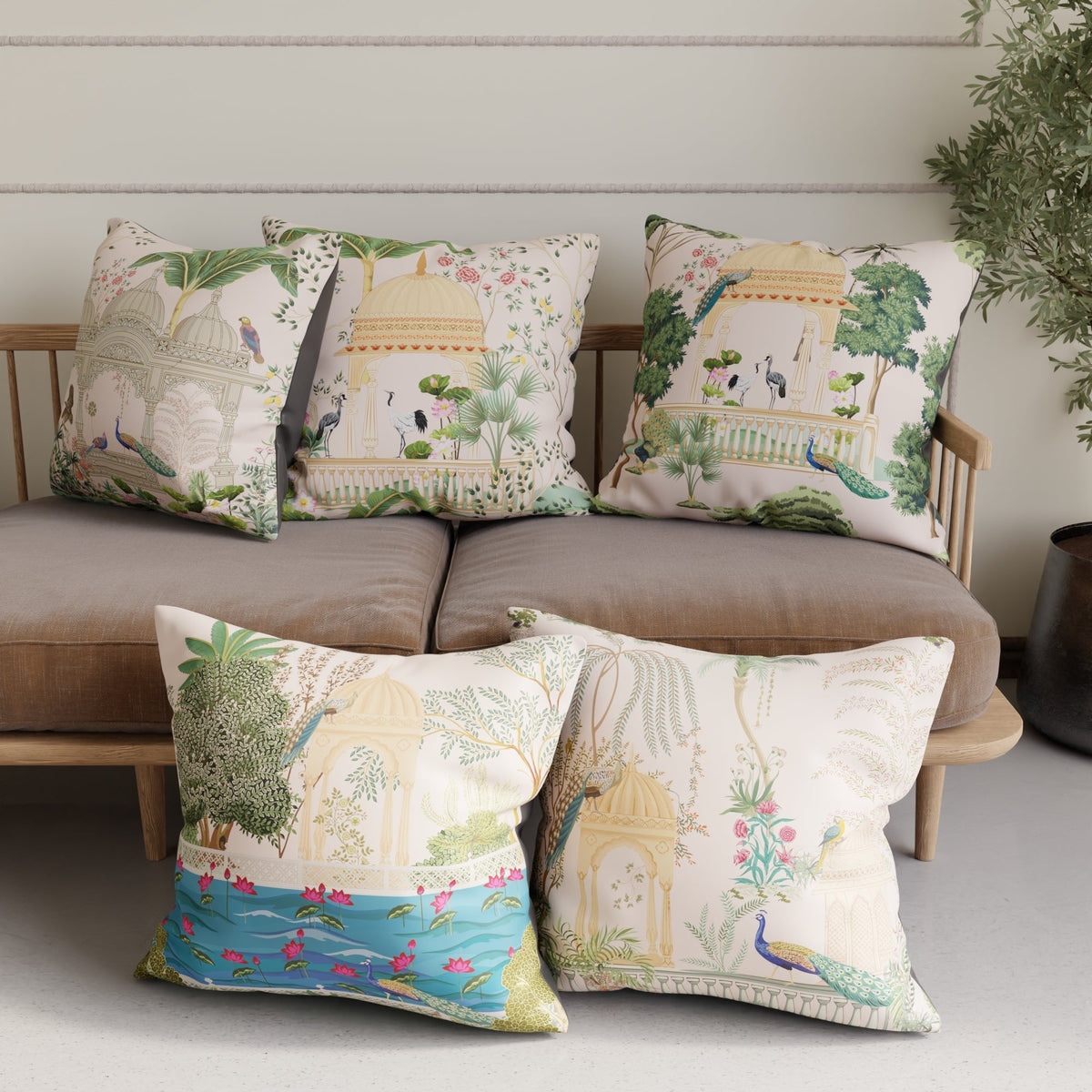
This is where a set of mixed prints works. The Mughal garden print set is five 40x40 cm covers, each a different panel of the same scene: pavilions, peacocks, palms and lotus ponds on a cream ground. Because the panels share one palette and one drawing style, five different prints look like a family rather than a fight. That is the hard part of pattern mixing, done for you.
What a set like this needs from the solids is restraint. Pull one colour from the print and use it in a plain textured fabric. The mustard and gold of the pavilions points to a mustard cover from the chenille range. Its soft pile adds the texture the flat prints lack, and a single solid stops five busy cushions from becoming too much. If the gadda on your diwan is already patterned, use three of the prints instead of five and give the rest to a floor seat.
Small things that make or break the look
Mix sizes as well as fabrics. A row of five 40 cm cushions looks lined up, however different the covers are. Two 50 cm cushions at the back with 40 cm in front gives the layered depth boho depends on. The full cushion cover range lists sizes per design, which matters here because some prints come only in one size.
Do not chase every colour in a print. Pick one, or two at most, for the solids. A mustard cushion, a green cushion and a pink cushion all pulled from one floral print is three new colours, not one.
Leave the throw loose. A folded throw at one end, or a dhurrie-style runner over the back, adds the texture of a lived-in room. A tightly folded matching throw reads as a showroom.
Think about the light. Velvet looks lovely in a boho set, but it fades in direct sun, so keep it for a shaded corner and put the prints and corduroy on the seat by the window.
Common questions
What colours go with boho cushion covers?
Earthy warm shades work most easily: rust, mustard, terracotta, olive, sage, sand and warm brown, with cream or off-white as the neutral. Keep the set to three or four colours plus one neutral.
Can boho cushions work on a grey sofa?
Yes, and grey is one of the easier bases. It is neutral, so warm boho colours stand out against it. Use at least one textured cover, such as jute-look or corduroy, so the arrangement does not look flat.
How do I mix patterns without it looking messy?
Vary the scale. Pair one large, open pattern with one small, close pattern, and keep both inside the same colour family. Add plain textured cushions between the prints so each one has space.
Are boho cushions only for casual rooms?
No. A boho set made of richer fabrics, such as chenille, corduroy and a detailed print, can look calm and grown-up. What keeps it boho is variety in texture and pattern, not how casual the room is.
Related guides
- How many cushions for a 3-seater and an L-shaped sofa, for the counts and sizes behind each look.
- Best cushion covers for every decor style in India, if boho is one of several styles you are weighing.
- Cotton, velvet or polyester: which cushion cover fabric to buy.

Leave a comment
This site is protected by hCaptcha and the hCaptcha Privacy Policy and Terms of Service apply.