
Blackout and room-darkening are not the same curtain, and treating them as interchangeable is why so many bedrooms in India still glow at 6 am. One is a fabric built to stop light. The other is a loose description of any curtain that makes a room dimmer, which could be a heavy weave that still leaks light at the edges. Buy on the label alone and you can easily end up with the wrong one.
The quick version: sheer curtains soften daylight and give daytime privacy while letting the room stay bright; blackout curtains are made from a tightly woven or coated fabric that stops nearly all light and gives full privacy day and night; room-darkening sits in between, dimming a room without going pitch dark. The trick to choosing is to stop thinking about fabric first and start with the job the window has to do.
Start with the job, not the fabric
Every window is really being asked to solve some mix of four separate problems: block light for sleep, cut glare on a screen or a bright wall, keep people from seeing in, and hold back heat. These do not automatically come together. A fabric can give you privacy without darkness, or darkness without much heat control, depending on how it is made.
That is the mistake behind most curtain regret. Someone wants to sleep past sunrise, buys a curtain described as room-darkening because it looked heavy and expensive, and finds the room still bright because the fabric was never built to block light fully. Name the job first, and the fabric almost picks itself.

What sheer curtains actually do
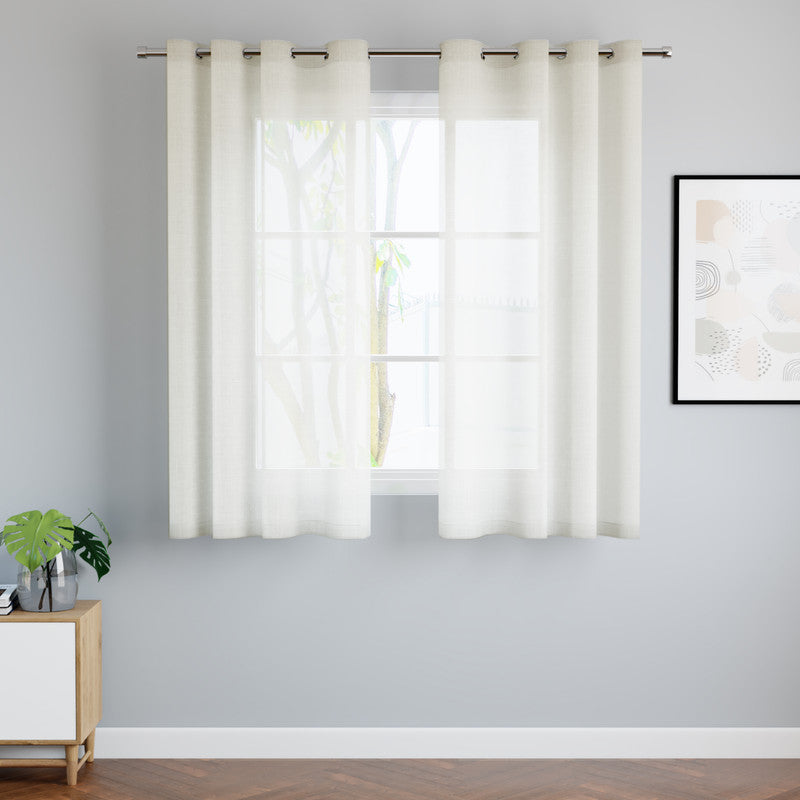
Sheer curtains are thin and translucent, made to be seen through in one direction. During the day they blur the view from outside while letting light pour in, which is exactly what you want on a living-room window where you are not trying to darken anything. After dark the logic flips: with the lights on inside, a sheer gives almost no privacy, because anyone outside can see in. That single fact catches people out more than any other.
So sheers earn their place where light and softness matter more than concealment: living rooms, balconies, a kitchen window, or as the daytime layer in a room that also has something heavier behind it. The cotton sheer range, like these cream sheer panels, is built for that diffused, bright look rather than for blocking anything.
What blackout curtains do differently
A blackout curtain blocks light because of how the fabric is constructed, either a very dense weave or a coated backing, not because of its colour. This is the part people get wrong: a dark-coloured curtain is not automatically a blackout, and a blackout can come in cream or gold. What you are paying for is the fabric build.
Because that dense fabric also slows the transfer of heat, blackout curtains do double duty in Indian summers, keeping afternoon sun off the glass and taking some load off the air conditioner in a west-facing room. For a bedroom, a nursery, a home theatre or anyone doing shift work and sleeping by day, this is the category that solves the actual problem. Encasa XO's blackout curtains come in prints and solids precisely so you do not have to choose between darkness and a room that looks like a cave.
Blackout vs room-darkening vs sheer, side by side
| Sheer | Room-darkening | Blackout | |
|---|---|---|---|
| Light blocked | Very little | Most, some leak | Almost all |
| Daytime privacy | Yes | Yes | Yes |
| Night privacy (lights on) | No | Mostly | Yes |
| Heat control | Minimal | Moderate | Best |
| Best room | Living room, balcony | Living room, nursery | Bedroom, home theatre |
Read across the rows and the pattern is clear. If your problem is glare and being overlooked during the day, a sheer or a room-darkening curtain is enough. If the problem is sleeping past sunrise or a hot west window, only blackout fully solves it.
Why so many people end up wanting both

One curtain rarely gives you the thing people most want: brightness by day and darkness by night from the same window. That is why layering has become common, a sheer on the front rod for daytime light and privacy, a blackout on the back rod to pull across for sleep or against the afternoon heat. On a double rod you get to choose the effect by time of day instead of committing to one. A softer, printed blackout like the beige twigs panels does the darkening job without the heavy, hotel-room look people fear from the word blackout.
If you only have budget or space for one layer, decide by the room. A bedroom leans blackout. A living room leans sheer or room-darkening, with the option to add a blackout later. You can browse both layers in the full curtains collection and match them to the same window width.
How to tell what a curtain really is before you buy
Labels are loose, so check the fabric behaviour, not the word. Hold the panel up to a light or a bright window. A sheer lets the shape of the light through clearly. A room-darkening fabric dims it to a glow. A true blackout shows barely a hint of the light source through the body of the fabric. Colour tells you nothing on its own, and neither does weight beyond a point, so this hold-to-the-light test is the most reliable thing you can do in a shop or with a sample at home.
Frequently asked questions
Are blackout curtains the same as room-darkening curtains?
No. Blackout is a specific fabric built to block nearly all light and give full privacy at night. Room-darkening is a loose term for any curtain that dims a room without fully darkening it, and it usually leaks some light at the edges. If you need a genuinely dark room, look for blackout specifically.
Do sheer curtains give privacy at night?
Not with the lights on inside. During the day a sheer blurs the view from outside, but once it is dark out and bright in, people can see in clearly. For night privacy you need a room-darkening or blackout layer behind the sheer.
Do blackout curtains keep a room cooler?
They help. The same dense fabric that blocks light also slows heat coming through the window, so a blackout curtain on a sunny west-facing window reduces heat gain and eases the load on your air conditioner. It is one reason they suit Indian summers, not only sleep.


Leave a comment
This site is protected by hCaptcha and the hCaptcha Privacy Policy and Terms of Service apply.