
A bath mat that has gone stiff usually gets thrown out. The pile feels crunchy underfoot, the corners have started to lift, and the underside has a dull chalky drag that was not there when it was new. The reasonable conclusion is that the backing has failed.
Often the backing is fine.
In hard-water cities, a mat soaked and half dried two or three times a day collects mineral deposits from the water and detergent that never quite rinsed out. Both settle into the pile and onto the backing, and both feel exactly like age. Washed once with a mild acid, that mat can come back soft enough to keep using. Replaced instead, the new one goes the same way by the following monsoon, because the mat was never the problem.
The wash itself is simple. Put the mat in on its own or with a couple of old towels, cold to warm, gentle cycle, mild detergent, no fabric softener, and dry it in air rather than in a machine. What changes from there is mostly the backing: whether the mat has one bonded to its underside, and whether it is still stuck down.
The check that decides everything: run a thumbnail along the edge
Turn the mat over, run a thumbnail under the binding along one long edge, then press each corner. You are feeling for whether the backing layer and the fabric above it are still one thing.
If it is bonded flat everywhere, with no give and no bubble, the mat takes a gentle machine wash without drama. A corner that lifts, or a soft pocket where the two layers have come apart, changes the answer: agitation pulls that opening wider, and a machine cycle is how a small lifted corner becomes a peeled half. Backing already shedding crumbs when you flex it is past saving by any wash.
The check matters because two flat and opposite rules circulate online: never machine wash a mat with a backing, or machine wash it, it is fine. They describe different objects. A thick moulded rubber mat, the sort meant to sit inside a tub, is a slab of material in its own right and behaves like one in a drum. A fabric mat with a thin layer bonded to its underside is a different thing with a different weak point, which is the seam between the two layers rather than the material itself. What sits beneath a mat, and why it grips or stops gripping, is covered in our guide to anti-slip bath mats.
Why heat, and not the washing, is what kills a backing
Care labels tell you to keep a bath mat out of the dryer, rarely with a reason attached, which leaves the rule sounding like superstition.
Rubber backings, and many of the adhesives that bond one down, are elastomers, and elastomers age chemically. Martin's Rubber, a UK rubber manufacturer, sets out the mechanism in its technical note on rubber deterioration: heat, oxygen and light generate free radicals in the polymer, and in many synthetic rubbers those free radicals go on to form new crosslinks between the chains. More crosslinks, less flexibility. The material stiffens, and eventually it cracks. The trade name for that is chain hardening. Natural rubber tends to go the other way and soften instead, which is why an old mat ends up either brittle or slightly tacky depending on what its backing was made from.
That note is about seals and O-rings rather than bath mats, and it names no temperature at which any of this begins, so there is no safe number to quote. What it explains is the shape of the risk. The damage adds up, and light and oxygen sit on the same list as heat. A tumble dryer runs the reaction fast. A mat baked on a terrace in full afternoon sun does the same slowly, over months, which is how mats stiffen in houses that own no dryer at all. Dry in shade, or indoors, where the choice exists.
How to wash a bath mat, by what it is made of

| Mat | Water | Cycle and load | Drying |
|---|---|---|---|
| All-cotton, no bonded backing | Warm, and hot when odour is the problem | Gentle or normal, with towels | Line or rail, turn it once |
| Cotton pile with a bonded backing | Cold to warm | Gentle, cushioned by two old towels | Flat or over a rail, no dryer |
| Microfibre with a bonded backing | Cold | Gentle, no fabric softener | Air, and it will be ready first |
| Heavy rubber or TPR, the in-tub kind | Cold | Hand wash, or gentle on its own | Flat, in shade |
The first row is the one people miss. Hot water is the standard advice for mildew smells, and it works, but only on something with no bonded layer to loosen. An unbacked cotton mat or a plain cotton bath rug can go in hot once it has started to smell. Anything with a backing stays cold to warm however bad the smell is. Some households wash hot regardless, decide hygiene matters more than backing life, and replace mats more often as a result. Nothing is wrong with that; it is a shorter-lived mat bought on purpose.
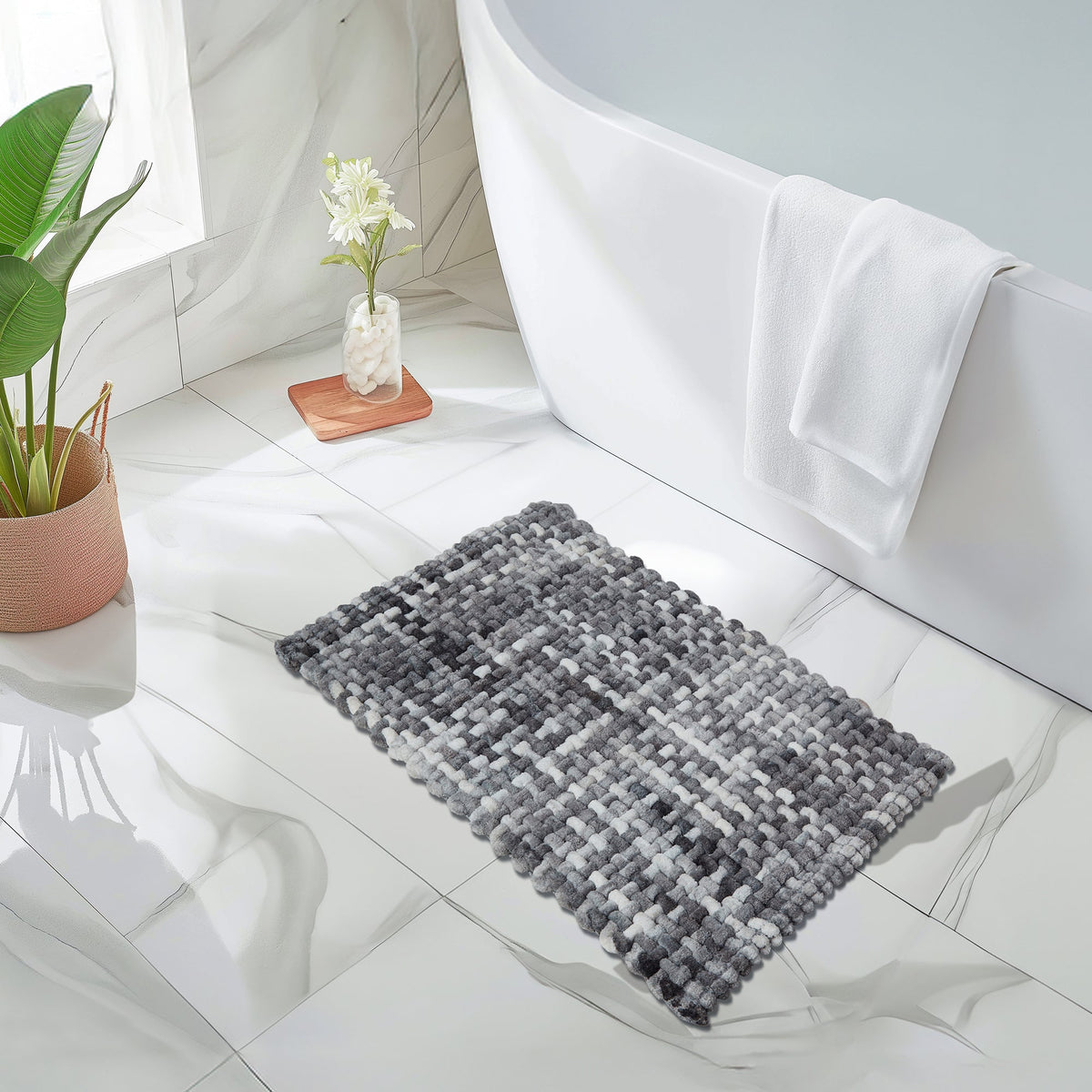
Row two is the ordinary case. The Cotton Grey Bathmat, a single 60 x 40 cm piece in the heavy loop weave photographed above, is the plain example: cotton face, hot-melt adhesive backing under it, so a warm gentle wash is fine and a dryer is not.
Microfibre wants cold water and no fabric softener, because softener coats the fibres and undoes the quick-dry behaviour you bought it for. Cotton and microfibre diverge on more than this, and cotton versus microfibre bath mats sets out the trade.
Your washing machine decides more than the label does

A top-loading machine with a central agitator does not tumble a load, it drags it around a post. That drag lands on the mat's backing, in the same plane, over and over. A front-loader lifts and drops instead, gentler on a bonded edge. The underside photographed here, from a Polyester Bathmat, is the type that matters in an agitator machine: a fine woven grid bonded to the fabric, with the join between the layers as its weak point.
On an agitator machine, put the mat in with two or three old towels so it is not the only thing catching the post, choose the shortest gentle cycle, and wash one mat at a time. A soaked mat also carries a lot of water, and a heavy wet lump on one side of the drum is what sets a machine banging through the spin.
Hand washing is the better answer for a heavy mat, a mat with a corner already lifting, or a house with only an agitator machine. Half a bucket of water, mild detergent, press the mat down and let it rise rather than scrubbing, then squeeze the water out with flat hands. Do not wring it. Wringing twists the pile one way and the backing the other, which is the one motion a bonded layer has no defence against.
Drying, and why the monsoon sets your wash schedule

Dry the mat with air reaching both faces. Folded over a line, the two halves press together and the inside stays damp for hours after the outside feels done, which is how a freshly washed mat smells by morning. Flat on a rack, or over a rail with the fold shifted halfway through, avoids it.
After that it comes down to the air in the room. On a balcony rail in dry February air, a cotton mat can be ready the same afternoon. In July, indoors, with the air already saturated and a ceiling fan the only thing moving, the same mat can still be heavy the next morning. That, rather than how dirty the mat is, is the real ceiling on how often it gets washed. If the drying spot is indoors for four months of the year, a faster-drying mat helps more than a longer schedule: the Microfibre Grey Bathmat and the wider microfibre range hold much less water than a heavy cotton loop pile. Single mats across these lines currently run roughly ₹450 to ₹800.
Where there is room for two mats, one dries while the other is in use, and neither goes back down damp.
If it feels stiff and chalky, try this before replacing it
Back to the stiff mat. Soak it for about half an hour in a bucket of warm water with a cup of plain white vinegar, then run its normal gentle cycle with a little detergent. Do not mix vinegar with bleach or any chlorine-based cleaner. If it comes out noticeably softer, what you had was mineral scale and detergent residue, and it will return unless you cut the detergent dose or add a rinse.
If it comes out just as stiff, and flexing a corner shows fine cracks in the backing rather than dirt, that is the hardening described earlier and it does not reverse. Choose the replacement on drying speed and grip rather than colour, and on size: a mat too small for the wet patch takes the splash at its edges and stays damp longest. Worth a look across the bath mat range.
How often should you wash a bath mat?
There is no standard here, only what a household can keep up. Once a week suits a bathroom used by one or two people. A family bathroom or a shared flat tends to want it every few days, as does any bathroom where the mat rarely dries fully between showers. During the monsoon, when it is never properly dry, hanging the mat up after every use does more than washing it more often, an argument made at length in why a bath mat stays wet and starts to smell.
Stiffness, cracking and a backing that no longer lies flat against the floor are replacement signals rather than wash-harder signals. A mat that curls at the edge is a trip risk before it is a laundry problem.
Frequently asked questions
Can you machine wash a bath mat?
Yes, for most fabric mats, as long as the backing is still fully bonded. Use a gentle cycle, cold or warm water, and put a couple of towels in with it. Mats with a thick moulded rubber body, the sort meant to sit inside a tub, are better washed by hand.
Can you put a bath mat in the dryer?
Not if it has any bonded or rubber backing. Dryer heat drives the chemical ageing that stiffens and cracks a backing, and it accumulates, so nothing appears to go wrong the first time and the damage shows up months later. An unbacked all-cotton mat is the exception and tolerates a low setting.
What temperature should you wash a bath mat at?
Cold to warm for anything with a backing, which on most machines means the cold or warm setting rather than a number you dial in. Hot water is reserved for unbacked cotton items, and only when smell is the reason. Warmer water cleans slightly better and costs backing life, a poor trade on a mat you want to keep.
Why does my bath mat still smell after washing?
Usually because it went back on the floor before it was fully dry, so residue at the base of the pile never left. Skipping fabric softener, drying both faces, and an occasional vinegar soak clear most of it.

Leave a comment
This site is protected by hCaptcha and the hCaptcha Privacy Policy and Terms of Service apply.